 Lynden Siding
 Siding Built for Everson's Climate
Everson sits in the part of Whatcom County where marine air off the Salish Sea meets the wetter, cooler weather patterns that roll in off the Cascades foothills. Homes here deal with a long stretch of the year where siding stays damp, whether from steady rain, morning fog, or the humidity that settles into low-lying yards and tree-shaded lots. That combination of moisture and mild temperatures is exactly what feeds moss, mildew, and algae growth on exterior walls, especially on north-facing sides that never get enough direct sun to dry out between storms.
Add in the salt-tinged air that moves through this part of Washington and you get a slow, steady form of weathering that most homeowners don't think about until paint starts failing or trim starts softening. Wood-based products absorb that moisture cycle and expand and contract with it. Over years, that movement is what opens up seams, cracks paint films, and eventually invites rot. It's not a dramatic failure — it's a gradual one, which is part of why it's easy to underestimate until a full re-side is the only option left.
We install siding across Whatcom County, and Everson-area homes come up in conversation a lot because the pattern is consistent: houses that were sided with the wrong product for this climate, or sided correctly but never maintained, end up needing full replacement 12-18 years sooner than they should have.
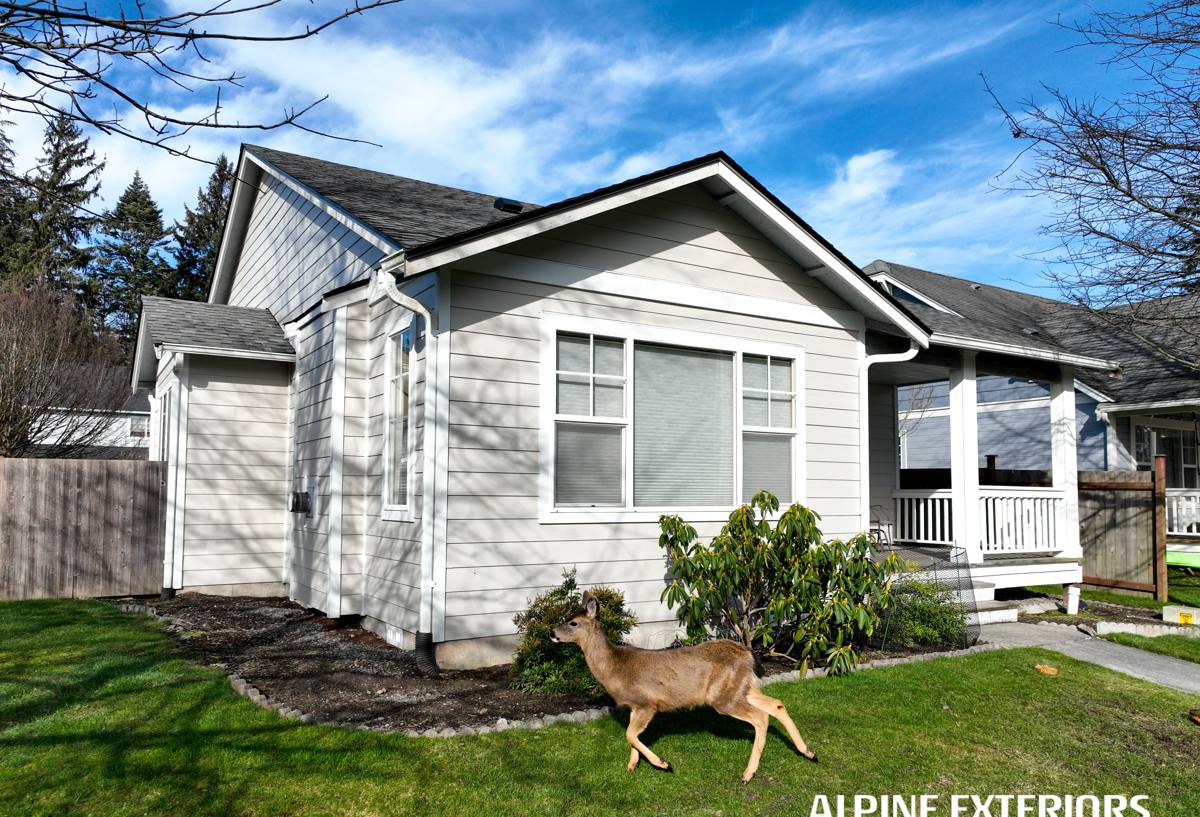
Why We Only Install James Hardie
We made a decision as a company to install James Hardie fiber cement siding exclusively. We don't install vinyl, LP SmartSide, Cemplank, Allura, primed spruce, or cedar lap siding. That's not a marketing angle — it's a standard we hold because of what we've seen happen to each of those products in exactly this kind of climate over a long enough timeline.
What Fiber Cement Does Differently
James Hardie siding is made from cement, sand, and cellulose fiber. It doesn't absorb water the way engineered wood products do, and it doesn't expand and contract with humidity the way wood and some composite sidings do. It's also non-combustible, which matters increasingly in Western Washington as wildfire smoke seasons and dry summer stretches become part of the yearly pattern, even in areas that get plenty of winter rain.
ColorPlus Factory Finish
Most of what we install uses Hardie's ColorPlus finish — a factory-applied, baked-on finish rather than a coat of paint applied on site after installation. That finish is engineered to hold color and resist fading, chipping, and cracking far longer than field-applied paint, which is one of the biggest weak points on wood and primed products exposed to this much damp weather.
HZ5 Climate Engineering
Hardie makes region-specific product formulations, and the HZ5 line is engineered for climates with more moisture exposure, which fits the Pacific Northwest well. It's a meaningful difference from a one-size-fits-all siding product, and it's part of why we don't treat "fiber cement" as a single generic category — the formulation matters as much as the material.
What a Full Exterior Job Looks Like
Siding is rarely an isolated problem. Roofing, windows, and siding all work together as a building envelope, and a weak point in one usually shows up as damage in another. We handle all four exterior trades — siding, roofing, windows, and decks — because it lets us look at a house as one system instead of patching pieces separately.
- Siding: Full removal of old material, inspection of sheathing underneath, correct water-resistive barrier and flashing detail, then Hardie installation to manufacturer spec.
- Roofing: Roof-to-wall flashing is one of the most common failure points we find when we open up a wall — if it's not right, new siding won't fix the underlying leak.
- Windows: Window flashing and trim get rebuilt as part of a re-side, since old flashing is rarely compatible with new siding thickness and detailing.
- Decks: Ledger board connections and deck-to-house flashing carry the same moisture risks as siding and windows, and often get inspected at the same time.
Why a Local Crew Matters Here
A lot of siding problems in this area trace back to installation, not the product itself. Fiber cement siding has specific requirements around clearances, fastening, caulking, and flashing that differ from wood or vinyl installation. A crew that installs Hardie regularly in Whatcom County knows how to detail it for a moss-prone, high-moisture environment — proper ground clearance, correct gaps at trim and window returns, and flashing sequences that shed water instead of trapping it against the wall.
We're not sending a crew that installs siding as one of five different products depending on the week. Because we only install James Hardie, our crews build deep, repeatable familiarity with one system, which shows up in the small details that determine whether a job lasts 10 years or 40.
Comparing Siding Materials for This Climate
| Material | Moisture Behavior | Maintenance | Typical Lifespan Here |
|---|---|---|---|
| James Hardie Fiber Cement | Does not absorb/swell; resists moss and rot | Occasional wash; ColorPlus finish reduces repainting | Multiple decades with correct install |
| Vinyl | Doesn't rot, but can warp, fade, and gap at seams over time | Low, but limited repair options once damaged | Variable; shorter in high-UV or impact areas |
| LP SmartSide / Engineered Wood | Treated to resist moisture, but still wood-based and can swell at cut edges | Requires attentive caulking and paint upkeep | Depends heavily on installation and upkeep |
| Cedar / Primed Spruce | Absorbs moisture readily; prone to cupping and rot in shaded, damp areas | Regular repainting/staining and moss treatment | Shorter without diligent, ongoing maintenance |
None of this means the alternatives are poorly made products. It means each one carries a maintenance and moisture-tolerance profile, and in a climate that stays damp as much of the year as Whatcom County does, that profile matters more than it would somewhere drier.
What Drives Cost on a Siding Project
| Factor | Why It Matters |
|---|---|
| House size and complexity | More corners, gables, and trim detail mean more cutting, flashing, and labor time |
| Condition of existing sheathing | Rot found during tear-off adds repair scope before new siding can go on |
| Product line and profile | Lap width, panel style, and trim selections affect material cost |
| Access and site conditions | Steep lots, mature landscaping, or multi-story walls affect staging and labor |
| Scope beyond siding | Bundled roofing, window, or deck work changes total project cost and timeline |
We give straightforward, honest ranges once we've actually looked at a house — broad national averages don't mean much until someone's walked your specific walls and looked at what's underneath the current siding.
Maintenance Once It's Installed
One of the appeals of fiber cement in this region is how little ongoing maintenance it asks for compared to wood-based sidings. It won't need repainting on the same cycle as cedar or primed spruce, and it won't develop the soft spots that invite rot in shaded, north-facing wall sections. That said, no siding in Whatcom County is entirely maintenance-free.
- Rinse siding periodically to keep moss and algae from building up, especially on shaded sides of the house
- Keep gutters clear so overflow doesn't run down wall sections repeatedly
- Trim back vegetation that keeps siding shaded and damp longer than it needs to be
- Check caulking at trim, window returns, and penetrations every year or two
- Address any impact damage promptly rather than letting moisture find its way behind a cracked panel
What to Ask Any Contractor Before Hiring
Whatever siding material you're considering, and whichever contractor you talk to, a few questions separate a serious operation from a crew that's just looking to close a sale:
- Are they licensed and insured to work in Washington, and can they show it without hesitation?
- Do they explain flashing and water-management details, or only talk about the visible siding itself?
- Will they put the manufacturer's installation instructions in writing as part of the scope?
- Do they inspect sheathing condition before quoting, or price blind off a photo?
- What's the warranty structure — on labor, and separately on the product itself?
If a contractor can't answer those clearly, that's worth weighing as heavily as the quoted price.
Get an Estimate for Your Everson Home
If your siding is showing moss buildup, paint failure, soft spots, or you're just planning ahead for a home in this climate, we're happy to take a look and talk through what we'd actually recommend for your house. There's no pressure and no obligation — just a straight assessment from a crew that installs one product system and knows it well. Use the form below to request a free estimate.