 Lynden Siding
 Blaine's Exterior Climate: Coastal, Wet, and Unforgiving on the Wrong Materials
Blaine sits right where Whatcom County meets the water, close enough to Semiahmoo Bay and Drayton Harbor that salt-laden air is simply part of daily life for homes near the shoreline and even several blocks inland when the wind is up. Add in the marine layer that keeps humidity elevated much of the year, driving rain that comes in sideways off the water during winter storms, and a moss season that can stretch from October through May, and you have one of the tougher exterior environments in the county. Homes here don't fail because owners neglected them — they fail because the wrong siding, trim, or roofing system was never built for this combination of salt, moisture, and shade.
We work throughout Whatcom County out of Lynden, and Blaine is one of the areas where we see the clearest evidence of climate mismatch: paint peeling early on wood trim, vinyl panels warped or faded on the south and west exposures, and moss creeping up from the roofline onto north-facing wall sections that rarely see direct sun. None of that is unusual for the area. It's exactly what you'd expect given the exposure, and it's exactly what the right materials and installation details are supposed to prevent.
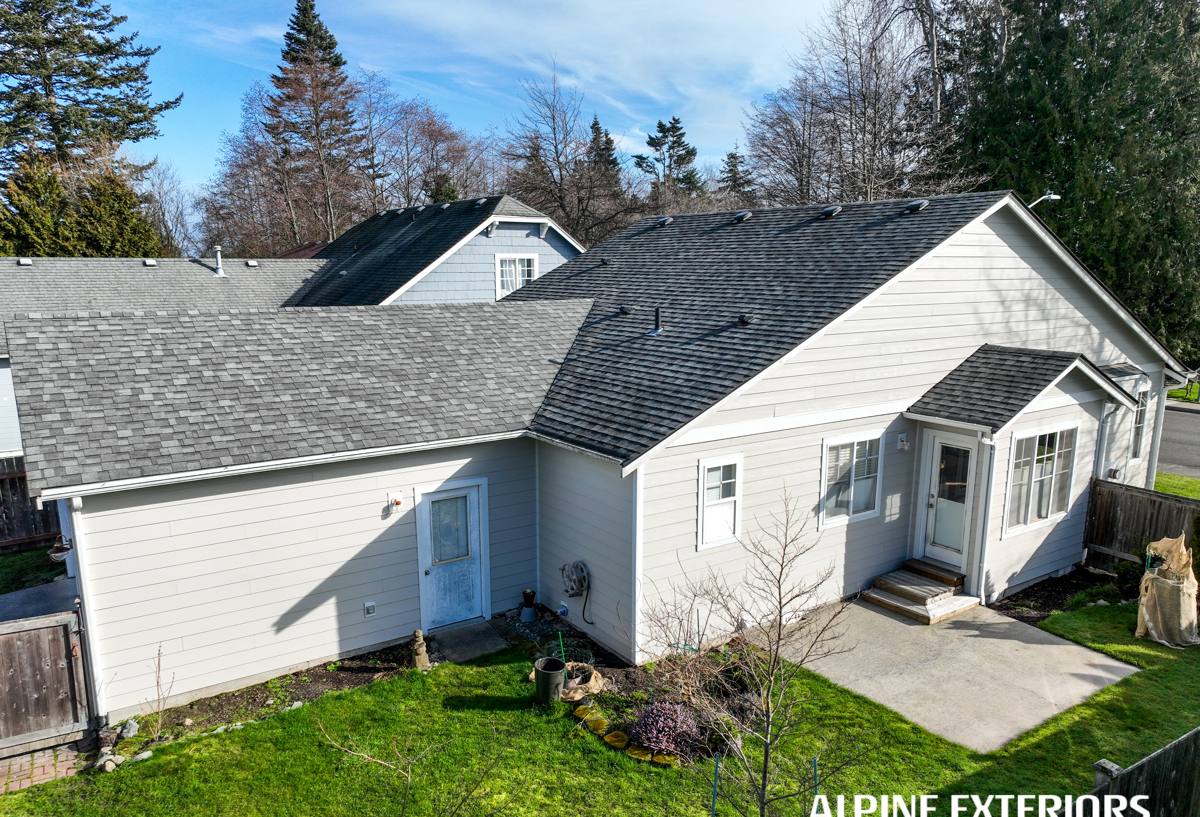
What Salt Air Actually Does to a Home's Exterior
Salt air isn't just "humid air with a coastal smell." Airborne salt is corrosive and hygroscopic — it pulls moisture out of the atmosphere and holds it against whatever surface it lands on. Over time that has a few predictable effects on a home's exterior:
- Fasteners, flashing, and hardware corrode faster if they aren't rated for coastal exposure.
- Paint and factory finishes break down sooner when salt crystals sit on the surface between rinses.
- Any material that swells, warps, or absorbs water reacts more aggressively because it's rarely getting a chance to fully dry out between rain events.
- Caulking and sealants at joints and penetrations age faster, which matters more on a coastal home because those joints are wet more often.
None of this means a home near the water is doomed to constant repairs. It means the materials and details have to be chosen with that exposure in mind, rather than treated the same as a house twenty miles inland in a drier microclimate.
Where Moss Fits In
Moss doesn't just grow on roofs. On homes with heavy tree cover or north- and west-facing walls that stay shaded most of the day, moss and algae can establish on siding surfaces too, especially at material seams, behind trim, and anywhere water sheds slowly. Porous or textured surfaces give moss spores something to grip. Smooth, factory-finished surfaces with tight, correctly installed joints give it a lot less to hold onto, and they're far easier to rinse clean when it does show up.
Why We Install Only James Hardie Fiber Cement
Lynden Siding Companies made a deliberate call some time ago to stop installing vinyl, LP SmartSide, Cemplank, Allura, primed spruce, and cedar, and to install James Hardie fiber cement exclusively. That's not a marketing position — it's a response to what we see on real homes in real Whatcom County weather, including the harder coastal conditions in Blaine.
Fiber cement is non-combustible and dimensionally stable — it doesn't expand and contract with moisture the way wood or wood-composite products do, and it doesn't get brittle and crack in cold, wet cycling the way some vinyl formulations can over the years. James Hardie's ColorPlus factory finish is baked on under controlled conditions, which gives it a more consistent, longer-lasting bond than field-applied paint, and it holds up better against the kind of relentless UV-and-salt exposure a shoreline-adjacent home gets. Hardie also engineers specific product lines — the HZ5 line, in particular — for regions with real moisture exposure, which the Pacific Northwest coastal zone qualifies as.
We're not telling homeowners that other products are junk. Cedar has real appeal and vinyl has a real price point. Our position is narrower: given what we've watched happen to those materials on homes in this specific climate over enough years, we don't think they hold up well enough here to put our name behind the installation. Fiber cement, installed correctly, does.
The Trade-Offs We're Honest About
| Factor | James Hardie Fiber Cement | Vinyl / LP SmartSide / Cedar |
|---|---|---|
| Upfront cost | Higher material and labor cost | Generally lower upfront cost |
| Coastal/salt exposure | Engineered HZ lines, stable finish | Varies — vinyl can warp/fade, wood needs frequent refinishing |
| Moisture/moss resistance | Non-porous surface, dimensionally stable | Wood absorbs moisture; some composites are moisture-sensitive at cut edges |
| Fire resistance | Non-combustible | Vinyl and wood are combustible |
| Finish longevity | Factory-baked ColorPlus finish | Field-painted or unfinished; earlier fading/peeling typical |
| Installation sensitivity | Requires correct fastening, clearances, joint treatment | Generally more forgiving to install, but that's part of the trade-off |
Roofing, Windows, and Decks: The Same Climate Logic Applies
Siding is only part of a home's defense against Blaine's weather. We also handle roofing, windows, and decks, and the same reasoning about exposure and material choice carries through each one:
Roofing
Moss growth on roofs is one of the most common calls we get in this part of the county. A roof that holds moisture in its shingles or shakes — especially on shaded slopes — feeds moss growth that eventually creeps toward the roof-to-wall transition, which is exactly where siding is most vulnerable to trapped moisture. Keeping that transition properly flashed and ventilated protects both systems at once.
Windows
Older windows on coastal-exposed homes often show corrosion at hardware and seal failure earlier than the same window would inland, simply because they're cycling through more humidity and salt exposure. Correct flashing and sealing at the window-to-siding interface matters more here than in a drier climate, because a small gap gives salt-laden moisture a way in far more often.
Decks
Decks facing the water take a similar beating — fasteners, ledger connections, and any exposed wood need to be chosen and installed with that exposure in mind, not treated like a deck in a sheltered backyard twenty miles inland.
Handling all four trades under one crew means the flashing, drainage, and moisture details at every transition — roof to wall, window to siding, deck ledger to wall — are coordinated by people who understand how they interact, rather than left to whichever trade happens to show up last.
What Correct Installation Looks Like on a Home Like This
Fiber cement performs well over decades, but only when it's installed to spec. On a coastal-exposure home in Blaine, the details we pay particular attention to include:
- Proper clearance between the bottom edge of the siding and the ground, deck, or roofline to avoid wicking moisture.
- Correct fastener type and spacing — coastal exposure calls for corrosion-resistant fasteners, not just whatever is standard inland.
- Rain-screen or drainage-plane detailing behind the siding so any moisture that does get past the surface has somewhere to go.
- Tight, correctly caulked joints at trim, corners, and penetrations, since gaps are where salt-laden moisture and moss spores both find their way in.
- Careful flashing at every roofline, window, and deck ledger intersection — the points where two systems meet are always the highest-risk spots on the house.
None of this is exotic. It's standard fiber cement installation practice done carefully, with extra attention paid to the details that matter more in a salt-air, high-moisture environment than they would somewhere drier.
Hiring for a Home Like This: What to Actually Check
Blaine homeowners are usually comparing bids that look similar on paper but represent very different levels of attention to these details. A few things worth checking before you sign anything:
- Ask specifically what fastener and flashing materials are being used, and whether they're rated for coastal exposure.
- Ask whether the crew doing the physical installation is the contractor's own crew or a subcontracted one, and how much fiber cement experience they have specifically.
- Confirm the manufacturer's installation instructions are being followed to the letter — James Hardie warranties can be affected by installation that deviates from spec.
- Ask how the bid handles the roof-to-wall and window-to-siding transitions, not just the flat wall area.
- Get local references if possible — a crew with experience on homes in this specific microclimate will have already worked through the details that matter here.
Maintenance That Actually Matters Here
Even the right materials benefit from basic upkeep in this climate. A periodic rinse to clear salt residue and any early moss or algae growth, keeping gutters and downspouts clear so water isn't sheeting down wall sections, and trimming back vegetation that keeps a wall section shaded and damp all go a long way. Fiber cement needs far less of this than wood, but "low-maintenance" isn't "no-maintenance" anywhere on this coastline.
A Local Crew Matters More Here Than It Might Seem
We're based in Lynden and work across Whatcom County, which means the crew showing up at a Blaine home has already dealt with this exact combination of salt exposure, rain load, and moss pressure on other homes nearby. That's not a small thing. A crew used to drier, more sheltered conditions can install a technically correct roof or wall system that still underperforms here, simply because they didn't weight the coastal details the way they needed to. Knowing the area means knowing which details to not skip.
If you're planning siding, roofing, window, or deck work on a home in Blaine, we're happy to come take a look and talk through what your specific home is facing — no pressure, no obligation. Use the form below to request a free estimate.