 Lynden Siding
 Exterior Work in Sumas: A Different Set of Conditions Than a Suburban Lot
Sumas sits at the edge of Whatcom County, tucked into the Nooksack lowlands close to the Canadian border. It's a small town with a different exterior-wear profile than a subdivision closer to Bellingham or set higher in the foothills. Homes here sit low, close to farmland and river-fed soil, in an area that stays damp longer into the season than higher ground a few miles south. That combination — low elevation, heavy moisture, and long stretches of shade from tree lines and cloud cover — is exactly the kind of environment that wears out the wrong siding, roofing, and trim faster than homeowners expect.
We're based in Lynden, a short drive from Sumas, and we've done exterior work throughout this corner of the county long enough to know it isn't identical to Whatcom County's coastal edge or its drier eastern reaches. Sumas gets its own mix: driving rain off Pacific systems, moisture that lingers in low-lying air, and a moss season that runs longer than most homeowners want to admit. Salt-tinged marine air moves through the broader region too, adding to the slow corrosion and finish breakdown that shows up on fasteners, trim, and lower-grade siding over the years. None of this is dramatic on its own. It's cumulative — and it's why the products and installation details that work fine in a dry climate quietly fail here.
What the Climate Actually Does to a House in This Area
It helps to be specific about mechanisms rather than just saying "wet climate is bad." Here's what we actually see on houses in and around Sumas:
- Moss and algae growth on north-facing walls, roof valleys, and anywhere shade and dampness overlap for months at a time — this holds moisture against the surface far longer than a quick rain event would.
- Wood-based siding and trim swelling at butt joints and cut ends where water gets in and doesn't fully dry before the next rain arrives.
- Paint and coating failure on lower-grade products, especially where sun exposure is inconsistent — some walls bake, others stay damp, and the finish degrades unevenly.
- Fastener and flashing corrosion that's accelerated by the region's persistent humidity and occasional salt-bearing air moving inland.
- Foundation-level splash-back and moisture wicking on homes sitting close to grade, which is common in the flatter, low-lying parts of this valley.
None of these are exotic problems. They're the ordinary, predictable results of a climate that stays wet longer than it's dry for a good chunk of the year. The fix isn't complicated either — it's choosing materials and installation methods that were built for exactly this, and not cutting corners on the details that keep water moving away from the house instead of into it.
Siding: Why We Only Install James Hardie
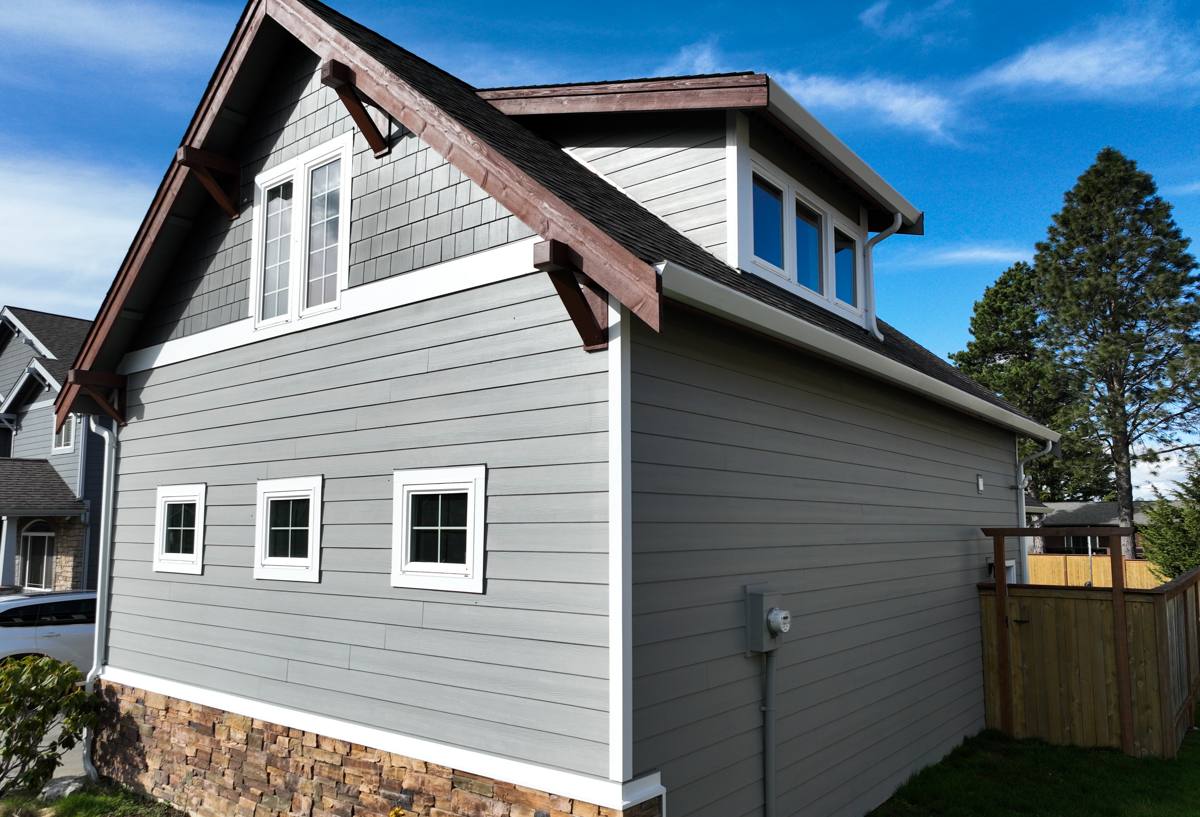
We install James Hardie fiber cement siding exclusively. We don't install vinyl, LP SmartSide, Cemplank, Allura, primed spruce, or cedar — not because those products have no merit, but because after years of exterior work in this climate, we standardized on the one material system that consistently holds up without demanding constant homeowner maintenance.
What that means in practice
Fiber cement is non-combustible, dimensionally stable, and doesn't swell or rot the way wood-based products can when moisture gets into a cut edge or a poorly sealed joint. James Hardie's ColorPlus finish is baked on at the factory under controlled conditions, which gives it far more consistent, long-term color retention than field-applied paint — a real advantage in a climate where inconsistent sun and shade patterns cause uneven fading on lesser products. Hardie also engineers its HZ5 product line specifically for regions with more freeze-thaw cycling and moisture exposure, which fits the Pacific Northwest better than a one-size-fits-all siding spec.
Being fair about the trade-offs
Fiber cement is heavier and more labor-intensive to install correctly than vinyl or engineered wood — it requires proper fastening, clearances, and joint treatment, and it costs more upfront. We're not going to pretend otherwise. But the products we chose not to install each carry their own long-term costs in this specific climate: vinyl can warp and doesn't stop moss and mildew from taking hold in its seams; LP SmartSide and other engineered wood products remain more vulnerable to moisture intrusion at cut edges and end grain than fiber cement; cedar looks excellent on day one but demands ongoing refinishing to survive a wet climate without rot. James Hardie's transferable warranty and track record of holding up when installed to spec are why it's what goes on the homes we work on — and why we won't put anything else there.
Beyond Siding: Roofing, Windows, and Decks
Siding rarely fails in isolation, and neither do the other systems on a house. We handle roofing, windows, and decks alongside siding because they interact with each other, and a weak point in one usually shows up as damage in another.
Roofing
A roof in this part of the county deals with the same moss and moisture pressure as the siding below it, plus the added stress of standing water in valleys and around penetrations if flashing isn't done right. Moss on a roof isn't just cosmetic — left alone, it holds water against shingles and accelerates granule loss and underlayment failure.
Windows
Window flashing and integration with the siding plane is one of the most common failure points we find on older homes. A window that isn't properly flashed into fiber cement (or whatever siding is on the wall) becomes a slow, invisible leak path — often not discovered until there's already interior damage.
Decks
Outdoor living structures in this climate take a beating from the same rain and shade cycles as the exterior walls. Ledger board attachment, proper drainage away from the house, and material choice all matter more here than they would in a drier climate.
Comparing Siding Options for a Sumas-Area Home
| Material | Moisture Resistance | Maintenance Burden | Typical Lifespan Here |
|---|---|---|---|
| James Hardie Fiber Cement | High — non-combustible, dimensionally stable | Low — factory finish, occasional wash | Decades when installed to spec |
| Vinyl | Moderate — seams and panels can trap moisture and moss | Low-moderate — prone to fading, cracking over time | Shorter in wet, shaded conditions |
| Cedar | Low without diligent upkeep | High — refinishing, sealing, rot inspection | Variable, maintenance-dependent |
| LP SmartSide / Engineered Wood | Moderate — vulnerable at cut edges and end grain | Moderate — coating maintenance over time | Shorter than fiber cement in wet climates |
This isn't meant to trash any single product — it's meant to show, side by side, why the moisture and moss pressure specific to this area pushed us toward one system.
What a Proper Installation Looks Like Here
Material choice is half the equation. Installation quality is the other half, and it's where a lot of exterior problems in this climate actually originate — not from bad siding, but from siding (of any brand) installed without the right clearances, flashing, or fastening.
- Correct clearance between siding and grade, decks, and roof lines to prevent splash-back and trapped moisture
- Properly lapped and sealed water-resistive barrier behind the siding, not just stapled and forgotten
- Window and door flashing integrated into the drainage plane, not caulked over as an afterthought
- Fastener spacing and type matched to manufacturer specs, not whatever's fastest on a given day
- Ventilation gaps where needed so trapped moisture has somewhere to go
Skipping any one of these is often invisible for a year or two, then shows up as a callback. We install to the manufacturer's specification because it's the difference between siding that performs for decades and siding that looks fine until the first wet winter finds the gap.
Why a Local Crew Matters for a Town Like Sumas
Sumas is small enough that it doesn't always get the same attention from larger regional contractors that bigger Whatcom County towns do. Being based in Lynden means we're close enough to be responsive, and familiar enough with this specific stretch of the county — its low-lying terrain, its moisture patterns, its longer moss season — to make material and installation decisions that fit the actual site, not a generic spec sheet. A crew that works this area regularly also tends to catch site-specific issues early: where water tends to pool, which walls hold shade longest, where a previous installation cut a corner that's about to become a problem.
A Practical Homeowner Checklist
- Walk your exterior after a heavy rain and note where water pools or lingers longest
- Check north- and shade-facing walls and roof valleys for moss buildup
- Look at caulk and trim joints for cracking, gaps, or soft spots
- Inspect window flashing for staining or bubbling paint nearby, a sign of trapped moisture
- Note any siding panels that feel soft, are visibly warped, or have peeling finish
- Check deck ledger boards and fasteners for rust or looseness
If several of these turn up at once, it's usually worth a professional look rather than patching one symptom at a time.
Ready When You Are
If you're weighing a siding, roofing, window, or deck project on a Sumas-area home, we're happy to take a look and talk through what actually makes sense for your property's exposure and condition. There's no pressure and no obligation — just a straightforward conversation from a crew that works this part of Whatcom County regularly. Use the form below to request a free estimate.