 Lynden Siding
 Custer's Climate Is Harder on Siding Than Most Homeowners Realize
Custer sits in an unincorporated pocket of Whatcom County between Ferndale and Blaine, close enough to the Strait of Georgia and Birch Bay that salt-laden air is a regular part of the weather here, not an occasional coastal event. Add in the long stretch of driving rain that moves through this part of northwest Washington from fall through spring, plus the deep shade many Custer properties sit under, and you get a climate that is genuinely tough on exterior building materials. This isn't marketing language — it's the reason certain siding products hold up fine in Spokane or Eastern Washington and struggle here.
Homes in Custer face three compounding stresses: salt air that accelerates corrosion and finish breakdown, near-constant moisture exposure for months at a time, and shaded, damp conditions that are close to ideal for moss and algae growth. Any one of these is manageable. Together, they're what separates siding that looks good for 30 years from siding that needs attention by year ten.
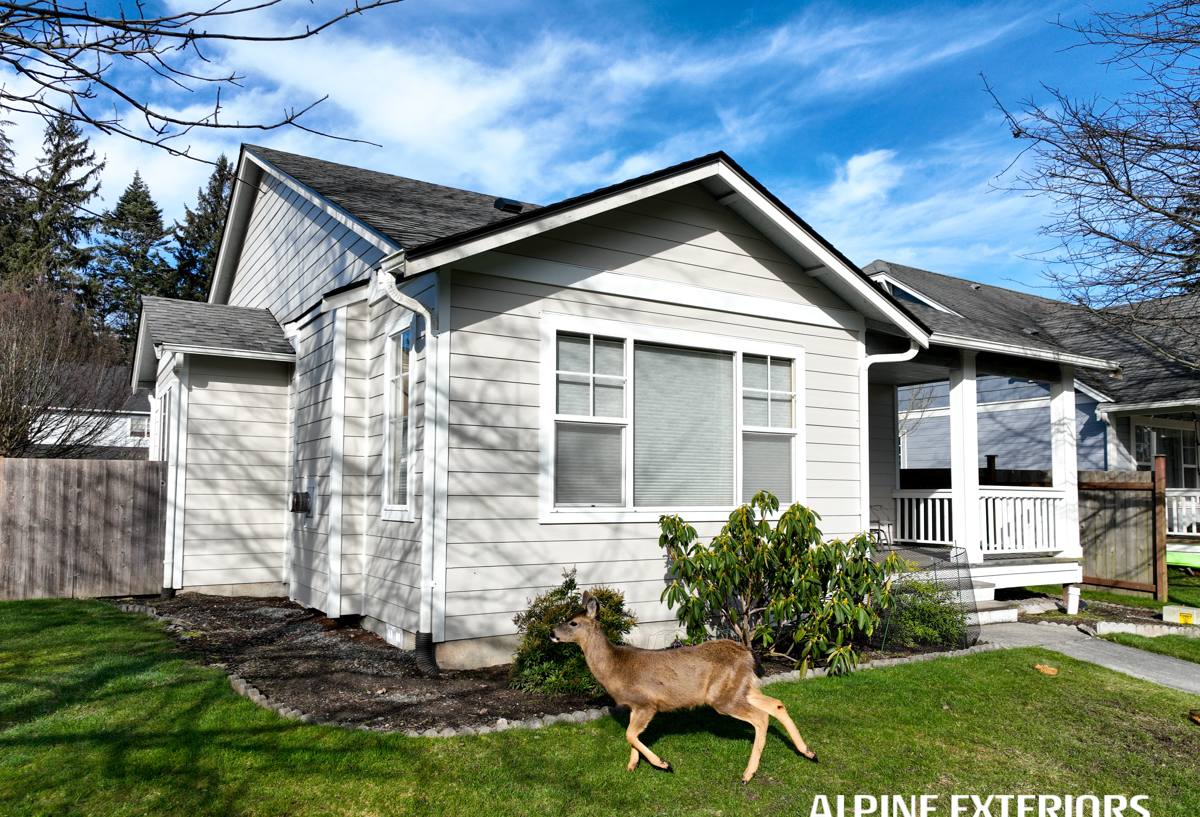
Salt Air: The Overlooked Factor in Whatcom County Siding Decisions
Proximity to the Salish Sea means Custer homes get a steady, low-grade dose of salt air, especially on days with onshore wind. Salt is corrosive to metal fasteners and trim, and it can also degrade certain paint and coating systems faster than inland exposure would. This matters most at the fine details — nail heads, cut edges, caulked joints, and factory-applied finishes — because that's where a coating first starts to fail and moisture first finds a way in.
It's a big part of why we standardized on James Hardie fiber cement with a factory-baked ColorPlus finish rather than field-painted materials. A factory finish cured under controlled conditions holds up to salt exposure and UV far more consistently than a coat of paint applied on site, and it doesn't rely on the homeowner keeping up with repainting every several years to keep the substrate protected.
What Salt Exposure Does to Different Materials Over Time
- Untreated or primed wood: finish breaks down faster near salt air, exposing raw wood to moisture
- Vinyl: can become brittle and discolor faster under combined UV and salt-air exposure
- Fasteners and trim hardware: corrode faster without corrosion-resistant specification
- Factory-finished fiber cement: the cured finish resists both UV breakdown and moisture intrusion at the surface
The Moss Season: Why Shade and Moisture Change the Equation
Whatcom County's wet season stretches long, and many Custer lots have mature tree cover that keeps north and east-facing walls shaded and slow to dry out. That combination — moisture plus shade — is exactly what moss and algae need to establish themselves on a home's exterior. Once moss gets a foothold on siding, it holds moisture against the surface even longer, which becomes a self-reinforcing cycle on materials that aren't dimensionally stable or that absorb water at the surface.
This is one of the practical reasons we don't install cedar or primed spruce siding as a standard offering. Both are wood products, and wood siding in a shaded, damp environment like parts of Custer requires a real maintenance commitment — regular cleaning, prompt recoating, and vigilance about trapped moisture — to avoid rot and moss buildup. Fiber cement doesn't eliminate the need to occasionally rinse moss or algae off a wall, but it isn't feeding decay the way exposed or under-maintained wood can.
Signs a Custer Home Is Already Fighting Moisture
- Persistent green or black staining on shaded walls, especially north-facing sides
- Soft or spongy spots when you press on siding near the bottom courses
- Paint that's bubbling, peeling, or chalking faster than the rest of the house
- Gaps or separation at seams, corners, and trim joints
- Musty smell near exterior walls inside the home
Why We Only Install James Hardie
We made a deliberate decision to install James Hardie fiber cement exclusively — not LP SmartSide, not vinyl, not Cemplank or Allura, not primed spruce or cedar. That's not a marketing position, it's a practical one based on what actually performs in this climate over decades, not just the first several years.
James Hardie fiber cement is engineered specifically for regional climate conditions through its HZ5 product line, which is formulated for the Pacific Northwest's wet, moderate-temperature weather. It's non-combustible, which matters increasingly for wildfire-adjacent insurance considerations even this far west. It holds paint and factory finish far more consistently than wood-based composites, and its warranty structure is transferable, which protects resale value — a real consideration if a Custer property changes hands down the road.
We're not going to tell you every other siding product is bad. LP SmartSide has genuine strengths, vinyl is inexpensive and low-maintenance in the right setting, and cedar has real aesthetic appeal that some homeowners specifically want. What we will say is that after years of installing and repairing siding in Whatcom County's salt air and rain, we stopped installing products that ask homeowners to fight the climate instead of working with it. James Hardie is what we're willing to put our name behind.
What a Full Exterior Job Looks Like in Custer
Siding rarely fails in isolation. Roofing, windows, and decking all interact with how water moves around a house, and in a climate like this, gaps between trades are exactly where problems start. We handle siding, roofing, windows, and decks as one crew, which means flashing details at rooflines, window openings, and deck ledger boards get coordinated instead of left to whoever shows up last.
Where This Matters Most
- Roof-to-wall transitions: improperly flashed step flashing is one of the most common sources of hidden water intrusion behind new siding
- Window flashing: old or missing window flashing tape is often only discovered once siding comes off — and it needs fixing before new siding goes back up
- Deck ledger connections: a deck attached through the siding plane needs proper flashing or it becomes a chronic leak point
- Weep and drainage paths: siding needs a way for incidental moisture to escape, especially on shaded walls that stay damp longer
The James Hardie Installation Process, Done Right
Correct installation is arguably more important than the product itself. Fiber cement that's installed with wrong fastener spacing, insufficient clearance at grade, or without a proper weather-resistive barrier underneath won't perform the way it's engineered to, regardless of brand. Our process follows Hardie's published installation requirements, which exist precisely because fiber cement behaves differently than wood or vinyl and needs to be treated accordingly.
| Step | What Happens | Why It Matters in Custer |
|---|---|---|
| Tear-off and inspection | Remove old siding, inspect sheathing for rot or hidden moisture damage | Shaded, wet-climate homes often have hidden moisture issues behind old siding |
| Weather-resistive barrier | Install or verify a code-compliant water/air barrier | Provides a secondary drainage plane in a high-rainfall area |
| Flashing details | Properly flash windows, doors, and roof intersections | Prevents the intrusion points where salt-air and rain damage typically start |
| Hardie panel/plank installation | Install per Hardie's fastener, spacing, and clearance specs | Improper installation voids warranty protection and undermines performance |
| Trim and caulking | Finish corners, trim, and joints with compatible sealants | Detail work is where salt air and moisture find weak points first |
Cost Factors Homeowners Should Understand
Siding cost varies by home size, existing wall condition, how much of the sheathing needs repair, and product selection within the Hardie lineup (lap siding, panel siding, and shingle-style profiles all price differently). Rather than quote a number that won't reflect your specific home, here's what actually drives the estimate:
| Factor | Why It Affects Price |
|---|---|
| Condition of existing sheathing | Rot or moisture damage found during tear-off requires repair before new siding goes on |
| Home size and wall complexity | More corners, dormers, and trim details mean more labor and material |
| Hardie product line and profile | Lap, shingle, and panel styles carry different material costs |
| Coordinated trade work | Bundling roofing, window, or deck flashing fixes during the same job can reduce overall disruption and cost versus separate projects |
| Access and site conditions | Tree cover, slope, and staging space affect labor time |
Why a Local Crew Matters for Custer Homes
A contractor who works across Whatcom County regularly sees how differently the same siding product performs on a sheltered Lynden lot versus an exposed, salt-air property closer to the water near Custer. That local pattern recognition shapes real decisions — where to add extra flashing attention, which walls are most likely to need moss treatment down the road, and how to sequence a job around this region's rain windows instead of fighting them. It also means someone is genuinely reachable if a question comes up after the job is done, not routed through a call center for a crew that's moved on to another state.
A Practical Checklist Before Hiring Any Siding Contractor Here
- Ask what siding products they install and why — and whether they'll explain the trade-offs of each
- Confirm they follow manufacturer-specified fastener and clearance requirements, not just "standard practice"
- Ask how they handle flashing at windows, rooflines, and deck ledgers, not just the siding panels themselves
- Check whether they inspect and repair sheathing before installing new siding, not just cover over it
- Confirm the manufacturer warranty is transferable if you sell the home
- Ask for a written estimate that breaks down material, labor, and any anticipated repair contingencies
Ready to Talk About Your Home
If you're noticing moss buildup, soft spots, or aging siding on a Custer property, it's worth having someone local walk the exterior and give you an honest read on what's going on before you commit to a product or a plan. We offer free, no-pressure estimates for siding, roofing, windows, and decks, and we'll tell you plainly what we see and what we'd recommend — use the form below to get started.