 Lynden Siding
 Kendall Is a Different Kind of Whatcom County Weather
Kendall sits up against the foothills east of Lynden, closer to the Nooksack River and the lower slopes leading toward Mount Baker than to the open flats of the valley floor. That location changes what a house has to deal with year-round. Homes here tend to sit under more tree cover, get less direct afternoon sun in the winter months, and hold onto moisture longer after a storm passes through than a house out in open pasture land closer to town. Combine that with the driving rain that comes off the Pacific and funnels up the river valleys, and you get siding, trim, and roofing that stay damp far more of the year than most homeowners realize.
We work Kendall the same way we work the rest of Whatcom County: as a local crew that knows the difference between a house that's merely wet after a storm and a house that's been quietly absorbing moisture for a decade. That distinction matters more here than it does in a lot of neighborhoods closer to Lynden proper, simply because of the shade and the terrain.
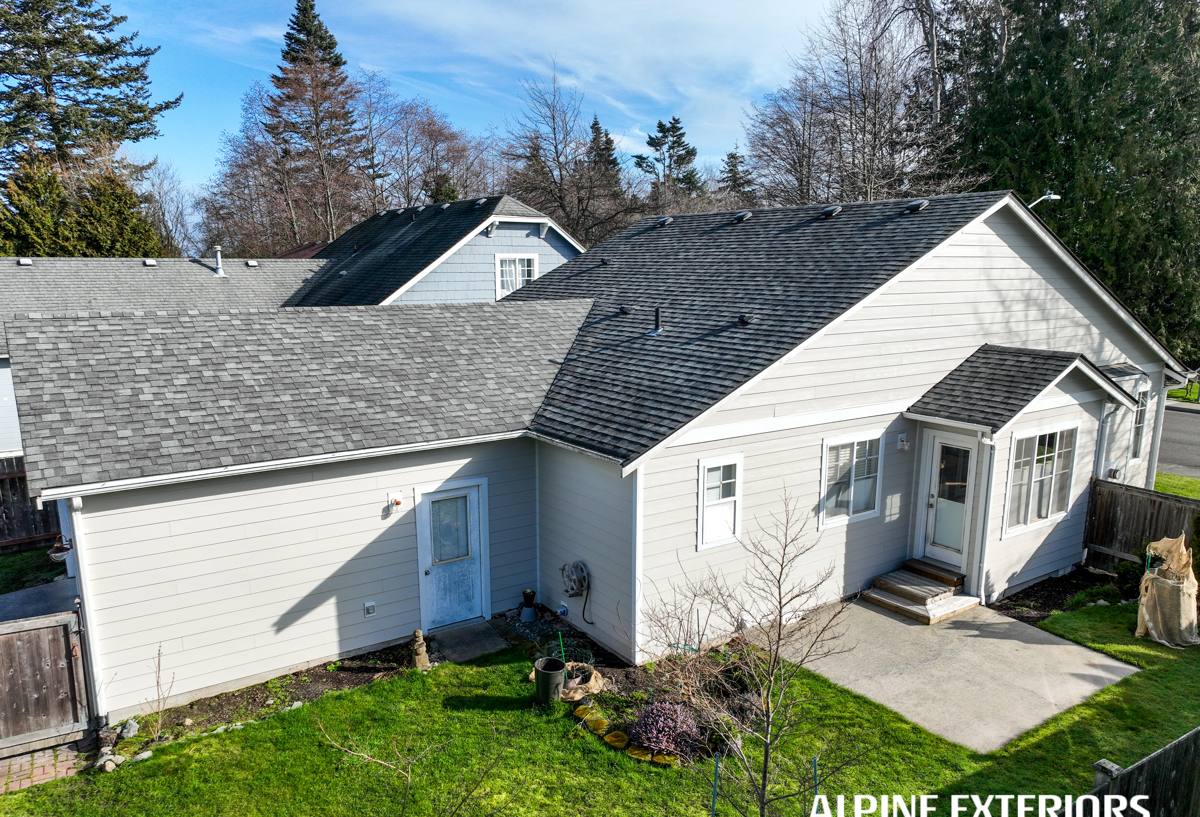
What the Local Climate Actually Does to a House
Shade and Moss
Tree-covered lots slow down drying time after every rain event. A siding product that can absorb even small amounts of water will hold onto that moisture instead of shedding it, and in shaded spots that means moss and algae get a long runway to establish themselves on north-facing walls, under eaves, and anywhere the sun doesn't reach until midday, if at all.
Driving Rain
Rain in this part of the county rarely falls straight down. Wind off the foothills pushes it sideways into wall assemblies, which puts real pressure on flashing details, siding laps, and butt joints. Products that are sensitive to installation quality show their weaknesses here first — a lapped joint that's a little too tight, or a piece that wasn't primed and sealed correctly on a cut edge, becomes a moisture entry point within a season or two.
Salt-Influenced Marine Air
Whatcom County as a whole sits under a marine-influenced weather pattern, and that humidity load doesn't stop at the coastline — it moves inland on weather systems and settles into low-lying, shaded areas like parts of Kendall just as readily as it does closer to the water. It's a slower, quieter form of exposure than a straight coastal site, but it still adds up over the life of a home's exterior.
Why We Only Install James Hardie Fiber Cement
We made a decision years ago to stop installing certain siding products, not because they're incapable of doing a job somewhere, but because of how they perform specifically in this climate over a 20-30 year timeline. In a place like Kendall, where shade and moisture linger, the trade-offs of wood-based and vinyl products show up faster and more visibly than they would in a drier region.
- We don't install LP SmartSide. It's an engineered wood product, and engineered wood is still wood at its core — it depends on an intact factory coating and correct field sealing at every cut edge to keep moisture out. In a shaded, damp environment, any gap in that protection is an invitation for swelling and edge deterioration.
- We don't install vinyl siding. Vinyl expands and contracts significantly with temperature swings, can warp near heat sources, and doesn't hold paint if a homeowner ever wants to change the color. It also doesn't offer the fire resistance or impact durability that fiber cement does.
- We don't install cedar, primed spruce, Cemplank, or Allura. Solid wood siding requires an ongoing maintenance commitment — refinishing, caulking, and vigilance — that most homeowners don't want to sign up for, especially in a climate where moss and mildew are already fighting an uphill battle against any painted surface. Cemplank and Allura are fiber cement competitors to Hardie; we standardized on Hardie specifically for its ColorPlus factory finish, its climate-engineered HZ product lines, and its transferable warranty structure.
James Hardie fiber cement is non-combustible, doesn't swell or rot the way wood-based products can, and comes from the factory with a baked-on ColorPlus finish that resists fading and doesn't need to be repainted on the same schedule as field-painted siding. For a house sitting in tree shade with limited direct sun exposure, that factory-cured finish is doing real work every single day it's up.
Comparison at a Glance
| Factor | James Hardie Fiber Cement | Wood-Based / Engineered Wood | Vinyl |
|---|---|---|---|
| Moisture behavior | Dimensionally stable, resists swelling | Depends on intact coating/sealant | Doesn't absorb, but can trap moisture behind panels |
| Finish longevity | Factory ColorPlus finish, long fade resistance | Field-applied paint wears faster in shade | Color can fade or chalk over time |
| Fire resistance | Non-combustible | Combustible | Can melt/deform near heat |
| Repainting | Optional, holds color long-term | Regular repainting needed | Difficult to repaint successfully |
| Typical warranty | Long-term, transferable | Varies by manufacturer | Varies, often prorated |
Our Process for Kendall Properties
Every job starts with an honest look at the house, not a sales pitch. On wooded or shaded lots we pay particular attention to a few things that matter more here than in an open, sunny lot closer to town:
- Moisture check first. Before we talk about new siding, we check what's happening behind the old siding — soft spots, staining, or trapped moisture around windows and at the base of walls tell us a lot about how the house has actually been performing.
- Drainage plane and flashing details. In a driving-rain environment, the water management behind the siding matters as much as the siding itself. We install proper weather-resistive barriers, flashing, and drainage gaps so wind-driven rain has somewhere to go.
- Correct fastening and joint treatment. Fiber cement performs exactly as well as its installation. Butt joints, corner details, and fastener patterns are where a rushed job fails years down the line — we don't cut corners here.
- Color and trim selection suited to a shaded lot. Some ColorPlus finishes read differently under tree cover than they do in full sun. We walk homeowners through samples on-site, not just on a screen.
We also handle roofing, windows, and decks, which matters on a property like this because siding failures are rarely isolated. A roof that's shedding water onto a wall, a window that's not flashed correctly, or a deck ledger board holding moisture against the house all affect how the siding around them performs. We look at the whole exterior, not just one component, because in a wet, shaded climate they all interact.
What to Watch For If You Live in Kendall
- Green or black staining on north-facing walls or under eaves that returns shortly after cleaning
- Soft or spongy spots near the bottom of walls, around window trim, or at deck ledger connections
- Paint that's peeling or bubbling rather than just fading evenly
- Visible gaps or separation at siding joints and corners
- Persistent moss growth on roofing that's also creeping onto adjacent wall surfaces
- Musty smell near exterior walls, especially in rooms that back up to shaded sides of the house
None of these are emergencies by themselves, but they're worth a professional look before they become a bigger repair. Catching moisture problems early is almost always cheaper than catching them late.
Cost Factors for Kendall Homes
Every property is different, but a few things tend to move the number up or down for houses in this area specifically:
| Factor | Why It Matters Here |
|---|---|
| Existing moisture damage | Shaded, tree-covered lots often have more hidden sheathing damage to address before new siding goes on |
| Access and tree clearance | Wooded lots can require more careful staging and sometimes limb clearance for scaffolding or lift access |
| Trim and detail complexity | Homes with more window and roofline detail take longer to flash and finish correctly |
| Siding profile choice | Lap, shingle, and panel Hardie products vary in material and labor cost |
| Combined scope | Bundling siding with roofing, window, or deck work on the same property can improve overall efficiency |
Why a Local Crew Matters Out Here
Kendall isn't a subdivision with identical lots — houses out here range from older farmhouses to newer builds tucked into wooded acreage, each with its own quirks in sun exposure, drainage, and wind exposure off the foothills. A crew that works this specific stretch of Whatcom County regularly knows what to check for before the first piece of old siding even comes off, and knows how the weather patterns here differ from a job in downtown Lynden or out toward the flats. That local familiarity saves time during the estimate and prevents surprises once the work starts.
If you're noticing moss, staining, or aging siding on a Kendall property, we're happy to take a look and give you an honest read on what's going on. There's no cost and no pressure for a free estimate — just a straight assessment of your home's exterior and what it would take to get it right.