 Lynden Siding
 The Everson Climate Test Your Siding Has to Pass
Everson sits in the low farmland of Whatcom County, close enough to the Salish Sea that marine air moves through the valley most of the year, and close enough to the Cascade foothills that rain systems stall and dump for days at a time. Add long stretches of overcast, low-sun winters and you get a climate that is quietly harder on exterior siding than most homeowners realize until a wall starts showing it. This isn't a page about siding in general — it's about what James Hardie fiber cement siding needs to do, specifically, on an Everson home, and what it takes to install it correctly here.
Driving Rain and Wind-Driven Moisture
Rain in this part of Whatcom County rarely falls straight down. Wind pushes it sideways into wall assemblies, and it finds every gap in flashing, every under-caulked joint, and every siding product that wasn't engineered to shed water at the seams. Over a wet season, a small installation flaw becomes a moisture problem behind the cladding, not just on top of it.
Moss, Algae, and a Long Damp Season
North-facing walls, shaded siding near trees and outbuildings, and anything close to sprinkler runoff stay damp for weeks at a stretch here. That's exactly the environment moss and algae need to take hold. On some siding materials that's a cosmetic nuisance you can pressure-wash away. On others, sustained moss growth traps moisture against the surface and accelerates whatever's happening underneath.
Marine Air and Salt Exposure
Everson isn't waterfront, but the airflow through Whatcom County still carries salt-laden marine moisture inland, especially during the wetter months. Salt in the air accelerates corrosion on fasteners and metal trim and adds another layer of stress to any siding system that depends on caulk, paint film, or seams to keep water out.
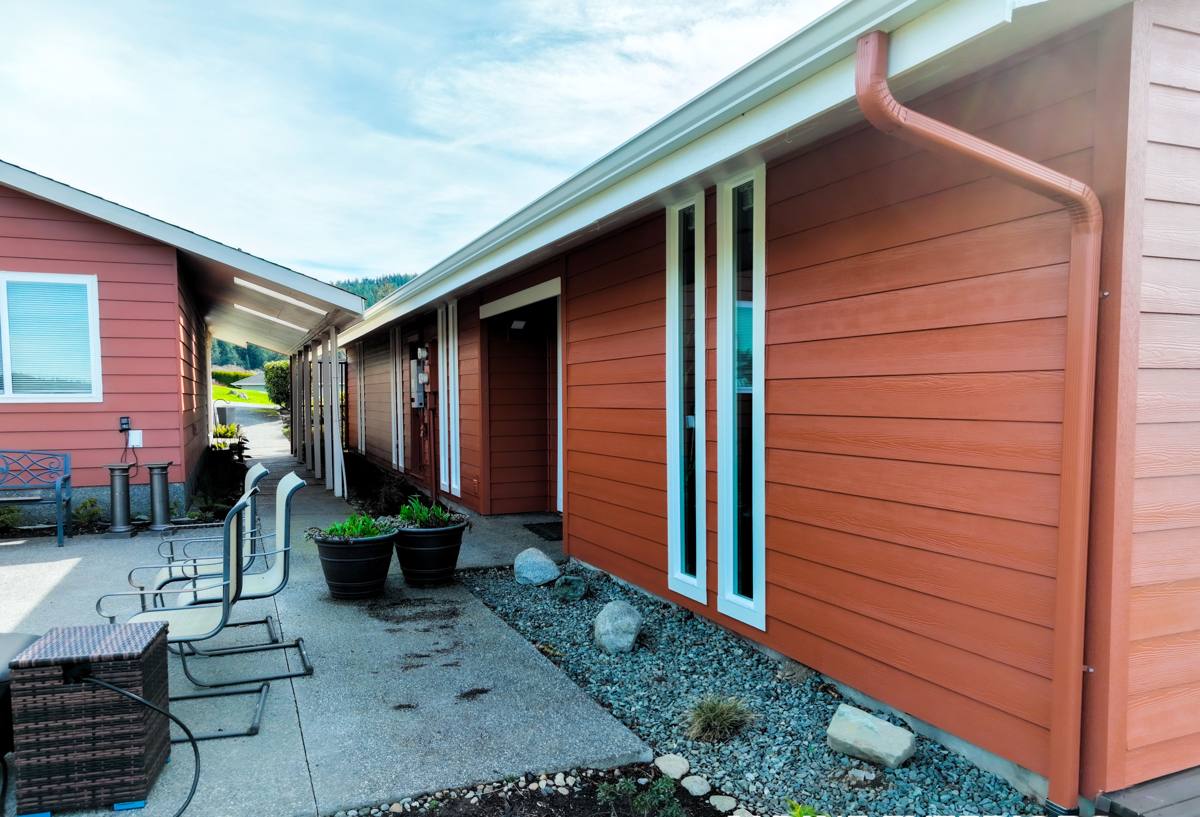
Why We Only Install James Hardie Fiber Cement
We made a deliberate choice not to install vinyl siding, LP SmartSide, Cemplank, Allura, or primed wood products like spruce or cedar. Every one of those has legitimate strengths — vinyl is cheap and fast, engineered wood is workable and light, cedar looks the way a lot of people want a house to look. But every one of them also asks an Everson homeowner to accept a trade-off we're not willing to install and then walk away from: vinyl distorts and cracks in temperature swings and offers no real fire resistance; engineered wood products rely on factory coatings that can fail at cut edges and exposed joints, inviting moisture into the wood fiber core; cedar and primed spruce need real, ongoing maintenance — staining, caulking, and inspection — to survive a climate this wet.
James Hardie fiber cement is cement, sand, and cellulose fiber. It doesn't have an organic wood core to rot, it's non-combustible, and it's engineered in HZ (HardieZone) formulations specifically for climates like ours — freeze-thaw cycling, sustained moisture, and everything that comes with a Pacific Northwest wet season. That's the whole reason we standardized on one product line instead of offering a menu of options: we'd rather install one thing correctly than five things with asterisks.
Choosing the Right Hardie Product Line for Your Home
James Hardie makes several profiles, and the right one depends on your home's style, existing trim, and how much of the wall is exposed to weather. Most Everson jobs land in one of three categories:
| Product | Best For | Look |
|---|---|---|
| HardiePlank lap siding | Most single-family homes; the standard replacement choice | Traditional horizontal lap, smooth or cedar-textured |
| HardiePanel vertical siding | Farmhouse and modern styles, accent walls, gable ends | Clean vertical lines, often paired with battens |
| HardieShingle siding | Accent gables, dormers, craftsman-style detail work | Staggered or straight-edge shingle profile |
Many homes end up using more than one profile — lap siding on the main walls with shingle accents on a gable, for example. Part of our estimate process is walking the exterior with you and matching the profile to how the home is actually built, not just picking one product for the whole house by default.
What Correct Installation Actually Looks Like
James Hardie siding performs the way it's rated to perform only when it's installed to manufacturer spec. Most of the failures we get called out to look at on other people's installs trace back to shortcuts taken here, not a flaw in the material itself.
Fastening and Clearances
Hardie board has to be fastened at the correct spacing with the correct nail type, and it needs proper clearance from grade, roof lines, and decks — typically a minimum gap so water has somewhere to go instead of wicking up into the bottom edge of the board. Skipping clearance is one of the most common corner-cuts we see, and in a climate that stays wet as long as Everson's does, it's also one of the most consequential.
Flashing and Joint Treatment
Every seam, window, door, and penetration needs flashing and sealant detailed correctly before the siding goes on, not caulked over afterward as an afterthought. Given how much wind-driven rain this area gets, a poorly flashed window head is where the next moisture problem starts.
Factory Finish vs. Field Paint
We install Hardie's ColorPlus factory-baked finish wherever possible instead of field-painting after installation. It's more UV- and fade-resistant than most field-applied paint, it's applied under controlled conditions rather than on a job site at the mercy of Whatcom County weather windows, and it carries its own finish warranty on top of Hardie's product warranty.
Our Process, Start to Finish
The steps don't change much from house to house, but the pace and sequencing get adjusted around Everson's weather windows:
- On-site walkthrough and estimate — we look at existing siding, trim, moisture damage, and which Hardie profiles fit the home.
- Tear-off and sheathing inspection — old siding comes off and we check the sheathing underneath for rot or damage before anything new goes up.
- Weather-resistive barrier and flashing — the house wrap and flashing details go in first; this is the layer that actually keeps water out long-term.
- Hardie installation — panels, planks, or shingles installed to spec, with correct fastening, clearances, and joint treatment.
- Trim, caulking, and final finish — trim work and touch-up finished, site cleaned up.
- Walkthrough — we go over the finished job with you before calling it done.
Signs Your Current Siding Is Already Losing
If you're not sure whether it's time to look at replacement, these are the signs we hear about most often on older Everson homes:
- Persistent moss or dark streaking on north-facing or shaded walls that comes back within weeks of cleaning
- Soft, spongy, or bubbling spots, especially near the bottom edges or around windows
- Paint that's peeling or alligatoring rather than just fading
- Visible warping, cupping, or gaps opening between boards
- Rising energy bills with no other explanation, which can point to a wall assembly that's no longer sealing properly
- Rust streaking from fasteners or trim, a sign salt-laden moisture is working on the metal
Caring for Hardie Siding After It's On
Fiber cement is low-maintenance compared to wood, but "low-maintenance" isn't "no-maintenance," especially with the moss season this area gets. A yearly rinse-down with a garden hose or low-pressure wash, keeping gutters clear so runoff isn't sheeting down the wall, and trimming back vegetation that's shading a wall and keeping it damp will do more for the siding's lifespan than almost anything else. ColorPlus finish holds color well, but it's still worth a visual check each fall before the wet season sets in — catching a small caulking gap early is a lot cheaper than dealing with what happens if it sits open all winter.
Why a Crew That Already Works Everson Matters
Installation details that matter everywhere matter more here: clearance heights, flashing sequencing, and fastener choice all need to account for how wet this part of Whatcom County stays and for how long. A crew that's already worked on homes in and around Lynden and Everson has a feel for which walls take the worst of the driving rain, which older homes tend to have moisture issues hiding under old siding, and how to sequence a tear-off around a weather window instead of leaving sheathing exposed longer than it should be. That local pattern recognition is the difference between a siding job that looks right on day one and one that's still performing right in year fifteen.
If you're weighing a siding replacement or just want an honest read on what your current siding is telling you, we're happy to come take a look. The estimate is free, there's no pressure, and you'll get a straight answer about what your home actually needs — use the form below to get started.