 Lynden Siding
 Siding in Laurel: Built for Whatcom County's Wet-Side Climate
Laurel sits in the flat, low-lying farmland northwest of Lynden, in the part of Whatcom County where marine air off the Salish Sea meets the open fields and drainage ditches of the Nooksack lowlands. That combination means moisture doesn't just fall here — it lingers. Homes in Laurel deal with driving rain that comes in sideways off open fields, long stretches of overcast humidity, and a moss season that can run from October through May. Exterior materials that hold water, absorb it, or trap it behind their surface don't hold up well in this environment, no matter what the brochure says.
We're a local siding, roofing, window, and deck contractor based in Lynden, and Laurel is part of our regular service area. That matters more than most homeowners realize — a crew that works this specific stretch of Whatcom County knows what the north wind does to a west-facing wall, how fast algae takes hold on a shaded eave, and which details actually keep water out versus which ones just look good on install day.
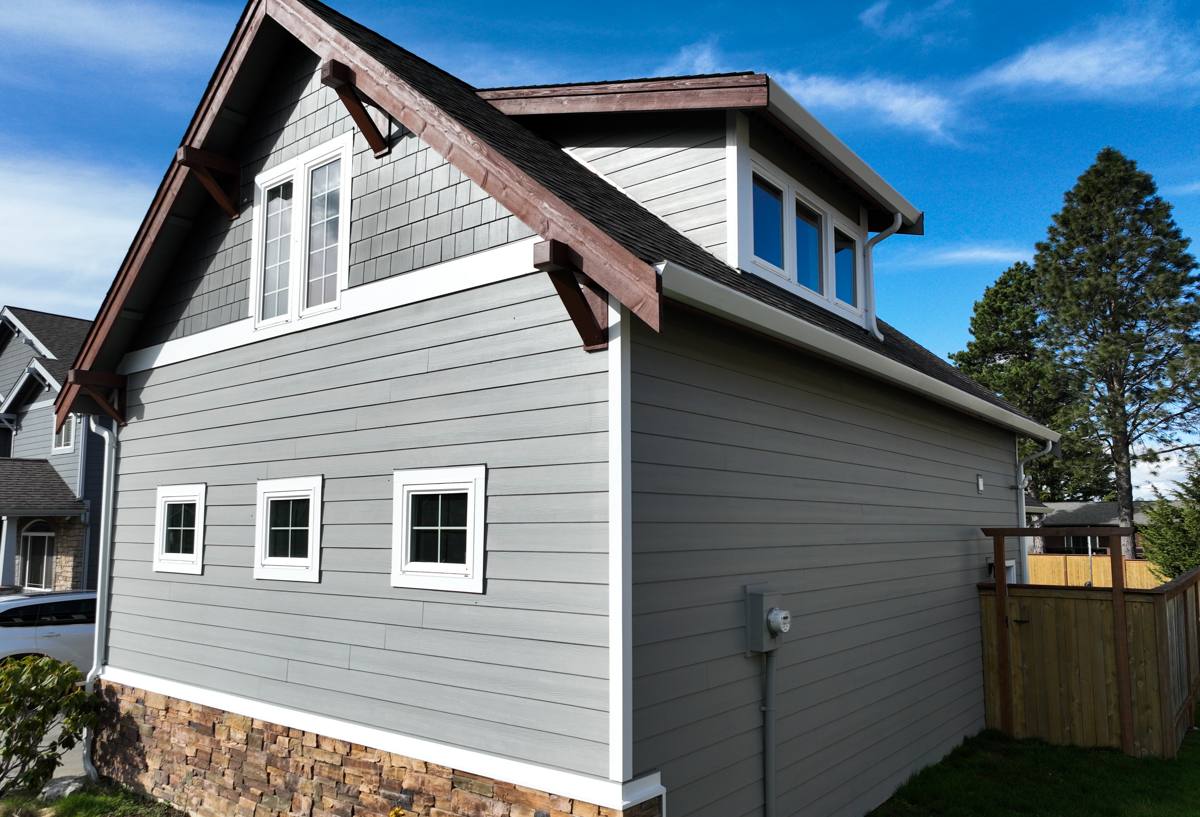
What Laurel's Climate Actually Does to a House
Driving Rain and Wind-Driven Moisture
Laurel's open, rural layout means less wind-blocking from trees and buildings than you'd find in denser parts of Lynden. Rain doesn't just fall straight down here — it gets pushed sideways into siding, window trim, and door casings, especially on the west and south exposures. Any weak point in the water-management layer behind the siding — a poorly lapped joint, a caulked seam that was never meant to be a primary water barrier, a nail hole in the wrong spot — becomes a slow, hidden leak path over years.
Moss, Algae, and Prolonged Dampness
Whatcom County's gray-sky season is long, and Laurel's flat, open exposure keeps humidity sitting on north- and shade-facing walls for days at a time. Wood-based siding products are especially vulnerable here: moss and algae take root in surface texture and cracks, and once established they hold moisture directly against the substrate. Over time that accelerates rot, especially at butt joints, corner boards, and anywhere caulk has started to fail.
Temperature Swings and Material Fatigue
Whatcom County doesn't get extreme heat, but the freeze-thaw cycles of a wet Pacific Northwest winter still stress exterior materials. Siding that absorbs moisture will expand, then contract and crack as it dries and freezes. Repeated cycles like this are what turn small maintenance issues into full panel or plank replacement.
Why We Install Only James Hardie Fiber Cement
We get asked regularly why we don't offer vinyl, LP SmartSide, Cemplank, Allura, or primed wood siding alongside Hardie. The honest answer is that we standardized on one product because it's the one we trust to perform, year after year, in exactly the conditions Laurel homes deal with.
- Vinyl can warp and become brittle over time, and its seams and J-channels give wind-driven rain more opportunities to get behind the cladding.
- LP SmartSide is an engineered wood product — it performs reasonably well when detailing is perfect, but any breach in its treated surface (a cut edge, a missed touch-up, a caulk failure) exposes wood fiber to exactly the kind of sustained moisture Laurel sees for months at a stretch.
- Cemplank and Allura are also fiber cement, and not inherently bad products — but we don't have the same install training, warranty backing, or factory-finish track record with them that we have with Hardie, so we don't put our name behind installs we can't fully stand by.
- Primed spruce or cedar looks great on day one, but it requires an ongoing maintenance commitment — repainting, caulking, and moisture monitoring — that most homeowners underestimate until the first signs of rot show up at a corner board or window sill.
James Hardie fiber cement is non-combustible, dimensionally stable, and engineered specifically for climates like ours. It doesn't swell, rot, or feed moss the way wood-based products can, and its factory-applied ColorPlus finish is baked on under controlled conditions — not sprayed on-site where weather and humidity can affect cure quality.
James Hardie Product Lines We Install
| Product | Best Use | Notes for Laurel Homes |
|---|---|---|
| HardiePlank Lap Siding | Most common residential application | Available in smooth or cedar-textured finishes; our most-installed product in Lynden and Laurel |
| HardiePanel Vertical Siding | Modern facades, accent walls, gables | Clean vertical lines, often paired with lap siding for a two-material look |
| HardieTrim | Corner boards, window and door trim, fascia | Matches siding durability so trim doesn't become the weak point |
| HardieShingle | Accent gables, Craftsman-style detailing | Gives dimension without the maintenance burden of real wood shingles |
James Hardie manufactures its siding in climate-specific formulations through its HZ5 and HZ10 engineering system. Whatcom County falls into the zone that accounts for our wetter, cooler Pacific Northwest weather, so the boards installed on a Laurel home are formulated for this region's rainfall and humidity — not a generic national spec.
ColorPlus Finish and Warranty Coverage
Most of what we install in Laurel uses James Hardie's ColorPlus Technology — a factory-applied, baked-on finish that resists fading and chipping far better than field-applied paint. That matters here specifically: with a moss and algae season this long, homeowners don't want to be adding a repaint to their maintenance list every several years on top of moss treatment and gutter cleaning.
James Hardie backs its siding with a 30-year non-prorated limited warranty on the substrate, and ColorPlus finishes carry their own separate finish warranty. Warranty coverage is only as good as the installation behind it, though — improper flashing, fastening, or clearance details can void coverage regardless of the product. That's a core reason we invest in Hardie-specific installation training rather than treating it like any other lap siding.
The Full Exterior: Siding, Roofing, Windows, and Decks
Siding doesn't work in isolation. On a Laurel property, the roof, windows, siding, and any exterior decking all interact as one moisture-management system. A few examples of how that plays out:
- Roofing: Poor flashing where a roofline meets a wall is one of the most common hidden water entry points behind siding — we look at this intersection on every siding project.
- Windows: Old or poorly flashed window units are a direct path for wind-driven rain to get behind new siding, so window condition is part of our siding assessment, not a separate conversation.
- Decks: Ledger boards attached to the house are a frequent rot point when siding and decking weren't coordinated correctly at install — we see this on older Whatcom County homes regularly.
Because we handle all four trades, we can flag these interactions during a single estimate instead of a homeowner discovering them mid-project with a siding-only contractor.
Why a Local Crew Matters in Laurel
Laurel isn't a dense subdivision — it's a mix of established farmhouses, newer builds on larger lots, and homes spread along rural roads outside Lynden's core. That layout means more direct wind and rain exposure on multiple sides of a house, less shelter from neighboring structures, and often longer driveways and larger properties to account for in scheduling and staging. A crew that works this area regularly knows to plan around that exposure — sequencing work to protect open wall sections from incoming weather, and building in buffer for the area's rain patterns rather than working off a generic install timeline.
Being based in Lynden also means we're a short drive away if a question comes up after the job is done — not routing a service call through a call center for a contractor based somewhere else in the region.
Signs a Laurel Home May Need Siding Attention
- Persistent moss or algae streaking on north- or shade-facing walls
- Soft spots, bubbling, or visible swelling in wood-based or engineered wood siding
- Cracked or missing caulk at trim boards, window casings, and corner joints
- Peeling or chalking paint that keeps returning within a couple of years of repainting
- Visible warping or waviness in vinyl siding panels
- Rising energy bills that suggest the wall assembly is no longer sealing well
What to Expect From the Process
Every project starts with an on-site walk-through of the exterior — not just the siding, but the roofline, window condition, and any deck ledger connections that touch the wall assembly. From there we put together a written scope and estimate before any work begins, and if we spot moisture damage or rot during the walk-through, we'll show you exactly where it is and what it takes to fix it correctly rather than covering it over. Installation follows James Hardie's published fastening, flashing, and clearance specifications — the details that actually determine whether a siding job performs for thirty years or ten.
If you're in Laurel and dealing with aging siding, ongoing moss and moisture issues, or you're planning ahead for a full exterior refresh, we're happy to take a look and put together a straightforward, no-pressure estimate — just fill out the form below to get started.