 Lynden Siding
 Siding Built for Everson's Particular Kind of Weather
Everson sits in a stretch of Whatcom County that takes a specific kind of beating year-round. Homes here deal with driving rain that comes in sideways for days at a time, salt-laden air drifting in off the Puget Sound and Georgia Strait, and a moss season that can run eight or nine months if conditions are right. None of that is dramatic on any single day. It's the accumulation that wears siding down — moisture that never fully dries out between storms, salt that corrodes fasteners and finishes, and moss and algae that hold water against a wall long after the rain has stopped.
Siding installation in this area isn't just about picking a product and nailing it up. It's about understanding how water moves across a wall system in a place where the wall rarely gets a long dry stretch to recover. A siding job that looks fine on day one but wasn't built with that reality in mind will show it within a few wet seasons — usually as swelling at the bottom courses, staining that won't wash off, or soft spots where moisture found a way in and stayed.
What "Correct" Siding Installation Actually Involves
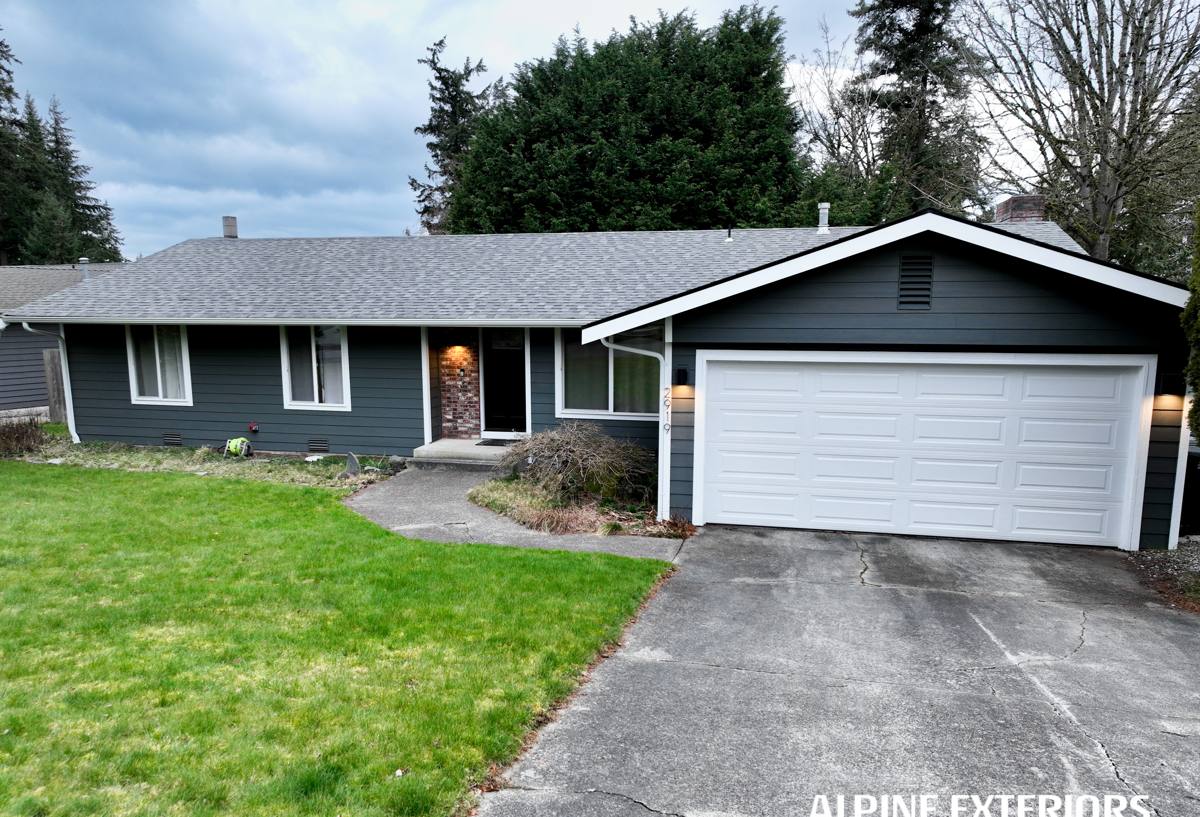
A lot of siding problems in this region aren't product failures — they're installation failures. The material gets blamed when the real issue was how it was flashed, gapped, or fastened. Correct installation for a house in Everson's climate means paying attention to details that don't show up in a sales pitch but matter enormously over ten or twenty years.
Water Management Comes First
Before a single piece of siding goes up, the wall needs a weather-resistive barrier installed correctly, with all seams taped and all penetrations — windows, doors, hose bibs, vents — properly flashed so water is directed out and away from the sheathing, not behind the siding. In a climate with this much sustained rain, a house that relies on the siding itself as the only defense against moisture is already behind.
Proper Clearances and Gaps
Siding needs clearance from grade, from roof lines, from decks and patios, and expansion gaps at every butt joint. Skipping these is one of the most common shortcuts we see on older installations, and it's exactly why so many homes in wetter parts of Whatcom County develop rot at the bottom courses first — that's where standing water and splash-back do the most damage.
Fastening for Coastal Air
Salt air corrodes the wrong fasteners faster than most homeowners expect. Installation needs to use fasteners rated for the exposure, driven correctly — not overdriven, not underdriven — so the siding can move slightly with temperature changes without cracking the finish or working itself loose over time.
Why We Install Only James Hardie Fiber Cement
We don't install vinyl, LP SmartSide, Cemplank, Allura, primed spruce, or cedar. That's a deliberate standard, not a limitation of what we're capable of doing. Every one of those products has real strengths, but each also comes with a trade-off that shows up specifically in a climate like this one — moisture sensitivity, maintenance burden, or a finish that can't stand up to years of driving rain and salt air without regular upkeep.
James Hardie fiber cement is non-combustible, dimensionally stable in wet-dry cycling, and comes factory-finished with ColorPlus Technology — a baked-on finish that resists fading and chipping far better than field-applied paint. Hardie's HZ5 product line is engineered specifically for climates like the Pacific Northwest, where moisture exposure is constant rather than seasonal. It also carries a strong, transferable warranty when installed to Hardie's published specifications — which is a meaningful detail, because a warranty is only as good as the install behind it.
Standardizing on one product system lets our crews get genuinely expert at it — the flashing details, the fastening patterns, the finish handling — rather than splitting attention across five different materials with five different failure modes.
| Factor | James Hardie Fiber Cement | Vinyl / LP SmartSide / Cedar |
|---|---|---|
| Moisture behavior | Dimensionally stable, engineered for wet climates | Varies — wood-based products absorb moisture; vinyl can warp with heat |
| Finish durability | Factory-baked ColorPlus finish, fade-resistant | Field-applied paint or factory coatings with shorter repaint cycles |
| Fire resistance | Non-combustible | Combustible (wood-based products); vinyl can deform under heat |
| Moss/algae resistance | Resists moisture retention that feeds growth | More prone to holding moisture against the surface |
| Typical maintenance | Periodic washing, minimal repainting | More frequent caulking, repainting, or panel replacement |
Our Installation Process for Everson Homes
Every job starts with an honest look at the existing wall assembly, not just the old siding. We want to know what's underneath before we commit to a plan, because covering up existing moisture damage with new siding just delays the problem.
- On-site assessment — we walk the exterior, check for existing rot, moss buildup, and problem areas around windows, decks, and grade level.
- Tear-off and sheathing check — old siding comes off and we inspect the sheathing underneath for damage before moving forward.
- Weather barrier and flashing — a properly lapped, taped weather-resistive barrier goes on, with flashing at every window, door, and penetration.
- Hardie installation to spec — panels or planks installed with correct clearances, fastening, and joint treatment per James Hardie's published instructions.
- Finish detailing — trim, caulking at approved joints only, and touch-up where field cuts exposed raw edges.
- Final walkthrough — we go over the finished exterior with the homeowner before calling the job done.
Signs an Everson Home Needs New Siding
Some warning signs are easy to miss from the ground, especially with darker siding colors or shaded elevations that don't dry out quickly.
- Soft or spongy spots when pressed, especially near the bottom few courses
- Persistent moss or algae staining that returns shortly after washing
- Paint that's peeling, bubbling, or chalking well before it should
- Visible gaps, warping, or buckling between panels
- Rising utility bills that suggest the wall assembly is no longer insulating or sealing properly
- Interior signs like musty smells or discoloration on walls that back up to exterior siding
Cost Factors for Siding Installation in Everson
Every home is different, so we don't quote broad numbers without seeing the house, but the factors that move a project's cost up or down are consistent.
| Factor | Why It Matters |
|---|---|
| Home size and elevations | More square footage and complex rooflines mean more material and labor |
| Existing wall condition | Rot or moisture damage found during tear-off adds repair scope before new siding goes on |
| Siding profile chosen | Lap siding, shingle-style panels, and board-and-batten each price differently |
| Trim and detail work | Window and door trim, corner details, and fascia work add labor time |
| Access and site conditions | Tight lots, slopes, or landscaping close to the house can slow installation |
Living With Hardie Siding in a Wet, Salty Climate
Once it's installed correctly, Hardie siding in this climate is genuinely low-maintenance, but "low" doesn't mean "none." A periodic gentle wash — a garden hose and soft brush, not a pressure washer aimed directly at seams — keeps moss and salt residue from building up. Keeping gutters clear and grading water away from the foundation matters just as much as the siding itself, since most siding failures we see start with water that had nowhere else to go. Checking caulked joints every year or two and addressing any cracking early prevents small issues from becoming bigger ones.
Why It Matters That We Already Work in Everson
A crew that already works in and around Everson and Lynden knows what this specific stretch of Whatcom County does to a house over time — which elevations take the worst of the driving rain, how quickly moss reestablishes itself on north-facing walls, and how much salt exposure a given property actually gets based on its position and tree cover. That local pattern recognition shapes real decisions on the job: where to be extra careful with flashing, which details are worth the extra time, and what a homeowner should realistically expect from their siding five and ten years down the road. It's the difference between an installation crew and a crew that understands the house they're working on in the context of the place it sits.
If you're weighing a siding replacement or new construction siding for a home in Everson, we're happy to take a look and walk you through what we'd recommend and why. Reach out for a free, no-pressure estimate — there's a form right below this page to get started.