 Lynden Siding
 Decking in Custer: A Climate That Doesn't Forgive Shortcuts
Custer sits in the flat agricultural stretch of Whatcom County north of Ferndale, close enough to the Salish Sea to catch salt-laden marine air on winter storms, and open enough that wind-driven rain reaches decks, siding, and outdoor structures with little to slow it down. Add in a moss and mildew season that can run most of the year on shaded, north-facing, or poorly ventilated surfaces, and you have a climate that's genuinely hard on outdoor living spaces. A deck built here doesn't get the luxury of a dry, sheltered install site — it needs to be built and installed correctly from the first board down, because this climate will find every weak point over time.
Composite decking has become the default recommendation for homeowners in this part of Whatcom County who want a deck that holds up without a yearly fight against rot, splintering, and moss. But composite decking is only as good as the structure underneath it and the details of how it's installed. We handle decking alongside siding, roofing, and windows for homes throughout Custer and the surrounding area, and on decks specifically, the framing, ventilation, and fastening choices matter just as much as the board brand on top.
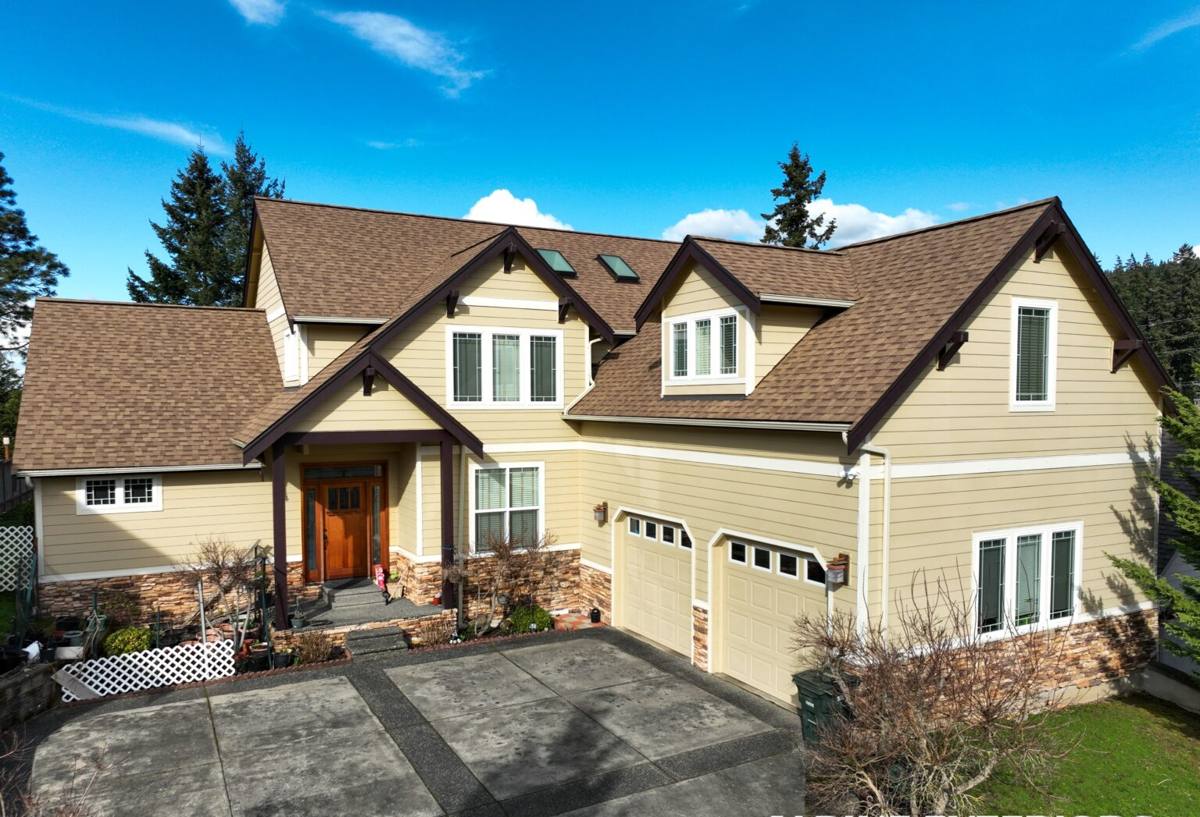
What Custer's Climate Does to a Deck
Driving Rain and Standing Water
Flat, open terrain around Custer means storms coming off the water push rain sideways as much as straight down, and that rain doesn't drain off a deck the same way it drains off a sloped roof. Any low spot, any gap where boards butt up against a house wall without a proper drainage path, and any spot where water pools instead of running off becomes a long-term moisture problem — whether the boards themselves are rot-resistant or not.
Salt-Laden Marine Air
Custer isn't waterfront, but it's close enough to the Salish Sea that salt-carrying air reaches inland on winter storms. Over years, that air accelerates corrosion on lower-grade fasteners, hidden clips, and any metal hardware used in the deck structure. A deck can look fine on the surface while the fasteners holding it together are quietly degrading underneath.
A Long Moss and Mildew Season
Mild, wet weather through fall, winter, and spring gives moss and mildew a long growth window across Whatcom County, and a deck's horizontal surface — especially in shaded yards or under overhangs — is exactly the kind of spot moss takes hold. Traditional wood decking absorbs moisture and gives moss and algae something to grip into the wood grain itself. Anywhere airflow is blocked underneath a deck, that moisture problem compounds, because the underside stays damp long after the surface has dried.
Freeze-Thaw and Seasonal Movement
Whatcom County doesn't see extreme cold most winters, but it does see enough freeze-thaw cycling to stress any decking material that absorbs water. Wood that's taken on moisture and then freezes can crack, cup, or split. Composite boards handle this cycling better than wood, but only if they're installed with the manufacturer's specified gapping and expansion allowances — composite still expands and contracts with temperature, just less dramatically than solid wood.
Why Composite Decking Fits This Climate
We recommend composite decking for most Custer homeowners not because it's trendy, but because it removes several of the failure points that wood decking struggles with in this specific climate. Composite boards don't absorb moisture the way wood does, so they're far less prone to rot, splintering, and the kind of moss growth that gets embedded into open wood grain. They also don't need annual staining or sealing to keep performing, which matters in a climate where a missed maintenance season can mean real damage by the time it's noticed.
That said, composite isn't maintenance-free, and we tell homeowners that directly rather than overselling it. It still needs periodic cleaning to keep moss and mildew from building up on the surface, and the framing underneath — whether wood or composite — still needs to be built with drainage and airflow in mind. A composite deck built on a poorly ventilated, poorly flashed substructure will still develop moisture problems, even if the boards on top never rot.
What a Correct Composite Deck Installation Actually Involves
Structural Framing First
The substructure — ledger board, joists, beams, and posts — determines how long the deck lasts, regardless of what decking material sits on top. In this climate, we treat the ledger board connection to the house as one of the highest-risk points on the entire structure, because it's where water most commonly gets trapped against the building if it isn't flashed correctly.
Ledger Flashing and Water Management
A ledger board bolted directly to a house without proper flashing is one of the most common sources of hidden rot behind a deck, and it's a mistake that can go unnoticed for years because the damage happens on the wall side, not the visible deck side. Correct installation means flashing that directs water away from the ledger-to-wall connection entirely, not just caulk applied around the edges. Caulk breaks down; proper flashing doesn't rely on a sealant staying intact for decades.
Joist Protection
Composite decking manufacturers generally recommend joist tape — a self-adhering waterproof membrane applied to the top of each joist — to protect the framing lumber from the moisture that inevitably reaches it over the life of the deck. Skipping this step is a common corner-cutting move because it doesn't show once the decking is installed, but in a climate with Custer's rainfall, unprotected joists tend to show rot years earlier than protected ones.
Ventilation Underneath
Airflow beneath a deck matters more here than in a drier climate. A deck built low to the ground or enclosed on multiple sides without any ventilation traps humid air underneath, which keeps the framing damp long after a storm passes and gives moss and mildew a head start. Proper skirting design and adequate clearance between the ground and the framing help the underside actually dry out between rain events instead of staying perpetually damp.
Fastening Method
Most composite systems use a hidden fastener clip system rather than face-screwing boards, which gives a cleaner look and eliminates the screw-hole points where water could otherwise sit on the board surface. Fastener and clip material matters here — stainless steel or coated hardware rated for coastal exposure holds up against the marine air reaching Custer far better than standard-grade fasteners, which can corrode and stain the decking around them over time.
Choosing the Right Composite Board
Not all composite decking is built the same way, and the differences matter more in a wet climate than they would somewhere dry. The biggest distinction is between capped and uncapped composite boards.
| Feature | Capped Composite | Uncapped Composite |
|---|---|---|
| Moisture resistance | High — polymer shell resists water absorption at the surface | Lower — more exposed to surface moisture absorption over time |
| Moss and mildew resistance | Better — smoother, sealed surface is harder for growth to grip | More prone to surface staining and growth in shaded, damp spots |
| Fading and staining | More resistant, especially with UV-stabilized capping | More prone to fading and staining over years of exposure |
| Upfront cost | Higher | Lower |
| Typical warranty | Longer, often 25–50 years depending on manufacturer | Shorter, often 10–25 years depending on manufacturer |
For a Custer property with real moss and moisture exposure, we generally steer homeowners toward capped composite boards, particularly on shaded elevations or decks under trees or overhangs where moisture sits longer. Uncapped composite can still be a reasonable, more budget-friendly option on a sunnier, more exposed deck that dries out quickly between rain events — the right call depends on the specific site, not just the product line.
Our Process for a Custer Deck Project
We start with an on-site assessment of the deck location — sun exposure, drainage slope, proximity to the house, and how the ground beneath the deck area handles water. From there we talk through board options and structural needs specific to that site, and provide a written scope before any work starts. Framing is built or reinforced to current code, ledger flashing and joist protection are handled as standard practice rather than optional upgrades, and hidden fastener systems are installed to manufacturer specification for proper board spacing and expansion gaps. We walk the finished deck with the homeowner before considering the job complete, including a look underneath to confirm drainage and ventilation are working as designed.
Maintaining a Composite Deck in a Moss-Prone Climate
Composite decking cuts down on maintenance significantly compared to wood, but "low-maintenance" isn't "no-maintenance," especially given how long Whatcom County's wet season runs. A simple seasonal routine keeps a composite deck performing the way it's supposed to:
- Sweep debris — leaves, needles, pollen — off the deck surface regularly, since trapped organic material holds moisture against the boards and feeds moss growth
- Wash the surface with a soft-bristle brush and mild soap-and-water solution a few times a year, more often on shaded sections
- Avoid pressure washers on composite boards at close range or high pressure, since it can damage the surface cap over time — a garden hose and brush is usually enough
- Check underneath the deck once or twice a year for standing water, debris buildup, or signs of moisture trapped against the framing
- Keep gutters and downspouts near the deck clear so roof runoff isn't dumping extra water onto or near the deck structure
- Address any moss or algae as soon as it appears rather than letting it establish, since it's far easier to remove early than after it's taken hold
Cost Factors for a Custer Composite Deck
Deck pricing depends on size, board selection, structural complexity, and site conditions, so we don't quote a flat number without seeing the property. In broad terms, the factors that move a project's cost the most are:
| Factor | Why It Matters |
|---|---|
| Board tier (capped vs. uncapped) | Capped boards cost more upfront but generally perform better long-term in this climate |
| Deck height and substructure | Taller decks need more structural framing, railing, and often stairs |
| Site access and grading | Sloped or hard-to-access sites take more labor to frame and level correctly |
| Railing and fastener grade | Coastal-rated hardware and quality railing systems add cost but reduce long-term corrosion issues |
| Tear-out of an existing deck | Removing and disposing of an old wood deck adds labor before the new build starts |
A Checklist Before Hiring for Deck Work in Custer
- Ask specifically whether ledger flashing and joist tape are standard practice, not optional add-ons
- Confirm current Washington contractor licensing and active liability insurance
- Ask what fastener and clip grade they use, and whether it's rated for coastal or marine air exposure
- Get a written scope that separates the manufacturer's product warranty from the contractor's installation warranty
- Ask how they handle ventilation and drainage under low-clearance decks specifically
Why a Local Crew Matters for Decking Work
A contractor who regularly builds decks in this part of Whatcom County already understands how wind-driven rain, marine air, and a long moss season interact with a deck's structure over time — not just in theory, but from having seen what fails and what doesn't after a few wet winters. That shows up in decisions that aren't visible in a sales brochure: how much lap a ledger flashing detail gets, whether joist tape is treated as standard or skipped to save a step, and what fastener grade actually gets installed once the homeowner isn't watching. Those choices are what determine whether a composite deck looks and performs the same in year fifteen as it did in year one, or starts showing hidden framing problems well before the boards themselves would ever fail.
If you're planning a new deck or replacing an aging one on a Custer property, we're happy to take a look at your site and talk through what makes sense for your specific conditions — sun exposure, drainage, and how the space gets used. Reach out below for a free, no-pressure estimate.