 Lynden Siding
 Why Siding Fails Faster in Custer
Custer sits close enough to the Strait of Georgia and Birch Bay that homes here deal with a version of coastal weather most inland Whatcom County towns don't see as directly. Salt-laden air moves in off the water, driving rain comes at siding sideways during winter storms, and the shaded, damp stretches of the year give moss and algae a long runway to take hold on north-facing walls and anything close to trees. None of that is unusual for this corner of Washington, but it adds up differently on siding than it does on, say, a roof or a fence.
Salt air accelerates corrosion on fasteners, flashing, and any exposed metal trim. Wind-driven rain finds every gap in caulking, every lifted seam, and every spot where a panel was face-nailed instead of properly fastened. And moss doesn't just sit on the surface — its root structure holds moisture against the siding face and, over time, against the wood or fiber cement underneath. On a lot of Custer properties, all three of these are working on the same wall at once.
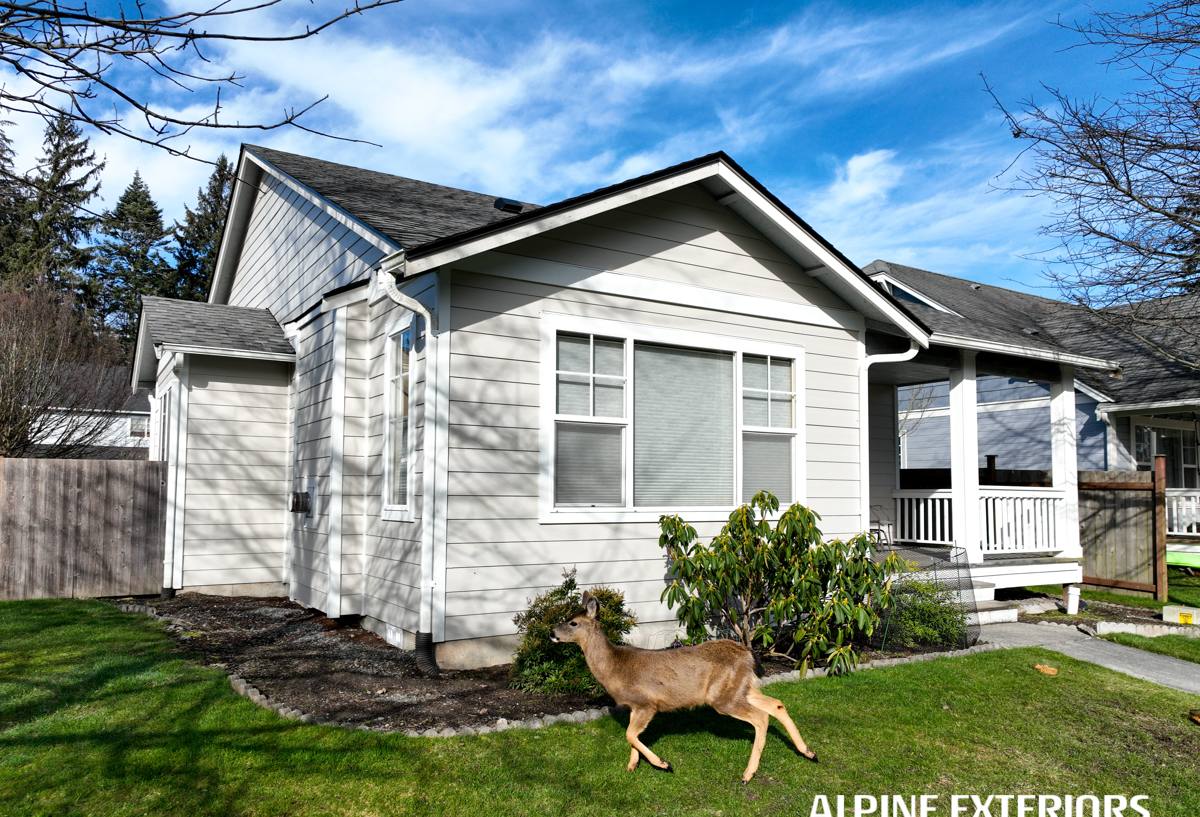
What "Siding Repair" Actually Covers
Repair work is not one-size-fits-all. Depending on what we find during an inspection, a repair visit to a Custer home might involve any combination of the following:
- Replacing individual cracked, split, or impact-damaged siding boards or panels
- Re-securing sections that have come loose from wind uplift or failed fasteners
- Cutting out and replacing sections with water damage or soft substrate underneath
- Re-flashing and re-caulking around windows, doors, and penetrations where seals have failed
- Correcting old repair work that wasn't installed to spec (mismatched material, wrong fasteners, missing flashing)
- Cleaning and treating moss- and algae-affected areas as part of the repair, not just cosmetically
A real repair job starts with figuring out which of these you actually need — not just patching the visible symptom and leaving the cause in place.
Signs a Custer Home Needs Siding Repair
What to look for from the ground
Most homeowners notice siding problems long before they call anyone, they just don't always know what they're looking at. Common signs we get called out for in this area include:
- Visible cracks, splits, or holes in siding boards, especially after a windstorm
- Panels that look warped, bowed, or slightly separated from the wall
- Dark streaking, green or black growth, or a persistently damp look on shaded walls
- Paint that's peeling, bubbling, or failing faster than the rest of the house
- Soft spots you can press in with a finger, particularly near the bottom of walls or below windows
- Gaps at seams, corners, or trim where caulking has shrunk or pulled away
Why acting early matters more here
With the amount of rain Whatcom County gets over a typical winter, a small gap that lets water behind the siding in October can turn into a rotted section of wall sheathing by spring. Custer's exposure to wind off the water also means loose siding tends to get worse fast rather than staying static — a lifted panel is an open invitation for the next storm to do more damage.
Repair or Replace? How We Make That Call
Not every damaged section means the whole wall needs to come off. But there's a point where patch-repairing an aging or failing siding system stops making financial sense. We walk every Custer property with that question in mind and give you a straight answer.
| Situation | Usually Repair | Usually Replace |
|---|---|---|
| Isolated impact damage (1-3 boards) | Yes | No |
| Damage limited to one wall or elevation | Often | Sometimes |
| Widespread moisture damage behind siding | No | Yes |
| Original material is vinyl, LP SmartSide, or old cedar past its service life | Case by case | Often, especially if failing broadly |
| Siding is James Hardie fiber cement in otherwise good condition | Yes | No |
| Multiple past repairs already failed in the same area | No | Yes |
If your home's existing siding is a material we don't stand behind long-term, we'll still tell you honestly whether a targeted repair now makes sense to buy time, or whether you're better off putting that money toward a permanent fix.
Why Material Matters When You're Repairing, Not Just Installing
This is where a lot of siding repair goes wrong, and it's worth being direct about it: a repair is only as good as its ability to match and integrate with what's already on the wall. We install James Hardie fiber cement exclusively, which means when we're repairing a Hardie system, we're working with a product we know inside and out — the exact plank profiles, the ColorPlus factory finish options, the fastening patterns, and the flashing details Hardie's installation specs call for.
When a home already has Hardie siding, a correct repair means matching board profile and reveal, using the right fastener type and spacing, and reinstalling flashing so water sheds the way the system was designed to shed it — not just caulking over a gap and calling it done. Caulk is not a repair strategy on its own; it's a short-term patch that fails again within a season or two, especially with the amount of driving rain this area sees.
We don't install vinyl, LP SmartSide, Cemplank, Allura, or primed wood siding, and that's a deliberate standard, not an oversight. If your home currently has one of those products, we'll repair it honestly where that's the right call, but we won't pretend it's a like-for-like match to fiber cement, and we'll tell you what your longer-term options look like.
How Our Repair Process Works
1. Inspection and diagnosis
We start by looking past the visible damage — checking for moisture behind the siding, condition of the house wrap or building paper, and whether flashing at windows, doors, and trim is doing its job. This tells us whether we're looking at a simple board swap or something that needs more attention underneath.
2. A clear, honest scope
You get a plain explanation of what's actually wrong, what it'll take to fix it correctly, and what it costs — no upselling a full replacement when a repair will genuinely hold up, and no downplaying a problem that's bigger than it looks.
3. The repair itself
Damaged material comes out, any compromised sheathing or house wrap gets addressed, flashing and moisture barriers are corrected where needed, and new material goes in matched to the existing siding's profile and finish as closely as possible.
4. Cleanup and a final check
We check the surrounding area for other early-stage issues while we're already on the wall — it's a lot more efficient to flag a second problem area during the same visit than to have you call us back out separately.
Why a Crew That Already Works Custer Is Worth Choosing
Custer isn't a huge town, and it doesn't have the density of contractors that a bigger city does. A crew that's already familiar with the area understands the specific weather exposure — how much wind and salt air a wall facing the water takes versus one that's more sheltered, and how much longer moss holds on in the shaded, damp pockets common around here. That local pattern recognition shortens the diagnosis step and helps us catch problems that a crew unfamiliar with the area might miss on a first pass.
There's also a practical side: local scheduling. A repair that gets fit into a route already running through Lynden and the surrounding Whatcom County communities tends to get done faster and with less overhead than one requiring a special trip.
What a Homeowner Should Expect From Any Repair Crew
Whether you end up hiring us or someone else, here's a straightforward checklist for vetting a siding repair contractor in this area:
- They inspect for hidden moisture damage, not just what's visible from the ground
- They explain repair vs. replace honestly, including when a repair is the right call
- They match material profile and fastening method rather than just covering the damage
- They check and correct flashing, not just re-caulk over a leak point
- They carry appropriate licensing and insurance for exterior work in Washington
- They give you a written scope before starting, not a verbal estimate that changes later
Protecting the Repair Long-Term
A well-executed repair on James Hardie siding should hold up for years without needing revisiting, provided the underlying cause — not just the symptom — was addressed. That's especially true in Custer's climate, where the combination of salt air, wind-driven rain, and a long moss season will find any shortcut in the work eventually. Regular gutter maintenance, trimming back vegetation that shades and dampens walls, and periodic visual checks after major windstorms go a long way toward catching the next issue small instead of letting it grow.
If you're noticing damage, discoloration, or loose sections on your home's siding, we're glad to take a look and give you an honest read on what it needs. Reach out for a free, no-pressure estimate and we'll walk the property with you.