 Lynden Siding
 Why Siding Installation in Custer Has to Account for the Climate
Custer sits close enough to the water that homes here deal with a version of Whatcom County weather that's a notch harder on exterior materials than what you'd see further inland. Salt-laced air moving in off the Salish Sea corrodes fasteners and finishes faster than dry-climate siding was ever engineered to handle. Add driving, wind-blown rain that hits walls at an angle instead of falling straight down, and a moss season that can stretch from October into May, and you've got three separate stresses working on your siding at the same time, year after year.
None of that means siding installation in Custer is exotic or requires anything unusual. It means the installer has to get the ordinary things right — flashing, drainage, fastening, and product selection — because there's less room for error here than in a milder climate. A shortcut that might go unnoticed for a decade in a dry inland town can show up as a moisture problem in Custer within a couple of wet winters.
What Salt Air Actually Does
Salt-bearing air accelerates corrosion on any exposed metal — nail heads, trim flashing, hose bibs, light fixtures — and it can dull or streak painted and coated surfaces faster than inland exposure. Siding systems that depend on a painted or coated finish for their weather resistance are more exposed to this than a material with the color built all the way through the product.
What Driving Rain Does
Wind-driven rain doesn't just wet the surface of a wall — it gets pushed sideways and upward into laps, seams, and penetrations that vertical rain would never reach. That's why the drainage plane behind the siding (not just the siding itself) is what actually keeps a Custer home dry.
What a Long Moss Season Does
Moss and algae need moisture and shade to establish, and Whatcom County gives them both for most of the year. Siding that holds surface moisture, or that has grain and texture that traps organic debris, gives moss a foothold. Siding that sheds water cleanly and dries fast resists it.
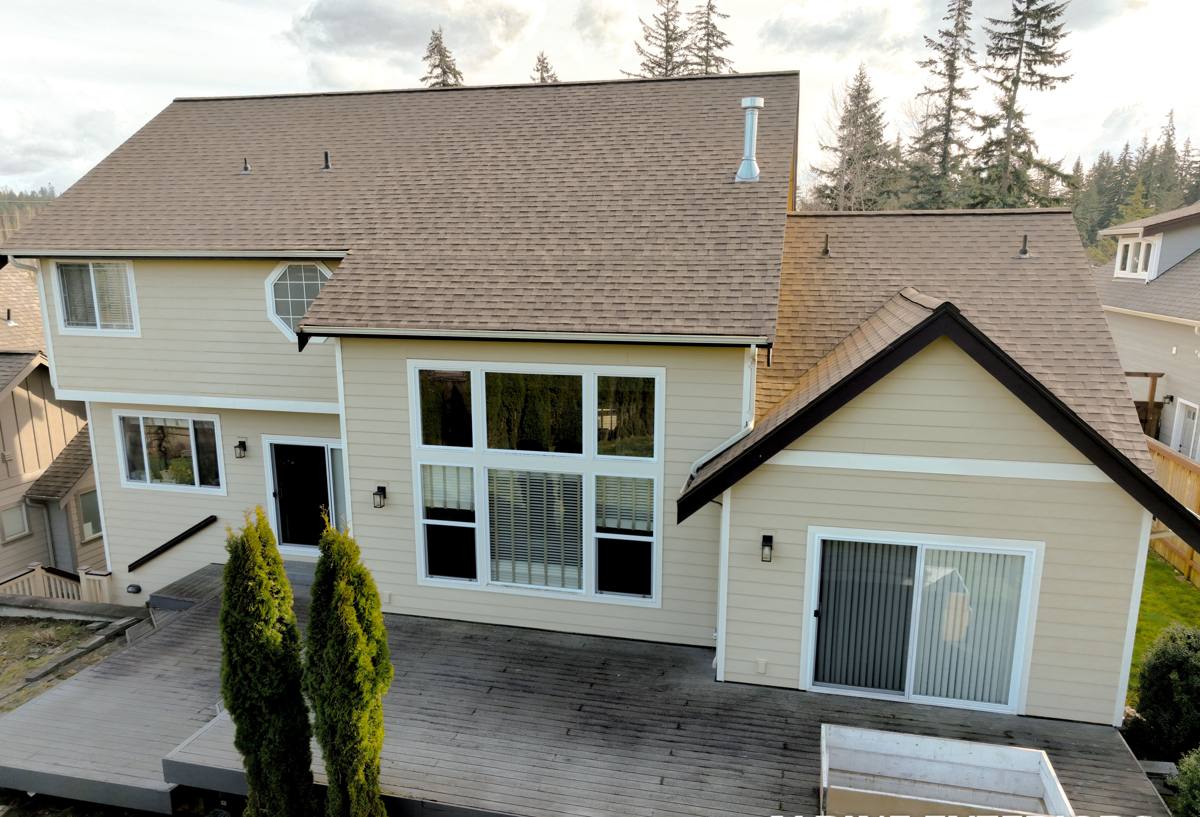
What Correct Siding Installation Actually Involves
"Correct" installation is mostly invisible once the job is done — it's the layer behind the siding, not the siding itself, that determines whether a Custer home stays dry for the next 30 years.
Weather-Resistive Barrier and Flashing
Every window, door, and penetration needs flashing detailed so that water is directed out and down, never trapped behind the cladding. The weather-resistive barrier underneath has to be lapped correctly — upper courses over lower ones — so gravity and wind-driven rain both drain to the outside instead of finding a gap to work into.
A Drainage Gap Behind the Siding
A rainscreen gap between the siding and the wall assembly gives any moisture that does get past the outer layer a path to drain and air to circulate and dry. In a climate with Custer's rain load, this gap is what keeps incidental moisture from turning into rot or mold inside the wall.
Fastening and Clearances
Fiber cement siding has specific nailing patterns, fastener types, and minimum clearances above grade, roofs, and decks that are engineered into the manufacturer's installation manual. Skipping or fudging these clearances is one of the most common ways a siding job fails early — not because the material was bad, but because it was installed without the gaps it needed to drain and dry.
Why We Install Only James Hardie Fiber Cement
We made a decision as a company to install one siding system: James Hardie fiber cement, in the climate-engineered HZ5 line built for the Pacific Northwest's wet, marine-influenced conditions. We didn't arrive at that by accident — it's a direct response to what we've seen hold up in this climate and what doesn't.
Vinyl siding is inexpensive and easy to install, but it's a thin, flexible material that can warp in heat, crack in cold, and it relies entirely on lapped seams for water management — seams that driving rain in a place like Custer will find over time. LP SmartSide and other engineered wood products perform reasonably well when the finish and edge sealing are maintained perfectly, but they're wood-based, and wood-based siding is more vulnerable to the kind of sustained moisture exposure that salt air and long wet seasons create. Primed spruce and cedar are attractive, traditional materials, but they demand a maintenance schedule (repainting, resealing cut edges, moss treatment) that most homeowners don't want to commit to indefinitely.
James Hardie fiber cement is non-combustible, holds its factory-applied ColorPlus finish far longer than field-painted materials because the coating is baked on and warrantied separately from the substrate, and it doesn't expand, contract, or absorb water the way wood-based or vinyl products do. It's not the cheapest option on day one, but it's the one we're willing to put our name behind for a Custer roofline.
The HZ5 Difference
Hardie's HZ (HardieZone) system means the product formulation is matched to the region it's installed in. HZ5 is engineered for wetter, more moderate climates like ours, with a moisture and freeze-thaw resistance profile suited to the Pacific Northwest rather than a generic, one-size-fits-all product.
Signs a Custer Home May Need New Siding
Some of these show up gradually, which is exactly why they get missed until the underlying damage is more extensive.
- Persistent moss or algae growth that comes back within weeks of cleaning
- Soft, spongy, or bubbling spots when you press on the siding
- Visible warping, cupping, or gaps opening up between boards or panels
- Peeling, chalking, or fading paint that's worse on the wind- and rain-facing sides of the house
- Rust streaks running down from nail heads or trim fasteners
- Rot or discoloration at corners, around windows, or near the ground line
- Rising energy bills that suggest the wall assembly is no longer doing its job as a weather barrier
Our Installation Process
- On-site assessment — We look at the existing siding, the wall assembly underneath where accessible, drainage patterns around the home, and any moisture or moss problem areas specific to the property.
- Removal and inspection — Old siding comes off and we inspect the sheathing underneath for rot or hidden damage before anything new goes up. Problems found here get addressed, not covered over.
- Weather barrier and drainage plane — A new weather-resistive barrier is installed and lapped correctly, with a rainscreen gap built in to let the wall breathe and drain.
- Flashing details — Windows, doors, and every penetration get flashed to direct water out and away from the wall assembly.
- Hardie installation to spec — Fiber cement siding is installed following James Hardie's fastening patterns, clearances, and joint treatment exactly as engineered.
- Final walkthrough — We review the finished work with the homeowner, including what routine maintenance (if any) looks like going forward.
Cost Factors for a Custer Siding Project
Every home is different, but the same handful of factors drive the price on nearly every job we quote in this area.
| Factor | Why It Matters |
|---|---|
| Home size and wall complexity | More square footage, corners, and dormers mean more material and labor time |
| Condition of existing sheathing | Rot or moisture damage found during removal has to be repaired before new siding goes up |
| Siding profile and accessories | Lap width, trim style, and corner details affect both material cost and install time |
| Access and site conditions | Slopes, tight setbacks, and landscaping around the home can add labor |
| Tear-off vs. overlay | Full removal costs more upfront but lets us fix what's underneath instead of building over a problem |
Why a Crew That Already Works Custer Matters
A contractor who works this specific stretch of Whatcom County regularly already knows how the wind comes off the water here, which sides of a house take the worst of the driving rain, and how aggressively moss establishes on north-facing walls in this microclimate. That's not something you can fully replicate from a general specification sheet — it shapes small decisions on the job, like where extra flashing attention is worth it or which detailing choices actually pay off here versus somewhere drier.
Being local also means we're not guessing at permitting requirements or driving hours to handle a warranty question. If something needs a second look after the job is done, we're already in the area.
Maintenance After Installation
One of the practical benefits of James Hardie fiber cement in a climate like this is how little ongoing maintenance it asks for compared to wood-based or painted alternatives. An occasional gentle rinse to clear moss spores or road film, and a visual check after major storms for any damaged trim or flashing, is generally all that's needed. There's no repainting cycle to plan around and no exposed wood edges that need resealing.
If your Custer home's siding is showing its age or you're planning ahead of a wet season, we're happy to take a look and walk you through what we'd recommend — no pressure, no obligation. Use the form below to request a free estimate.