 Lynden Siding
 Why Blaine Homes Wear Out Siding Faster Than Most
Blaine sits right on the water, close enough to Semiahmoo Bay and the Strait of Georgia that salt-laden air is a daily fact of life, not an occasional event. Add Whatcom County's long, wet winters and the driving rain that comes off Pacific storms, and you have a climate that is genuinely tougher on exterior siding than what homes twenty miles inland deal with. Salt air accelerates corrosion on fasteners, trim, and any exposed metal. Wind-driven rain finds every gap in flashing and caulking that a calmer climate would never test. And the region's long, low-sun moss season keeps north- and west-facing walls damp for weeks at a stretch, which is exactly the environment mold, mildew, and moss need to take hold.
None of this means Blaine homes are doomed to constant siding problems. It means the siding material, the installation detailing, and the maintenance plan all have to be chosen with this specific climate in mind — not a generic Pacific Northwest climate, but the wetter, saltier, mossier version of it that shows up this close to the water.
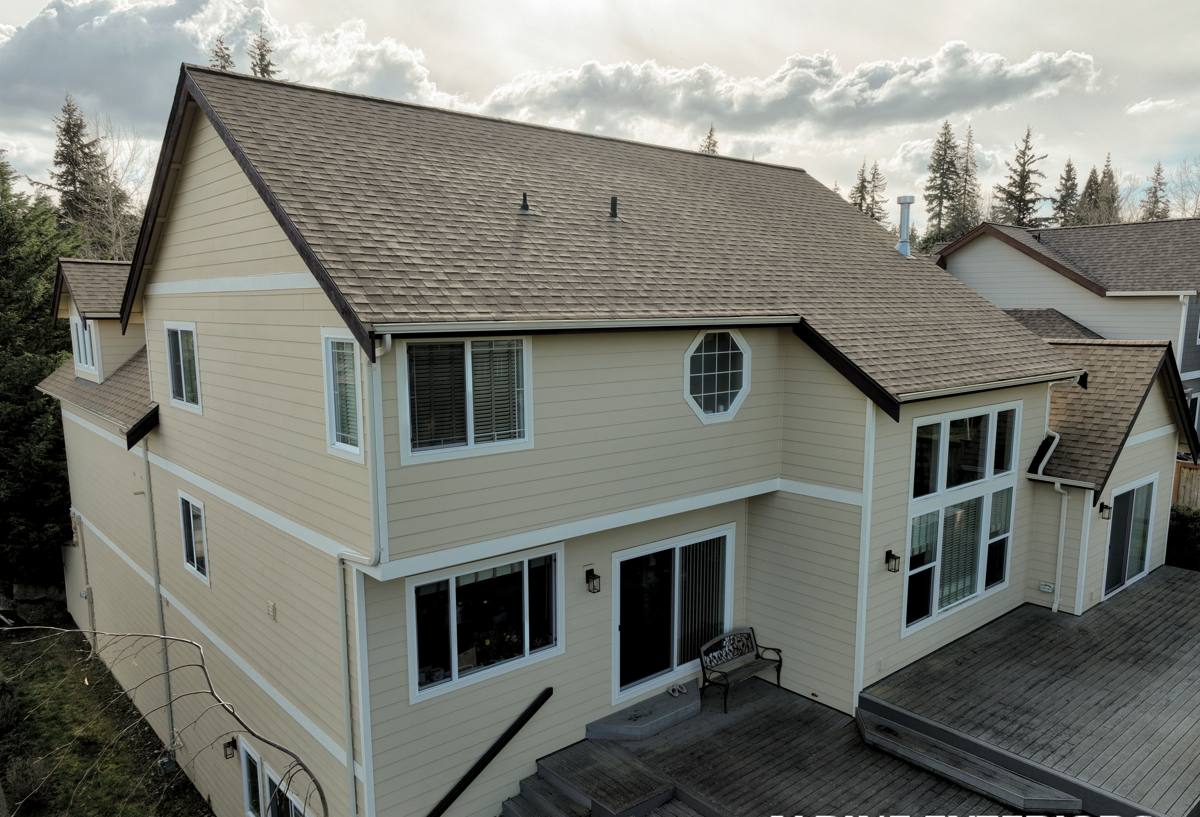
Signs a Blaine Home Actually Needs Siding Replacement
Not every issue calls for a full tear-off. But in a coastal climate, small problems compound quickly because moisture doesn't get a chance to fully dry out between storms. These are the signs we take seriously on a Blaine inspection:
- Soft or spongy spots when you press on the siding, especially near the bottom courses and around window trim
- Paint that's bubbling, peeling, or needs repainting more often than every 6-8 years
- Visible warping, buckling, or gaps opening up between boards or panels
- Persistent moss or dark streaking on north- and west-facing walls that comes back within a season of cleaning
- Rusting or corroding nail heads and trim fasteners bleeding rust streaks down the wall
- Rising energy bills with no other explanation, which often points to a failing weather barrier behind the siding
- Visible rot at butt joints, corners, or anywhere trim meets siding
If you're seeing two or more of these at once, it's usually a sign the underlying weather-resistive barrier has failed somewhere, not just that the surface material is tired. That distinction matters, because it changes what "correct" replacement looks like.
What a Correct Siding Replacement Actually Involves
A siding replacement done right is not just swapping old boards for new ones. In a climate like Blaine's, the layers you don't see matter as much as the siding itself.
Full Tear-Off, Not Overlay
We remove the old siding down to the sheathing rather than installing over it. Overlaying traps moisture that's already gotten in, hides existing rot, and voids the manufacturer warranty on the new material. In a coastal climate especially, whatever moisture damage is already present needs to be found and fixed, not sealed in.
Sheathing Inspection and Repair
Once the old siding is off, we inspect the sheathing for soft spots, delamination, or rot — most commonly around windows, doors, and the lower few feet of the wall where splash-back and standing moisture do the most damage. Damaged sheathing gets replaced before anything new goes on; installing new siding over compromised sheathing just resets the clock on the same failure.
Weather-Resistive Barrier and Flashing
This is the layer that does the real work of keeping wind-driven rain out. We install a continuous weather-resistive barrier with properly lapped and taped seams, then flash every window, door, and penetration so water is directed out and down, never trapped behind the cladding. Given how much wind-driven rain Blaine gets off the water, corner and window flashing detail is where a lot of lower-quality installs fail first.
Correct Fastening
Fastener choice and placement matter more here than in a drier climate. We use corrosion-resistant fasteners, follow manufacturer nailing patterns exactly, and pay attention to clearances — siding installed too tight to the ground, a deck, or a roofline holds moisture and invites both rot and moss growth.
Why We Install Only James Hardie Fiber Cement
We don't carry vinyl, LP SmartSide, primed spruce, cedar, or other fiber cement brands. That's a deliberate standard, not a limitation on options. In a salt-air, high-moisture climate like Blaine's, the material has to hold up to conditions that punish anything with a wood component or a plastic skin.
Vinyl expands and contracts more than fiber cement in temperature swings, can warp under direct sun exposure on south and west walls, and its seams and J-channels give wind-driven rain more opportunities to get behind the cladding. Wood-based products — including engineered wood siding and primed spruce or cedar — perform well when maintained perfectly, but in a climate where moss and moisture are a near-constant presence, that maintenance burden is real and the consequences of falling behind on it (rot, delamination, swelling) are severe.
James Hardie fiber cement is non-combustible, dimensionally stable, and doesn't feed mold or moss the way wood-based siding can. The ColorPlus factory finish is baked on under controlled conditions, which holds up better against salt air and UV than field-applied paint. Hardie's HZ5 product line is specifically engineered for climates with more moisture exposure, which fits Blaine better than a generic siding spec. It's also backed by a strong, transferable material warranty — something worth asking about no matter which contractor or product you choose.
Our Siding Replacement Process
- On-site inspection: We look at your current siding, trim, and — where accessible — the sheathing condition, and walk you through what we find in plain terms.
- Written estimate: A clear scope covering tear-off, sheathing repair allowances, Hardie product selection, and trim work, with no vague line items.
- Tear-off and sheathing repair: Old siding comes off, damaged sheathing gets replaced, and we document anything unexpected before closing the wall back up.
- Weather barrier and flashing installation: Continuous WRB, properly lapped and taped, with full flashing at every window, door, and penetration.
- Hardie siding installation: Installed to manufacturer specification — correct fastening, clearances, and joint treatment.
- Final walkthrough: We go over the finished work with you and cover basic care specific to your home's exposure.
What Siding Replacement Costs Depend On
Every home is different, so we won't quote a number without seeing the house, but these are the factors that actually move the price on a Blaine project:
| Factor | Why It Matters |
|---|---|
| Extent of sheathing damage found | Rot repair behind the old siding is common near the water and adds material and labor beyond the base tear-off |
| Home size and wall complexity | More corners, dormers, and trim details mean more cutting, flashing, and labor time |
| Siding profile chosen | Lap siding, shingle-style panels, and vertical board-and-batten each have different material and install time |
| Trim and accent work | Fascia, soffit, and window trim replacement alongside siding adds scope but avoids mismatched materials |
| Access and site conditions | Steep lots, limited driveway access, or multi-story walls affect equipment and labor time |
| Existing paint or coating removal | Some older siding requires extra prep or disposal handling depending on age and condition |
Because this is a permanent exterior investment, the right approach is usually to price the correct scope — sheathing repair included — rather than the cheapest version of the job. Patch-and-cover estimates that skip sheathing inspection tend to look better on paper and worse in five years.
Why Hiring a Crew That Already Works in Blaine Matters
Siding installation isn't uniform across Whatcom County. A crew that mostly works drier, inland jobs may not default to the flashing detail, fastener spec, or clearance standards that a coastal property actually needs. A crew that regularly works Blaine and the surrounding waterfront areas has already seen how salt air affects fasteners over time, how moss establishes on shaded walls, and where wind-driven rain typically finds its way in on this type of exposure. That familiarity shows up in the details — the ones you can't see once the siding is back on, but that determine whether the job lasts fifteen years or thirty.
It also matters for something more practical: a local crew can respond quickly if something needs attention after the install, without a long drive or a scheduling backlog.
Caring for Hardie Siding in a Coastal Climate
Correctly installed Hardie siding is low-maintenance, but "low-maintenance" isn't "no-maintenance," especially this close to the water. A simple annual routine goes a long way:
- Rinse siding annually with a garden hose to clear salt residue and airborne debris, focusing on walls facing the water
- Keep gutters clear so overflow doesn't run down the siding face repeatedly
- Trim back vegetation and tree cover on shaded walls to reduce the moss and mildew that thrive in constant dampness
- Address any caulking gaps around trim and penetrations promptly, before wind-driven rain can work its way behind them
- Repaint or touch up trim on the manufacturer's recommended cycle, even though the Hardie panels themselves hold their factory finish far longer
If your Blaine home is showing signs of siding failure — or you'd simply rather deal with it before winter storms roll back in — we're happy to take a look. The estimate is free, there's no pressure, and you'll get a straight answer about what your home actually needs. Use the form below to get started.