 Lynden Siding
 Acme's Setting Puts Extra Stress on Siding
Acme sits back in the foothills east of Lynden, where the Nooksack valley narrows and the tree canopy thickens. That setting is beautiful, but it changes how siding ages. Homes in town get more open sun and wind that dry a wall out between storms. Homes tucked in around Acme often sit in partial shade most of the day, which means rainwater and condensation stick around longer on the siding, the trim, and the wall behind it.
Add in Whatcom County's long wet season and the marine-influenced weather that rolls in off Bellingham Bay and pushes rain up the valley, and you get siding that stays damp for days at a stretch during fall and winter. That's the combination that drives moss growth, slow paint and finish breakdown, and — if water is finding its way behind the boards instead of running off them — rot in the sheathing and framing underneath.
None of that means siding in Acme is doomed. It means repairs need to account for shade, drainage, and moisture retention specifically, not just patch what's visible and move on.
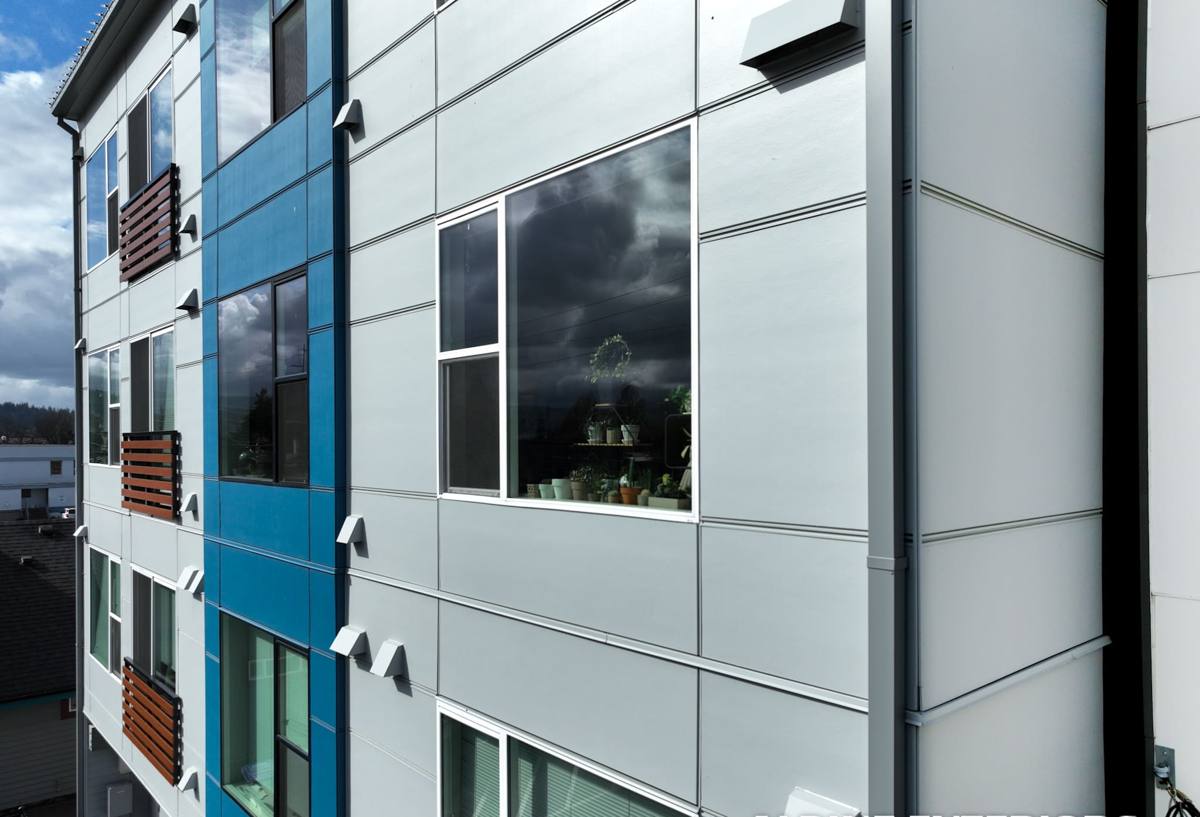
Signs an Acme Home Needs Repair, Not Just a Wash
A lot of siding problems out this way get mistaken for a cleaning issue. Moss and algae will come back fast if the underlying moisture problem isn't addressed, so it's worth knowing the difference between cosmetic buildup and a sign of real damage.
- Moss or dark streaking that returns within a few months of being cleaned off
- Soft or spongy spots when you press on the siding, especially near the bottom courses or under windows
- Paint or factory finish bubbling, peeling, or flaking in one concentrated area rather than evenly across a wall
- Visible gaps or separation at seams, corners, or trim where caulking has failed
- Siding boards that look swollen, warped, or slightly bowed compared to the boards around them
- A musty smell in an interior room that backs up to an exterior wall showing outside damage
- Staining on interior drywall or trim below or beside a suspect section of siding
Any one of these on its own might be minor. Several together, especially on a shaded, tree-covered wall, usually mean water has been getting behind the siding for a while.
What a Correct Siding Repair Actually Involves
Diagnose Before You Patch
The first job isn't swapping a board — it's figuring out why that board failed. That means checking the flashing above windows and doors, looking at how the weather-resistive barrier behind the siding is lapped, and confirming whether water is entering from a failed seal, a clogged gutter dumping water onto a wall, or vegetation holding moisture against the siding. Replacing a damaged board without fixing the cause just buys a year or two before the same repair is needed again.
Open It Up Enough to Know
Once we know roughly where the problem is, we remove enough siding to actually see the sheathing and framing behind it — not just the one board that looks bad. Rot spreads sideways along framing faster than it shows on the face of the siding, so a repair that only addresses the visible damage can leave hidden decay working behind the new material.
Rebuild the Water Path, Not Just the Surface
Correct flashing, properly lapped house wrap, and the right gap at the bottom of the siding for drainage matter more to the life of the repair than the siding material itself. We reinstall these details to code and to manufacturer spec before any new siding goes back on.
Match the Finish
For homes already sided in James Hardie fiber cement, we match the profile and, where possible, the ColorPlus factory finish so the repair blends in rather than becoming a visible patch. Field-painted touch-ups on ColorPlus siding rarely match the factory color exactly over time, so we're upfront about that trade-off before starting.
Repair or Replace? A Straight Answer
Homeowners in Acme often ask whether a problem area is worth repairing or whether it's a sign to plan for full replacement. There's no universal answer, but here's how we actually weigh it.
| Situation | Usually Repair | Usually Replace (at least that elevation) |
|---|---|---|
| Damage location | Isolated to one or two boards or a single wall section | Recurring across multiple walls or both stories |
| Underlying sheathing | Sound once opened up | Soft, delaminating, or rotted over a wide area |
| Siding age and material | Newer Hardie install with a localized flashing or impact issue | Original wood or aging composite siding nearing end of service life |
| Cause of failure | One-time event (impact damage, a single failed seal) | Systemic issue — grade sloping toward the house, chronic shade and moisture, poor original detailing |
When the damage is contained and the framing behind it is still sound, a targeted repair is the right call and the more cost-effective one. When we open a wall and find rot has been traveling along the framing for years, we'll say so — and we'd rather tell you that plainly than patch over a problem that's going to resurface.
What We Repair With
We install and repair James Hardie fiber cement siding exclusively. It's a non-combustible material engineered for the Pacific Northwest's wet, shaded conditions, and its HZ5 product line is built specifically for climates like ours — it holds up to sustained moisture exposure better than wood, and it doesn't feed moss and algae growth the way some materials do.
If your Acme home currently has wood, vinyl, or LP SmartSide siding, we can still assess and repair damaged sections in most cases, matching what's there as closely as possible. But if a repair conversation turns into a bigger question — because the existing siding is failing broadly rather than in one spot — our recommendation is Hardie fiber cement. We don't install vinyl, LP SmartSide, or unfinished wood siding as a rule, not because those products have no merit, but because on shaded, moisture-heavy properties like the ones common around Acme, we've seen where each of them tends to struggle: vinyl can trap moisture behind it and shows heat and impact damage more readily, LP SmartSide is an engineered wood product that depends heavily on unbroken factory sealing to resist rot, and bare wood needs a maintenance schedule most homeowners don't keep up with once the novelty wears off. Hardie's factory-baked ColorPlus finish and cement composition sidestep most of that.
Our Process for a Siding Repair Visit
- On-site inspection. We look at the full exterior, not just the spot you called about — problems in shaded, tree-covered areas often show up in more than one place.
- Diagnosis and scope. We identify the cause (flashing, drainage, seal failure, material fatigue) before quoting a fix, and we explain what we found in plain terms.
- Written estimate. You get a clear scope of work and cost before anything is opened up, with any uncertainty (like unknown sheathing condition) flagged honestly.
- Repair. We remove only what needs removing, correct the water management details behind the siding, and reinstall with matching material and finish where possible.
- Cleanup and walkthrough. We clear debris and walk the repair with you so you know exactly what was done and what to watch for going forward.
Cost Factors for Siding Repair Near Acme
| Factor | Why It Affects Cost |
|---|---|
| Extent of hidden damage | Rotted sheathing or framing behind the siding adds carpentry work beyond the siding itself |
| Access and site conditions | Tree cover, sloped lots, and rural driveways common around Acme can affect setup time and equipment access |
| Material match | Matching an existing Hardie profile and ColorPlus color adds sourcing time versus a full re-side |
| Height and roofline complexity | Second-story or steep-roof sections require additional staging or lift equipment |
| Number of affected areas | Multiple isolated repairs across a house cost more in aggregate than one contained section |
We won't quote a number without seeing the property — anyone who does, especially sight unseen, is guessing. What we can tell you honestly upfront is that a straightforward, contained repair costs meaningfully less than putting it off until the damage spreads.
Why It Matters to Hire a Crew That Already Works This Area
Acme isn't downtown Lynden. Properties out here tend to be larger, more wooded, and further off the main road, and a lot of the siding issues we see are tied directly to that setting — shade patterns, tree litter against walls, longer drying times after storms, and older homes where the original construction didn't account for how much moisture the site actually holds onto. A crew that's worked this stretch of Whatcom County knows to check those things by default instead of treating every property like a standard in-town lot.
It also means we're not adding a long drive as an afterthought or treating a rural repair call as low priority. We already serve Acme alongside Lynden and the surrounding communities, so scheduling and follow-up work the same way they would for a job in town.
Keeping a Repair From Becoming a Repeat Job
Once a repair is done, a little upkeep goes a long way in a shaded, tree-heavy setting like Acme. Trimming back branches and brush that hold moisture against the wall, keeping gutters clear so water isn't dumping onto a wall section, and rinsing moss or algae buildup before it takes hold again all reduce the chances of the same spot failing twice. None of that requires special equipment — it's mostly about not letting moisture sit against the siding longer than it has to.
If you're seeing moss, soft spots, or finish damage on your home near Acme, we're happy to take a look and give you a straight read on what's going on and what it would take to fix it right. Reach out for a free, no-pressure estimate — there's no obligation, and you'll walk away knowing exactly what your siding needs.