 Lynden Siding
 Siding Built for the Nooksack Climate
Nooksack sits in a stretch of Whatcom County where the weather doesn't do anything in half measures. Winters bring long stretches of driving rain that comes in sideways off the Strait, humidity that never fully lets up even in the dry months, and a moss and algae season that can run eight or nine months out of the year on north-facing walls and shaded elevations. Add in the salt-tinged air that moves inland from the Puget Sound and Georgia Strait on a west wind, and you have a climate that is genuinely hard on exterior building materials. Siding here isn't just decorative. It's the single largest weather barrier your house has, and in this specific pocket of the county, it takes a beating most siding products were never engineered to handle long-term.
We install siding for homes in and around Nooksack regularly, and the failure patterns we see are consistent: soft or delaminating panels at the bottom courses where splashback and standing moisture collect, caulk lines that gave up years before the siding did, and paint that chalked and faded well ahead of schedule on the sun-exposed south and west walls. None of that is a mystery once you understand what this climate actually does to a wall over ten or fifteen years.
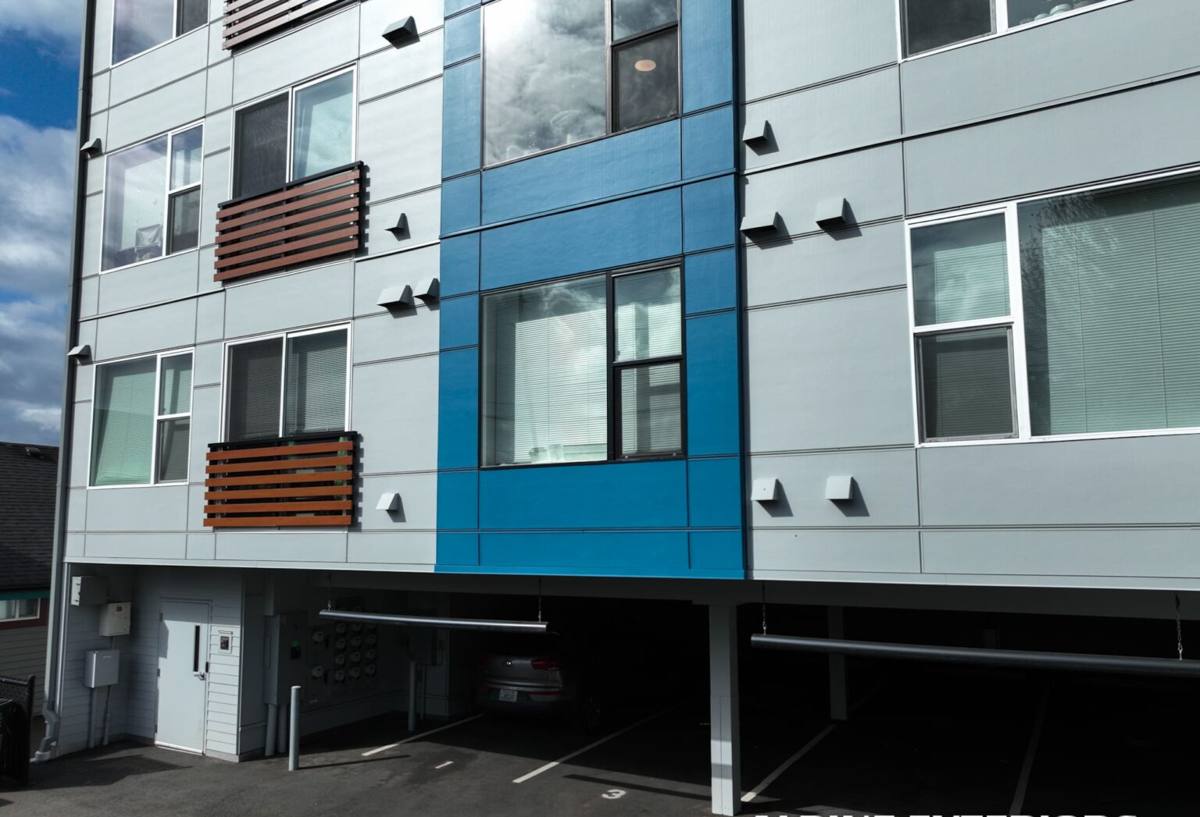
What Nooksack Homes Actually Need From Their Siding
Before talking about installation, it's worth being specific about what a house in this area needs its siding to do, because it's a longer list than most homeowners expect.
- Resist moisture absorption — not just shed rain, but resist soaking it up at cut edges, laps, and butt joints where wood-based and composite products are most vulnerable.
- Hold a factory finish — field-applied paint fails faster here than in drier climates; a factory-cured finish resists UV fade and moisture-driven peeling far longer.
- Shrug off moss and algae growth — organic growth needs constant moisture and shade, both of which Nooksack has in abundance for most of the year.
- Tolerate salt-influenced air — corrosion-resistant fasteners and trim matter more here than in inland parts of the county.
- Stay dimensionally stable — swelling and shrinking with seasonal moisture changes is what opens up seams and cracks paint lines over time.
This is exactly why we install James Hardie fiber cement siding exclusively. It's engineered specifically around moisture behavior, and Hardie makes a version of its product line — the HZ5 formulation — built for climates like ours, where freeze-thaw cycles and sustained damp weather are the norm rather than the exception.
Why We Don't Install Everything on the Market
Homeowners in Nooksack sometimes ask why we don't offer vinyl, LP SmartSide, primed wood, or cedar as options alongside Hardie. The honest answer is that we made a standard for our own work, and we stand behind it. Vinyl siding expands and contracts significantly with temperature swings, which over time works fasteners loose and opens gaps at seams — not a great match for a climate with constant moisture intrusion opportunities. Engineered wood products like LP SmartSide perform well when installed and maintained exactly to spec, but they're wood-based, meaning any breach in the factory treatment or field-applied caulking gives moisture a path into the substrate, and repairs are rarely invisible. Primed wood and cedar are beautiful materials, but they demand a maintenance schedule — recoating, caulking, spot repairs — that most homeowners underestimate until they're three years in and already behind on it.
None of those products are "bad." They're reasonable choices for the right owner in the right climate with the right maintenance commitment. But we install roofs and walls that have to survive Whatcom County weather for decades with minimal upkeep, and that's a narrower set of requirements than "works fine somewhere." Fiber cement, and James Hardie specifically, is what we've found holds up to that standard without asking the homeowner to become a part-time siding technician.
What Correct Installation Actually Involves
Siding installation done right is mostly invisible — the parts that matter most are underneath the finished product. A huge share of the premature siding failures we get called out to inspect in this area trace back to installation shortcuts, not the material itself.
Weather-Resistive Barrier and Flashing
Every wall gets a properly lapped weather-resistive barrier before any siding goes up, with flashing integrated at every window, door, and penetration so water is directed out and down, never trapped behind the cladding. In a climate that gets as much sustained wet weather as Nooksack does, this layer matters as much as the siding itself.
Rainscreen Gap Where It Counts
On many installations, especially where wall assemblies face prevailing wind-driven rain or sit close to grade, we build in a drainage gap behind the siding so any moisture that does get past the outer layer has somewhere to go besides straight into the sheathing.
Correct Clearances
James Hardie's own installation instructions specify minimum clearances from grade, roof lines, decks, and patios — typically several inches minimum, more where consistent splashback or snow load is a factor. We hold those clearances even when it means adjusting trim or grading details, because the bottom courses are where nearly every siding failure we inspect actually starts.
Fastening Pattern and Fastener Choice
Hardie panels and lap siding have specific fastener spacing, embedment depth, and corrosion-resistance requirements. In a salt-influenced air environment, we use fasteners rated for that exposure rather than whatever's cheapest at the supply house — a detail that's invisible on install day and very visible in a rust-streaked wall five years later if it's skipped.
Joint and Butt Seam Treatment
Every horizontal and vertical joint gets treated per manufacturer spec, with the right combination of flashing, caulk, or H-molding depending on the product line. Sloppy joint work is one of the most common shortcuts we find on inspections, and it's one of the fastest ways for a paint-worthy install to turn into a moisture problem.
Our Process for a Nooksack Installation
- On-site assessment — we walk the property, check existing wall condition, drainage, grade clearances, and any moisture damage already present.
- Product and profile selection — lap siding, panel, or a mix, in the HZ5 formulation, with color and texture options reviewed on-site in real light.
- Tear-off and substrate check — old siding comes off, sheathing gets inspected for hidden rot or damage before anything new goes up.
- Weather barrier and flashing install — the part nobody sees but everything depends on.
- Siding installation to Hardie spec — correct fasteners, clearances, and joint treatment throughout.
- Trim, caulking, and final detailing — corners, window and door surrounds, and transitions finished cleanly.
- Walkthrough — we go over the finished work with the homeowner before calling the job done.
Why Hiring a Crew That Already Works Nooksack Matters
Installation quality is only half the equation — the other half is whether the crew understands the specific conditions of this area before the first panel goes up. A crew that mostly works drier inland climates may not think twice about grade clearances that are marginal here, or may not automatically reach for corrosion-resistant fasteners because it's never bitten them before. A crew that regularly works Nooksack and the surrounding Lynden area knows where moss tends to establish first, which elevations take the worst of the wind-driven rain, and where drainage details need extra attention because of how local lots are graded. That local pattern recognition doesn't show up on a spec sheet, but it shows up in how long the job lasts.
Comparing Siding Options for This Climate
| Factor | Vinyl | LP SmartSide / Engineered Wood | Cedar / Primed Wood | James Hardie Fiber Cement |
|---|---|---|---|---|
| Moisture resistance | Good surface resistance, seams vulnerable | Good if maintained perfectly | Requires diligent maintenance | Engineered specifically against moisture damage |
| Finish durability | Fades over time, cannot be repainted easily | Field-applied finish wears faster | Needs recoating on a schedule | Factory ColorPlus finish holds color for years |
| Moss/algae resistance | Moderate | Moderate | Low without treatment | High, especially with proper install detailing |
| Maintenance burden | Low but limited repair options | Moderate to high | High | Low |
| Fire resistance | Low, can melt/deform | Moderate | Low, combustible | Non-combustible |
A Pre-Install Checklist We Walk Through With Every Homeowner
- Confirm grade and hardscape clearances meet or exceed Hardie's minimum spec
- Identify any existing moisture or rot damage before covering it back up
- Review drainage plane and rainscreen needs for the specific elevations
- Select the right HZ formulation and profile for sun, wind, and moisture exposure on each wall
- Confirm fastener type is rated for salt-influenced coastal air exposure
- Plan flashing details at every window, door, and roofline transition
- Set expectations on timeline around Whatcom County's wetter months
Timing an Installation Around Whatcom County Weather
Siding can be installed across most of the year here, but stretches of sustained heavy rain slow the schedule and matter more for this trade than most people assume — flashing and weather barrier work needs a reasonably dry window to be installed correctly, not just installed. We plan around realistic weather windows rather than rushing details to hit a date, because a flashing detail installed in a downpour is a detail that has to be redone.
What a Correct Installation Means for the Long Run
The payoff for doing all of this correctly isn't cosmetic — it's fewer callbacks, fewer moisture surprises behind the wall, and a finish that still looks factory-fresh well past the point where a lesser install would already be chalking, staining, or growing moss in the shaded corners. James Hardie backs its products with a strong transferable limited warranty, but a warranty on the material doesn't cover a bad flashing detail or a fastener pattern that missed spec — the installation has to match the product for either of those guarantees to mean anything in practice.
If you're weighing a siding project for a home in Nooksack or elsewhere around Lynden, we're happy to come take a look, walk the property with you, and put together a straightforward, no-pressure estimate based on what your specific walls and exposure actually need.