 Lynden Siding
 Deck Repair Built for Nooksack's Weather, Not a Generic Checklist
Nooksack sits close enough to the water and the valley floor that decks here take a specific kind of beating. Driving rain off the Strait works its way sideways under flashing and railing posts. Salt-tinged air speeds up corrosion on fasteners and hardware faster than most homeowners expect. And the long, gray moss season — often six months or more of the year — keeps deck boards damp long after a storm has passed. A deck repair that doesn't account for all three of those factors tends to fail again within a year or two. We've spent years working on homes throughout this part of Whatcom County, and the repairs we do here are built around what actually happens to wood, fasteners, and composite decking under these specific conditions.
This page is about deck repair specifically — not full deck replacement, not new construction. Most decks we're called out to in Nooksack don't need to be torn out and rebuilt. They need targeted, correctly executed repair: the right boards replaced, the right hardware upgraded, the right moisture pathways closed off.
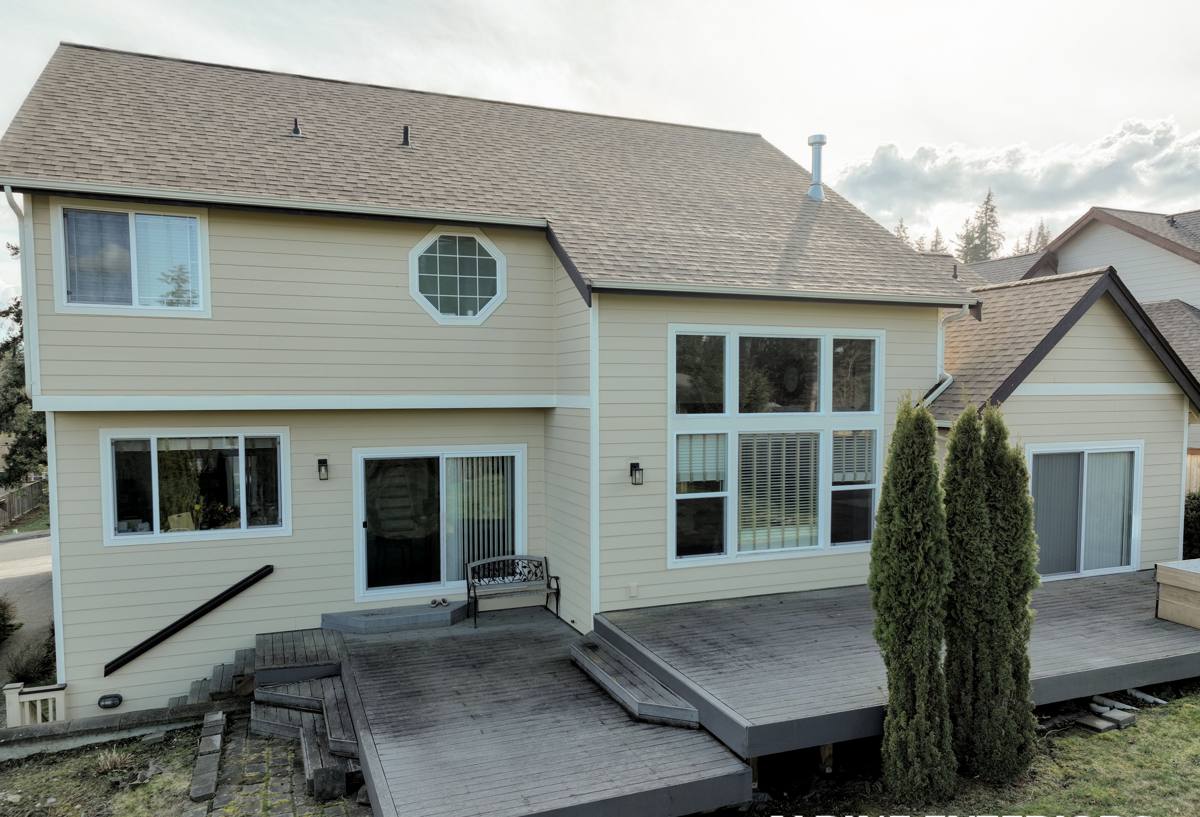
What Nooksack's Climate Actually Does to a Deck
Moss and Prolonged Dampness
Moss doesn't just look bad — it holds moisture against the wood surface far longer than open air would. On a deck with poor drainage or boards installed too tight together, moss growth accelerates rot at the board edges and around fastener heads, which is usually where the wood is already most vulnerable. In our experience, a deck that's shaded by trees or the house itself and gets heavy moss coverage will show rot years before an identical deck in full sun.
Driving Rain and Wind-Driven Moisture
Storms coming off the water don't fall straight down — they come in sideways. That matters because it pushes water into places a standard rain wouldn't reach: under railing base plates, behind ledger board flashing, into the end grain of boards that butt up against the house. End grain soaks up water many times faster than the face of a board, which is why so much deck rot starts at board ends and stair stringer cuts rather than in the middle of a run.
Salt Air and Hardware Corrosion
Even away from the immediate waterfront, salt-laden air carried inland corrodes standard fasteners, joist hangers, and railing brackets faster than it would in a dry inland climate. Once a fastener starts rusting, it loses grip strength in the wood around it, and the resulting movement widens the hole and lets in more water — a cycle that speeds itself up. We see this most often on older decks built with galvanized (rather than stainless or coated) hardware.
What a Correct Deck Repair Actually Involves
A lot of deck "repair" is really just cosmetic patching — sistering a board here, tightening a rail there. That can be fine for minor issues, but it's not adequate when the underlying structure has been compromised. Here's how we approach it:
- Full structural inspection first. We check ledger board attachment, joist condition, post bases, and stair stringers before touching decking boards. Surface rot on a board is often a symptom, not the whole problem.
- Probe for hidden rot. A screwdriver or awl test at ledger connections, post bases, and anywhere water pools tells us more than a visual inspection alone. Wood can look sound on the surface and be soft an inch below.
- Identify the moisture source, not just the damage. Replacing a rotted board without fixing the flashing or drainage issue that caused it just resets the clock on the same failure.
- Match repair to actual load-bearing needs. Structural members (joists, beams, posts) get repaired or replaced to code-equivalent standards, not just enough to look finished.
- Upgrade hardware where it's failing. If we find corroded galvanized fasteners, we replace them with stainless or heavily coated hardware rated for coastal exposure, not a like-for-like swap of the same material.
Common Nooksack Deck Repairs We Handle
- Rotted decking boards, especially at ends and around fastener lines
- Soft or failing ledger board connections where the deck meets the house
- Corroded or failing joist hangers and structural hardware
- Loose, wobbly, or rotted railing posts and balusters
- Stair stringer rot, particularly at ground contact points
- Moss and algae buildup contributing to slick, deteriorating surfaces
- Drainage issues that trap water against framing or the house wall
- Fastener pop, board cupping, and surface checking from repeated wet-dry cycles
Wood vs. Composite: What Repair Looks Like for Each
Nooksack has a mix of older wood decks and newer composite installs, and repair looks different depending on which you have.
| Factor | Wood Decking | Composite Decking |
|---|---|---|
| Typical failure mode | Rot at ends, fastener holes, and shaded/mossy areas | Substructure (joist) rot underneath; surface itself rarely rots |
| Repair approach | Replace individual boards; treat cut ends before reinstall | Inspect framing carefully since surface can hide problems below |
| Moss/mold response | Can stain and soften wood fibers over time | Grows on the surface but doesn't structurally weaken the board |
| Hardware needs | Standard deck screws often insufficient long-term near the coast | Manufacturer-specified fasteners matter for warranty compliance |
| Longevity after repair | Depends heavily on wood species and finish maintenance | Longer board life, but framing beneath still needs periodic inspection |
One thing we won't do is patch a composite deck's surface without checking the wood framing underneath. Composite boards can look perfectly fine while the joists supporting them are quietly rotting from years of trapped moisture — that's a structural safety issue, not a cosmetic one, and it's the kind of thing a surface-level repair will miss entirely.
Our Process for a Nooksack Deck Repair
We keep this straightforward because deck repair shouldn't require a lot of back-and-forth to understand:
- On-site assessment. We walk the deck, probe suspect areas, and check the substructure — not just what's visible from the top.
- Honest scope and options. We tell you what actually needs repair versus what's cosmetic, and what happens if you defer either.
- Written estimate. Clear line items, no vague allowances buried in a lump sum.
- Repair work. Structural fixes first, then decking, then railings and finish details.
- Walkthrough. We show you what was replaced and why, and flag anything worth watching going forward.
Signs You Likely Need a Deck Repair Call
- Boards that feel spongy or flex noticeably underfoot
- Visible gaps or movement where the deck meets the house
- Railings that wobble or shift when pushed
- Persistent moss or dark staining that doesn't clear with cleaning
- Rust streaks running down from fastener heads or hardware
- Stair treads that feel less solid than they used to
What Repair Typically Costs — and What Drives the Range
Exact pricing depends on what we find once we're on-site, but the main cost drivers on a Nooksack deck repair are generally the same handful of factors:
| Cost Factor | Why It Matters |
|---|---|
| Extent of hidden rot | Structural repairs (joists, ledger, posts) cost more than surface board swaps |
| Decking material | Composite material costs more per board than standard wood replacement |
| Hardware condition | Full hardware upgrades add cost but prevent repeat failures near salt air |
| Access and deck height | Elevated decks or tight access sites take longer to work safely |
| Railing and stair scope | Code-compliant railing repair can involve more than a simple tighten-and-patch |
Small repairs — a handful of boards, a loose rail — are often a modest, contained cost. Repairs involving ledger board or joist rot cost more because they require removing decking to access the structure properly. We'll always tell you which category your project falls into before work starts, not after.
Why Hire a Crew That Already Works in Nooksack
Deck repair isn't a one-size-fits-all trade skill. A contractor who mostly works dry-climate builds may not think to check for the specific rot patterns that show up after a Whatcom County winter, or may default to standard hardware that won't hold up long-term near the coast. Working regularly in and around Lynden and Nooksack means we've seen how local moisture, moss, and salt air interact with different deck materials over multiple seasons — not just at the moment of installation, but years later when the first signs of trouble show up. That's the difference between a repair that resets the problem and one that actually solves it.
If you've got a deck showing soft spots, moss buildup, wobbly rails, or hardware that's clearly seen better days, we're happy to take a look. We offer a free, no-pressure estimate — just fill out the form below and we'll get back to you to schedule a time that works.