 Lynden Siding
 Why Ferndale Decks Wear Out Faster Than the Manual Says
Every deck comes with a lifespan estimate printed somewhere in the builder's paperwork. In Ferndale, that number is more of a suggestion than a guarantee. Sitting close to Bellingham Bay and the open water of the Salish Sea, this part of Whatcom County gets a steady dose of salt-laden air, wind-driven rain, and a wet season that can stretch from October well into spring. That combination doesn't just make decks look tired — it actively speeds up the mechanical failures that make a deck unsafe.
Salt air is corrosive to metal in ways that inland homes never have to think about. Driving rain gets pushed sideways into places a deck was never designed to shed water from — under railings, behind ledger boards, into end grain. And the long stretch of gray, damp weather each year gives moss and algae months to take hold on any surface that doesn't dry out quickly. None of this means a Ferndale deck is doomed. It means repairs here have to account for conditions that a generic repair job, done the same way you'd do it in a dry inland climate, simply won't hold up against.
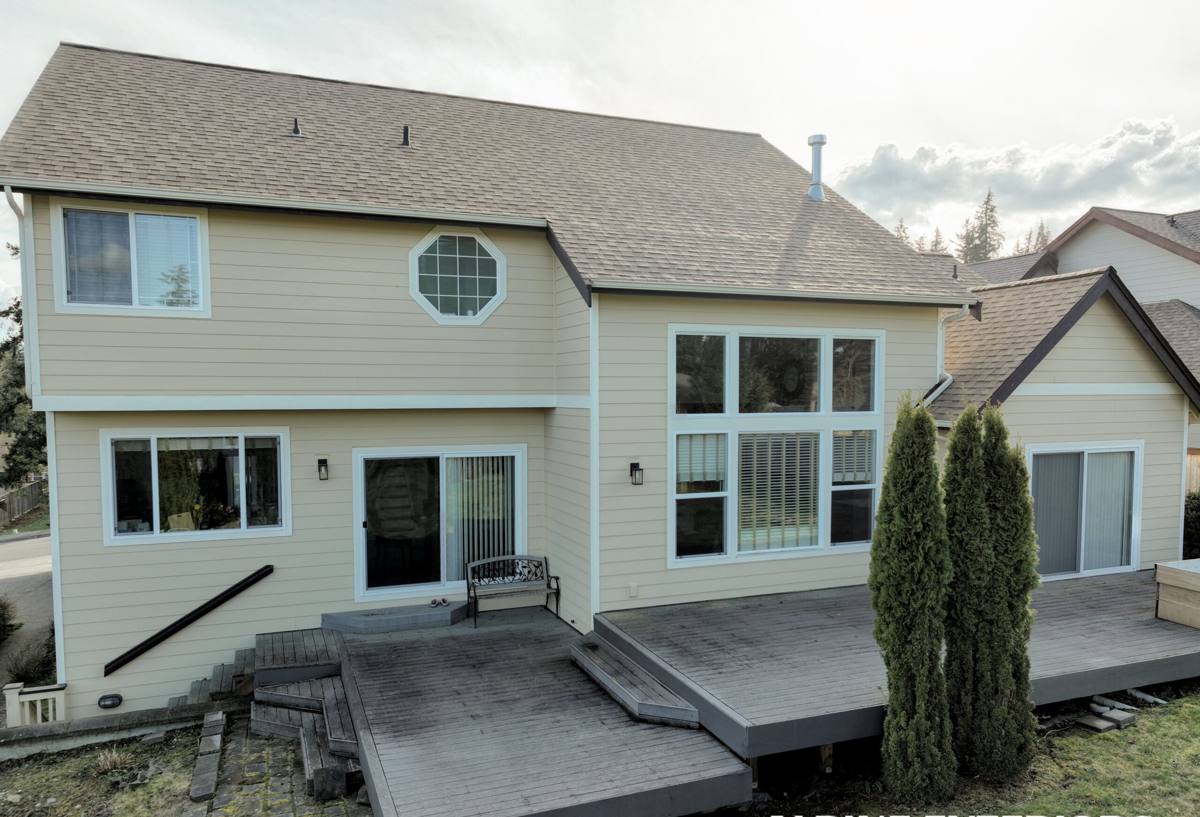
Where the Damage Actually Starts
The Ledger Board and House Connection
The ledger board — the piece that bolts your deck to the house — is the single most common failure point we find, and it's usually hidden until we pull decking or siding back to look. Water works its way behind flashing that was installed too thin, too short, or without the right lap sequence, and the wood behind it starts to rot from the inside. Because it's out of sight, homeowners often don't know there's a problem until the deck starts to feel spongy or pulls slightly away from the house.
Framing, Joists, and Fasteners
Joist hangers, nails, and screws take a beating from salt-tinged moisture. Standard galvanized coatings that hold up fine forty miles inland can start showing rust streaks and pitting within a few years this close to the water. Once a fastener corrodes, it loses grip strength long before it looks obviously broken — which is why a deck can feel structurally fine and still be one bad storm away from a real problem.
Decking Boards and Surface
Wood decking absorbs water at end cuts, screw holes, and anywhere the factory sealant has worn through. In a climate that rarely gives boards enough consecutive dry days to fully release that moisture, cupping, splitting, and soft spots show up faster than the lumber's rated lifespan would suggest.
Railings, Stairs, and Posts
Railing posts and stair stringers are load-bearing but often get the least attention until something wobbles. Post bases that sit in standing water, or stringers notched without any protection at the cut, are frequent failure points we find during inspections.
Common Repairs We See Around Ferndale
| What's Happening | How It Shows Up | Typical Fix |
|---|---|---|
| Ledger board rot | Deck feels slightly loose at the house, gaps at flashing | Pull back decking/flashing, replace rotted wood, re-flash properly, re-bolt to code |
| Corroded fasteners | Rust streaks on decking, loose joist hangers | Replace with stainless or hot-dip galvanized hardware rated for coastal exposure |
| Cupped or soft decking boards | Boards feel spongy, water pools instead of shedding | Spot-replace individual boards or resurface with new decking |
| Moss and algae buildup | Green-black film, slick surface especially in shade | Deep clean, correct drainage/airflow issues causing the buildup to return |
| Loose or unsafe railings | Wobble under hand pressure, visible post movement | Reinforce or replace posts, upgrade to properly rated connectors |
| Stair stringer wear | Flex underfoot, visible checking at the cuts | Sister or replace stringers, add flashing at exposed cuts |
Repair or Replace? How We Help You Decide
Not every damaged deck needs to come down. A lot of what we see is fixable, and we'd rather tell a homeowner the truth about that than push a full rebuild that isn't necessary. But there's a point where patching stops making financial sense, and we walk through that math honestly during the inspection.
| Factor | Leans Toward Repair | Leans Toward Replacement |
|---|---|---|
| Ledger board condition | Solid or only locally affected | Widespread rot along the house connection |
| Framing/joists | Isolated corrosion or damage | Multiple joists compromised or undersized for current code |
| Decking surface | A few problem boards | Most of the surface cupped, splitting, or delaminating |
| Age of original build | Under 10-15 years, built to a reasonable standard | Older build with outdated hardware or footing depths |
| Homeowner goals | Want to preserve existing footprint/design | Want to change layout, size, or switch materials entirely |
Our Process for a Ferndale Deck Repair
- Full inspection first. We check the ledger connection, crawl under the deck to look at framing and fasteners, and test decking and railings by hand — not just a visual walk-around.
- Honest assessment. We tell you what's actually wrong, what's cosmetic versus structural, and what happens if it's left alone through another wet season.
- Written scope and estimate. No vague "we'll see once we open it up" language on the parts we can already see and test.
- Repair with climate-appropriate materials. Corroded fasteners get replaced with hardware rated for coastal exposure, not just swapped for the same grade that failed.
- Correct water management. Any repair near the ledger or framing includes fixing the flashing and drainage path, not just patching the wood and leaving the cause in place.
- Final walkthrough. We show you what was done and what to keep an eye on going forward.
Materials We Use — and Why It Matters Here
In a coastal-influenced climate, the material choice matters as much as the workmanship. We use fasteners and hardware rated for exterior, corrosion-prone environments — stainless steel or hot-dip galvanized, depending on the application — rather than standard electroplated hardware that's fine in a dry climate but starts failing early here. For framing repairs, that means pressure-treated lumber rated for ground or moisture contact where it's relevant, not a lighter-duty grade that saves a few dollars up front.
For decking surfaces, we'll talk through wood versus composite honestly. Wood is often the right call when it matches the rest of the home or the homeowner prefers it, but it does need more attention — sealing, cleaning, and periodic inspection — to hold up against this area's wet season. Composite decking costs more upfront but sheds moisture differently and doesn't need staining, which is worth discussing if you're tired of fighting the same moss and rot cycle every year. We'll give you our honest read on which fits your situation rather than pushing whichever is easier for us to install.
Moss Season: What Homeowners Can Do Between Visits
Ferndale's moss season is long, and a deck that sits in partial shade near mature trees or close to the water gets the worst of it. Moss doesn't just look bad — it holds moisture against the wood and turns the surface into a slip hazard, especially on stairs. A few habits go a long way between professional cleanings or inspections:
- Sweep leaves and debris off the deck regularly, especially in fall — trapped organic matter is what moss feeds on
- Keep gutters and downspouts clear so roof runoff isn't dumping extra water onto or near the deck
- Trim back overhanging branches to let more light and airflow reach shaded sections
- Rinse visible algae or moss growth before it gets thick and embedded in the wood grain
- Check railings and stair treads by hand periodically for movement, not just visually
- Watch for standing water after storms — pooling anywhere on the deck means a drainage or slope problem worth having looked at
Why Hiring a Crew That Already Works in Ferndale Matters
Deck repair isn't one-size-fits-all, and a crew that mostly works drier inland areas can miss the specific failure patterns that show up this close to the water. We've seen how salt air chews through standard hardware, how moss takes hold in the shaded, low-airflow spots that are common on Ferndale lots, and where flashing tends to fail first on homes built to older coastal-adjacent standards. That familiarity means fewer surprises during the repair and a fix that's built for the conditions your deck actually faces, not the conditions a generic spec sheet assumes.
It also means we're not guessing at permit or setback questions specific to Whatcom County jurisdictions, and we're not learning on your project what materials hold up here versus what fails in a season or two.
If your deck has soft spots, rust streaks, stubborn moss, or just doesn't feel as solid as it used to, we're happy to take a look. Estimates are free and there's no pressure — just an honest read on what's going on and what it would take to fix it right. Reach out through the form below to get started.