 Lynden Siding
 Building Decks for Birch Bay's Coastal Conditions
Birch Bay sits right on the water, and that changes what a deck has to survive. A deck built to a generic spec sheet might hold up fine twenty miles inland, but out here it's dealing with salt-laden air blowing off the bay, wind-driven rain that gets up under railings and ledger boards, and a moss season that runs longer than almost anywhere else in Whatcom County. We build decks in this area regularly, and the difference between a deck that looks good for two years and one that looks good for fifteen almost always comes down to material choice, fastener selection, and how the structure handles moisture at the connection points.
This page is specifically about deck building for homes in and around Birch Bay. If you're comparing options for a new deck, a replacement, or a rebuild after storm or rot damage, this covers what actually matters for a property in this microclimate.
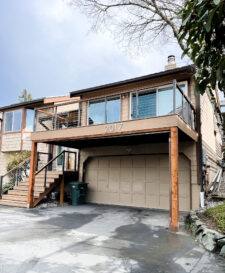
What Salt Air and Coastal Moisture Do to a Deck
Salt air isn't just a nuisance — it accelerates corrosion on anything metal and speeds up the breakdown of certain finishes. On a deck, that shows up in a few predictable places:
- Standard fasteners and hardware corrode faster near the bay than they would a few miles inland, which weakens connections over time if the wrong grade of hardware was used.
- Wind-driven rain pushes moisture sideways, not just down, so it gets behind fascia boards, into end grain, and under poorly flashed ledger connections.
- Constant damp air combined with shade from trees or the house itself keeps deck surfaces wet longer between dry spells, which is exactly what moss and algae need to take hold.
- Freeze-thaw cycles, while milder here than inland, still stress joints and fasteners that are already compromised by corrosion or trapped moisture.
None of this means a deck near Birch Bay can't last — it means the build has to account for these conditions from the framing up, not just at the surface finish.
Getting the Structure Right First
Fasteners and Hardware
This is where a lot of decks fail early, and it's invisible until something gives way. In a coastal environment, we use stainless steel or high-grade coated fasteners and structural hardware rated for corrosive exposure, not the standard hot-dip galvanized hardware that's fine in drier, inland parts of the county. It costs more up front. It's also the single biggest factor in whether your deck's structure is still sound in ten years.
Ledger Board Flashing
The ledger board — where the deck attaches to the house — is the single most common point of rot failure on any deck, and it's worse near the water. Proper flashing (metal flashing plus a waterproof membrane behind it) keeps rain from wicking into the house's rim joist and the deck's structural attachment point. This is not an optional detail; it's the difference between a deck that stays structurally attached to your home and one that quietly rots at the connection over several winters.
Joist and Beam Protection
Even with pressure-treated lumber, cut ends and drilled holes expose untreated wood. We seal cut ends and treat exposed framing with a wood preservative before it's covered or buried against the house, which matters more here than in a drier climate where that untreated wood would dry out between rains.
Decking Material Comparison for Birch Bay Conditions
Every decking material handles salt air, rain, and moss differently. Here's an honest comparison for a coastal Whatcom County property:
| Material | Moisture/Salt Air Behavior | Moss & Algae Resistance | Maintenance |
|---|---|---|---|
| Pressure-treated wood | Good if sealed regularly; end grain and fastener holes are vulnerable points | Needs periodic cleaning and treatment to stay ahead of moss | Annual inspection, re-sealing every 1-2 years |
| Cedar | Naturally rot-resistant but still needs finish protection near salt air | Moderate — natural oils help but don't stop moss long-term | Regular oiling or staining, more frequent than composite |
| Composite decking | Doesn't absorb moisture like wood, handles salt air well | Better resistance, but shaded/damp areas can still grow algae film | Occasional washing, no sealing or staining required |
| PVC decking | Fully moisture-resistant, best option directly exposed to bay winds | Best resistance of the group | Lowest — periodic washing only |
There's no single "correct" material for every project — it depends on your budget, how exposed the deck is to wind off the water, and how much upkeep you want to do. What matters is choosing with eyes open rather than assuming a material will perform the same here as it would somewhere drier and further from the bay.
Design Choices That Matter More Near the Water
Airflow Under and Around the Deck
Decks built low to the ground or tight against the house without adequate airflow trap moisture underneath, which is exactly what accelerates rot and gives moss a foothold. We plan clearance and ventilation into the framing layout rather than treating it as an afterthought.
Railing and Post Hardware
Railings take the brunt of wind-driven rain and salt spray, especially on decks with any water-facing exposure. Post bases and railing brackets are a common weak point if standard hardware is used — the same corrosion-resistant standard applies here as it does to the structural fasteners below deck.
Surface Drainage and Board Spacing
Correct board spacing lets water shed instead of pooling, which matters more in a climate that sees frequent rain rather than occasional heavy storms. Pooled water on deck boards is one of the most common causes of premature moss growth and surface staining.
Our Process for a Birch Bay Deck Project
- On-site assessment — we look at sun exposure, wind direction relative to the bay, existing drainage, and how close the deck will be to shade or tree cover, since all of these affect the moss and moisture equation differently on every lot.
- Material and design conversation — we walk through the trade-offs above in plain terms so you're choosing based on your budget and how much maintenance you actually want to do, not a sales pitch toward the most expensive option.
- Structural build — proper ledger flashing, corrosion-resistant hardware, and treated or sealed framing throughout, done to hold up to the conditions specific to this area, not a generic inland spec.
- Decking and railing installation — installed with attention to spacing, drainage, and airflow so the finished deck sheds water instead of holding it.
- Walkthrough — we go over what maintenance your specific material choice actually needs so you know what to expect in year one versus year five.
Why a Local Crew Matters for This Job
A contractor who mostly works inland or in drier parts of the state doesn't build the same way we do out here — not because of skill, but because they haven't had to watch what happens to a deck near the bay over several wet seasons. We work in Lynden and the surrounding Whatcom County communities, including Birch Bay, and we've seen what corrodes, what rots, and what grows moss first when it's built the wrong way. That's not a marketing line — it's the reason we spec hardware and flashing the way we do, and it's why we can tell you honestly which shortcuts will cost you a rebuild in a few years.
Maintenance Checklist for a Coastal Deck
Whatever material you choose, a few habits go a long way toward getting the lifespan you're paying for:
- Rinse salt residue and debris off the deck surface a few times a year, especially after storms.
- Clear leaves and organic debris from between boards and in corners before they trap moisture.
- Inspect railing posts and ledger flashing annually for early signs of corrosion or water staining.
- Treat or clean for moss at the first sign of growth rather than waiting until it's established.
- Reseal wood decking on the schedule appropriate to your finish — don't wait for visible graying or cracking.
- Keep gutters and downspouts on the house clear so runoff isn't dumping extra water onto the deck.
Getting Started
If you're planning a new deck or need to replace one that's showing its age, we're happy to come take a look and give you a straightforward, no-pressure estimate. We'll walk the site, talk through material options honestly, and give you a clear picture of what the job involves before any commitment is made — just fill out the form below to get started.