 Lynden Siding
 Composite Decking for Laurel: Building for Whatcom County's Marine Climate
Laurel is a small, rural community in the low farmland between Lynden and Bellingham, the kind of place where properties tend to sit on larger lots, often with mature trees, open pasture, or an older farmhouse footprint rather than a tight subdivision layout. It's set back from the water compared to towns right on Bellingham Bay or the Strait, but it still sits well within the reach of the same marine weather pattern that shapes exterior work across Whatcom County — salt-tinged air moving in off the Sound, driving rain through fall and winter, and a moss season that runs long on shaded, low ground. A deck has no wall or roofline protecting it from any of that; it takes the climate head-on, every day, in a way that siding and roofing don't.
Composite decking holds up to that kind of exposure far better than wood does, but the category covers a wide range of quality, and a generic deck design dropped onto a Laurel property without accounting for its specific setting — flat, low ground, mature shade, sometimes a septic system to work around — tends to develop problems earlier than it should. This page covers what a Laurel deck actually needs from its materials and construction, what a correct build involves, and how our process works for a composite deck project in this part of Whatcom County.
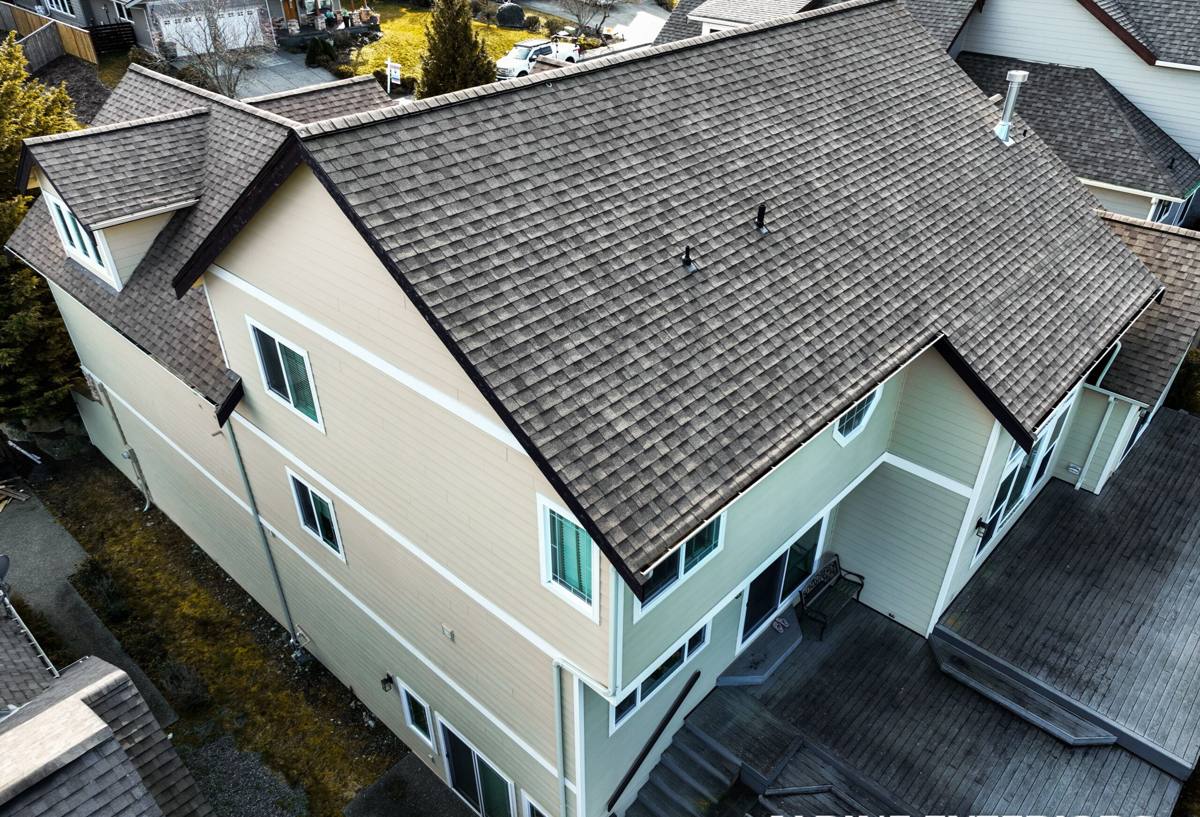
What Laurel's Climate and Setting Do to a Deck
Salt-Tinged Marine Air, Even This Far Inland
Laurel isn't a waterfront community, but Whatcom County as a whole sits close enough to the Sound and the Strait that salt-laden marine air reaches well inland, especially with weather systems moving through from the west. That air accelerates corrosion in exposed metal — fasteners, brackets, railing hardware — whether a property is a mile from the water or several. A fastener that starts corroding loses holding strength long before it looks obviously bad, which matters on a structure people walk and stand on every day.
Driving Rain on Flat, Low Ground
Laurel sits in the flatter, lower part of the county, in farmland shaped by the Nooksack River system, and low ground holds water differently than a sloped lot does. Storms here don't just drop rain straight down — wind pushes it sideways into ledger connections, under railings, and between deck boards that aren't gapped correctly. On flat terrain, water that gets under or around a deck also has less natural grade to drain away on, so standing moisture beneath the structure can linger longer after a storm than it would on higher ground.
A Long Moss Season Under Mature Trees
Many Laurel properties carry mature trees — windbreaks, orchard remnants, established shade — left over from decades of farm use, and that shade combines with mild temperatures and steady moisture to give moss and mildew a long growing season. A deck surface is one of the first places it takes hold, since it holds water longer than a vertical wall and stays damp between rain events. Shaded decks, and any decking material with even a little surface porosity, tend to show it first.
Why Composite Decking Fits This Climate
Capped vs. Uncapped Composite
Capped composite boards wrap a wood-plastic composite core in a protective plastic shell, which resists moisture absorption, staining, and UV fade far better than the core material alone. Uncapped composite is the older style of the product, with the wood-plastic blend exposed on all sides — it absorbs more moisture and is more prone to fading and mold growth over time. In a climate with this much sustained dampness and shade, that difference shows up faster than it would somewhere drier, which is why we standardize on capped composite for Laurel installs.
Where PVC Decking Fits In
Cellular PVC decking contains no wood fiber at all, so it doesn't absorb moisture the way even a capped composite board can at a cut edge or fastener hole. It typically costs more than composite and can flex a bit more under heavy point loads, but for a heavily shaded deck or one that sits low to damp ground, some homeowners find the added moisture resistance worth the extra cost. We'll walk through whether capped composite or PVC makes more sense for a specific lot based on sun exposure, budget, and how the deck will actually be used.
What a Correct Composite Deck Build Involves Here
The decking boards get most of the attention, but on a low, farmland lot like a typical Laurel property, the substructure, drainage, and fastening details are what actually determine whether the deck holds up. A build done right for this area includes:
- Footings set to the correct depth for the site's soil and drainage conditions, since flat, low ground doesn't always shed water the way a sloped lot does
- Framing material rated for sustained moisture exposure, sized correctly for the span and load rather than built to a generic minimum
- Stainless steel or coated corrosion-resistant fasteners throughout, not standard hardware that starts corroding faster in salt-tinged marine air
- Hidden fastener systems on the deck surface where the product allows, reducing exposed metal and giving a cleaner, more consistent surface
- Correct board gapping for expansion, contraction, and drainage, since composite moves with temperature differently than wood does
- Proper ledger board flashing where the deck ties into the house, a common failure point in wind-driven rain
- Ventilation and a gravel or drainage base beneath the deck so moisture doesn't sit against the framing on flat ground
- On properties served by a septic system, footing placement checked against the drain field location before the design is finalized, not after
Skipping any one of these rarely causes a problem on day one. It shows up years later, as a soft spot in the framing, a loose railing post, or moisture trapped underneath a deck that never had anywhere to drain.
Composite Decking Compared to the Alternatives
| Material | Handling Marine Air & Moisture | Moss Resistance | Upkeep |
|---|---|---|---|
| Cellular PVC | Excellent — no wood fiber to absorb moisture | Strong, smooth non-porous surface | Occasional washing |
| Capped composite | Strong — cap layer resists moisture and staining | Good on most established product lines | Occasional washing |
| Uncapped composite | Moderate — some moisture absorption at exposed fiber | Fair; more prone to buildup under shade | Periodic cleaning |
| Cedar | Moderate — natural resistance, but needs sealing | Fair when sealed and maintained regularly | Regular oiling or sealing |
| Pressure-treated wood | Weak against sustained moisture and salt exposure over time | Poor without regular treatment | Regular sealing or staining |
How Our Process Works for a Laurel Deck
We start with a site visit to look at the actual conditions — existing framing if it's a replacement, how the ground drains around the proposed footprint, how much shade the site gets through the day, and where a septic system or well sits relative to the build area on properties that have them. From there we go over composite or PVC product options that fit the budget and how the space will be used, whether that's a simple entry deck, a larger entertaining space, or something built around an existing patio or pool.
Because Laurel is unincorporated, permitting for a deck here runs through Whatcom County rather than the City of Lynden, and the requirements can differ slightly from what a project just inside town limits would need. We handle that permitting process as part of the job. Once permitted, the build follows the sequence above — footings and framing first, sized for the site's actual ground and moisture conditions, then the composite surface, railing, and any trim work. We finish with a walkthrough covering what the specific product you chose actually needs going forward, which is usually minimal, but not nothing.
What Composite Decking Still Needs From You
Composite decking is low-maintenance compared to wood, not maintenance-free, especially under the shade many Laurel properties carry. A little routine care keeps it performing the way it's supposed to:
- Rinse or wash the surface periodically to clear pollen, organic debris, and salt residue before it stains the cap layer
- Keep gaps between boards clear so water and airflow can move through as the system was designed to
- Check railing posts and hardware once a year for early corrosion or loosening, especially heading into the wet season
- Trim back trees or brush that hold moisture against the deck edge or block airflow underneath it
- Address any drainage or standing-water issue beneath the deck right away, since that affects the framing, not just the surface
Why It Matters That We Already Work in Laurel and Lynden
A crew that mostly builds decks in town can still put together a competent composite deck, but a Laurel property brings a few things that don't come up as often on a standard in-town lot — county rather than city permitting, flat ground that needs real thought given to drainage and footing depth, and often a septic system or well to design around. Working this area regularly means we're not learning those details on your project. We know how Whatcom County handles permitting for unincorporated properties, what a footing needs on this kind of low ground, and which composite lines actually hold up under heavy shade rather than just looking good in a showroom.
That familiarity also shows up in smaller, practical ways — knowing which products handle sustained moisture and shade well over years rather than months, and being straightforward with you about what your specific lot actually needs versus what's just an add-on.
Get a Straight Answer About Your Deck
Whether you're replacing an old wood deck that's started to go soft, planning a new one from scratch, or just want an honest read on what composite decking would take on your Laurel property, we're glad to walk the site with you and lay out the options plainly. Reach out below for a free, no-pressure estimate.