 Lynden Siding
 Blaine's Coastal Climate Asks More of Your Siding
Blaine sits right on the water at the top of Whatcom County, and that location changes what a house needs from its exterior. Homes here deal with salt-laden air coming off Drayton Harbor and Semiahmoo Bay, driving rain that comes in sideways during winter storms, and a moss season that can stretch from October through May. That combination is harder on siding than what you'll find twenty miles inland, and it's why the material and the installation details matter more here than in a lot of other Whatcom County neighborhoods.
Salt air is corrosive to exposed metal fasteners and trim, and it accelerates the breakdown of coatings that aren't formulated to handle it. Wind-driven rain finds every gap, seam, and undersized flashing detail a siding job might have. And moss and algae don't just look bad — sustained moisture against a wall system is what causes rot, delamination, and paint failure over time. A siding product and installation that shrug off a typical Pacific Northwest winter can still struggle with what a waterfront-adjacent property in Blaine sees year after year.
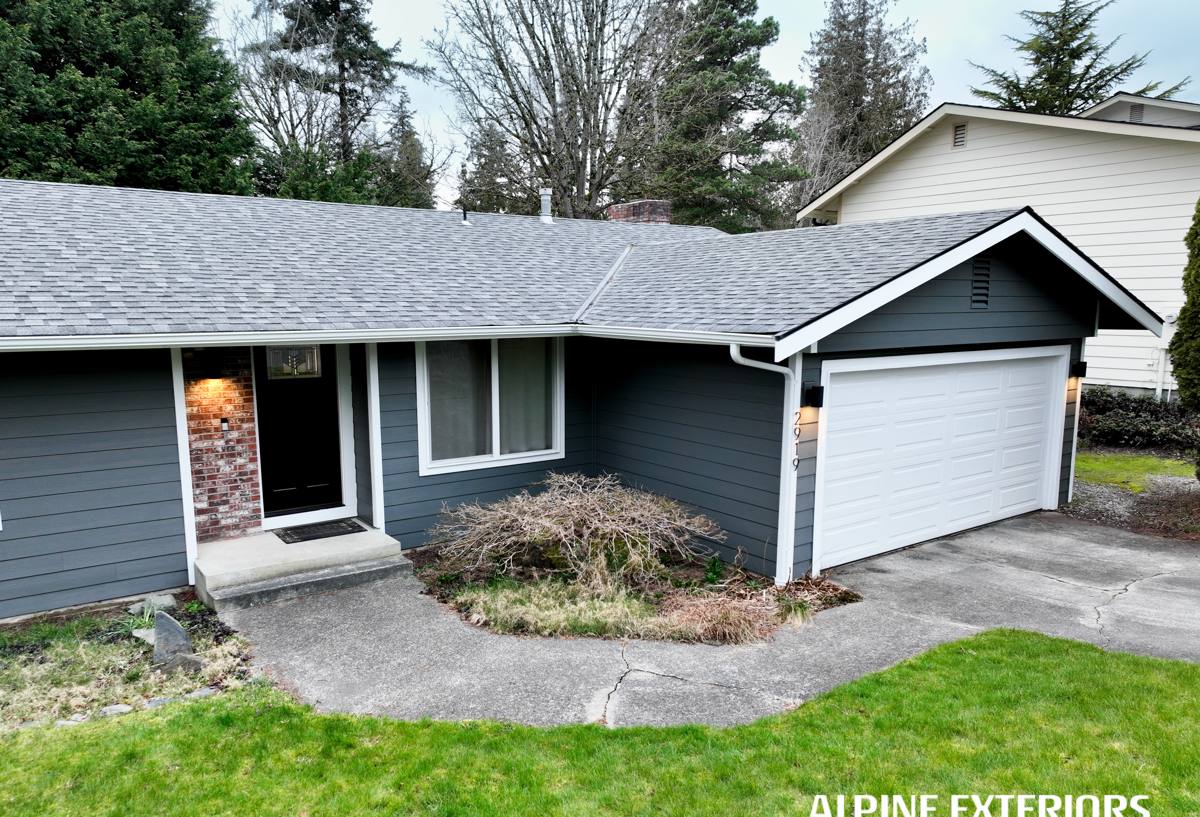
Why We Install James Hardie Fiber Cement — and Nothing Else
We're a Lynden-based crew, and we install James Hardie fiber cement siding exclusively. We don't install vinyl, LP SmartSide, Cemplank, Allura, or primed wood siding like cedar or spruce, and that's a deliberate professional standard, not a sales pitch. Each of those alternatives has real strengths, but each also has a trade-off — vinyl can warp and fade and offers little protection against wind-driven moisture at the seams, wood needs ongoing paint and moisture maintenance that's tough to keep up with in a wet coastal climate, and other fiber cement brands don't offer the same factory-cured color finish or climate-specific engineering that James Hardie does. For a property exposed to salt air and driving rain, we don't think those trade-offs make sense.
James Hardie fiber cement is non-combustible, dimensionally stable, and manufactured with a factory-applied ColorPlus finish that's baked on rather than field-painted — which matters in an environment where a hand-applied paint job would be fighting salt spray and moisture from day one. Hardie also engineers its siding by climate zone (HZ5 for our region), which changes the moisture-resistance formulation for areas that see more rain and humidity. That's the product we stand behind, and it's the only one we put on a home.
What This Means for a Blaine Home Specifically
On a property exposed to open water and prevailing coastal winds, the finish and fastening details do more work than they would on a sheltered inland lot. We pay particular attention to trim and fastener corrosion resistance, factory-finish coverage at cut edges, and joint sealing — the places where salt air and wind-driven rain actually get in.
What a Correct Fiber Cement Installation Actually Involves
Fiber cement siding is only as good as the installation behind it. A huge share of the siding failures we get called out to inspect aren't a material problem — they're a water management problem hiding under a wall that looks fine from the curb. In a climate like Blaine's, getting these details right is not optional.
Moisture Barrier and Drainage Plane
Every wall gets a code-compliant weather-resistive barrier installed as a complete, lapped system — not just stapled up and covered. Behind that, we use a drainage plane so that any moisture that does get past the siding has a path to drain and dry out instead of sitting against the sheathing. This is the single most important layer for a home taking on regular wind-driven rain.
Flashing at Every Penetration
Windows, doors, hose bibs, light fixtures, vents — every penetration through the siding is a place water can enter if it isn't flashed correctly. We flash and integrate each one with the drainage plane so water is directed out and away from the wall assembly, not funneled into it.
Fastening and Clearances
James Hardie specifies exact fastener types, spacing, and minimum clearances from grade, decks, and roof lines. Corrosion-resistant fasteners matter everywhere, but they matter more within reach of salt air. We also hold the manufacturer's minimum ground and roof clearances so the bottom edge of the siding isn't sitting in a splash zone or trapped against standing moisture.
Caulking and Joint Treatment
Butt joints, corners, and trim intersections get treated according to Hardie's published details — not general caulk-everything guesswork. Over-caulking can trap moisture just as easily as under-caulking lets it in, so the goal is getting each joint type right, not just sealed.
Our Process on a Blaine Job
We keep the process straightforward and give homeowners a clear picture before any siding comes off the house.
1. On-Site Assessment
We walk the exterior, check the current siding and trim condition, look for existing moisture damage or rot at vulnerable points, and talk through what the home is dealing with — sun exposure, wind direction, drainage around the foundation.
2. Tear-Off and Sheathing Inspection
Once old siding comes off, we inspect the sheathing underneath. This is often where hidden problems from a previous installation show up, and it's the point where we flag anything that needs repair before new siding goes back on — patching over damaged sheathing just locks the problem in.
3. Weather Barrier and Flashing Installation
The drainage plane, weather-resistive barrier, and flashing details go in first, inspected before any siding panel is hung.
4. Hardie Siding Installation
Panels or lap siding go up to manufacturer spec — correct fasteners, spacing, clearances, and joint treatment, as outlined above.
5. Trim, Caulk, and Final Walkthrough
Trim and corner details are finished, joints are sealed appropriately, and we walk the completed job with the homeowner before calling it done.
Comparing the Options for a Coastal Whatcom County Home
| Factor | James Hardie Fiber Cement | Vinyl | Untreated Wood (Cedar/Spruce) |
|---|---|---|---|
| Salt air / coastal exposure | Engineered for climate zone, factory finish resists fading | Can chalk, fade, and warp faster near salt air | Needs frequent refinishing to hold up |
| Wind-driven rain resistance | Strong when installed with proper drainage plane and flashing | Seams are a common entry point for driven rain | Absorbs moisture if coating fails |
| Fire resistance | Non-combustible | Combustible, can melt/deform in heat | Combustible |
| Ongoing maintenance | Occasional wash, no repainting for the ColorPlus finish life | Low maintenance but limited repair options once damaged | Regular painting/staining required |
| Typical lifespan when installed to spec | Multiple decades | Shorter, varies with UV and impact damage | Shorter without diligent upkeep |
Living With Salt Air and Moss Season After Installation
Fiber cement siding installed correctly is genuinely low-maintenance, but "low-maintenance" isn't "no-maintenance" in a climate like this. A yearly rinse-down helps clear salt residue and organic buildup before it has a chance to hold moisture against the surface. Trimming back vegetation and tree cover that keeps a wall shaded and damp through moss season goes a long way too — moss grows where things stay wet, and the north and west-facing walls on a lot of Blaine properties are exactly the sides that see the least sun and the most wind-driven rain.
It's also worth periodically checking caulked joints and trim intersections, especially after a hard winter storm season, since sealant is the one part of a siding system that has a shorter service life than the siding itself.
Signs Your Current Siding Is Struggling
- Paint or finish peeling, chalking, or fading unevenly, especially on wind- and rain-exposed walls
- Soft spots, bubbling, or visible warping in the siding material
- Persistent moss, algae, or dark streaking that comes back shortly after cleaning
- Gaps opening up at seams, corners, or trim joints
- Visible rot or staining at the bottom edge near grade or below windows
- Rising energy bills that may point to moisture or air infiltration behind the siding
Why It Matters That We Already Work in Blaine
A crew that's worked coastal Whatcom County properties knows what to check for before problems show up on the surface — where wind and rain hit hardest on a given lot orientation, which details tend to fail first on homes near open water, and how to plan an installation schedule around this region's wetter months. That local pattern recognition doesn't replace following manufacturer specs, but it does mean fewer surprises once the old siding comes off and fewer callbacks after the job is done.
Being based nearby in Lynden also means we're not a crew passing through once and moving on. If a question comes up after the job is finished, we're a short drive away, not a phone number tied to a company working three counties from home.
Get a Free, No-Pressure Estimate
If you're weighing a siding replacement on a Blaine property and want a straight answer about condition, options, and what correct installation actually costs, we're happy to take a look. The estimate is free, and there's no pressure to move forward — just an honest read on where your siding stands and what we'd recommend given your home's exposure. Use the form below to get started.