 Lynden Siding
 Why Decks in Birch Bay Wear Out Faster Than Inland Decks
Birch Bay sits right on the water, and that changes what a deck has to survive. Salt-laden air corrodes metal fasteners and hardware years before it would inland. Wind-driven rain off the Strait of Georgia gets pushed sideways into ledger boards, railings, and joints that were never designed to shed water from that angle. And the long Pacific Northwest moss season — cool, damp, and shaded much of the year — turns any deck surface that doesn't drain and dry quickly into a slick, spongy mess.
None of this means a deck in Birch Bay is doomed. It means the build has to account for coastal exposure from the ground up, not just get repainted or resurfaced every few years. A deck built the same way you'd build one in a dry inland yard will fail early on a coastal lot in Whatcom County, no matter how good the lumber looks on day one.
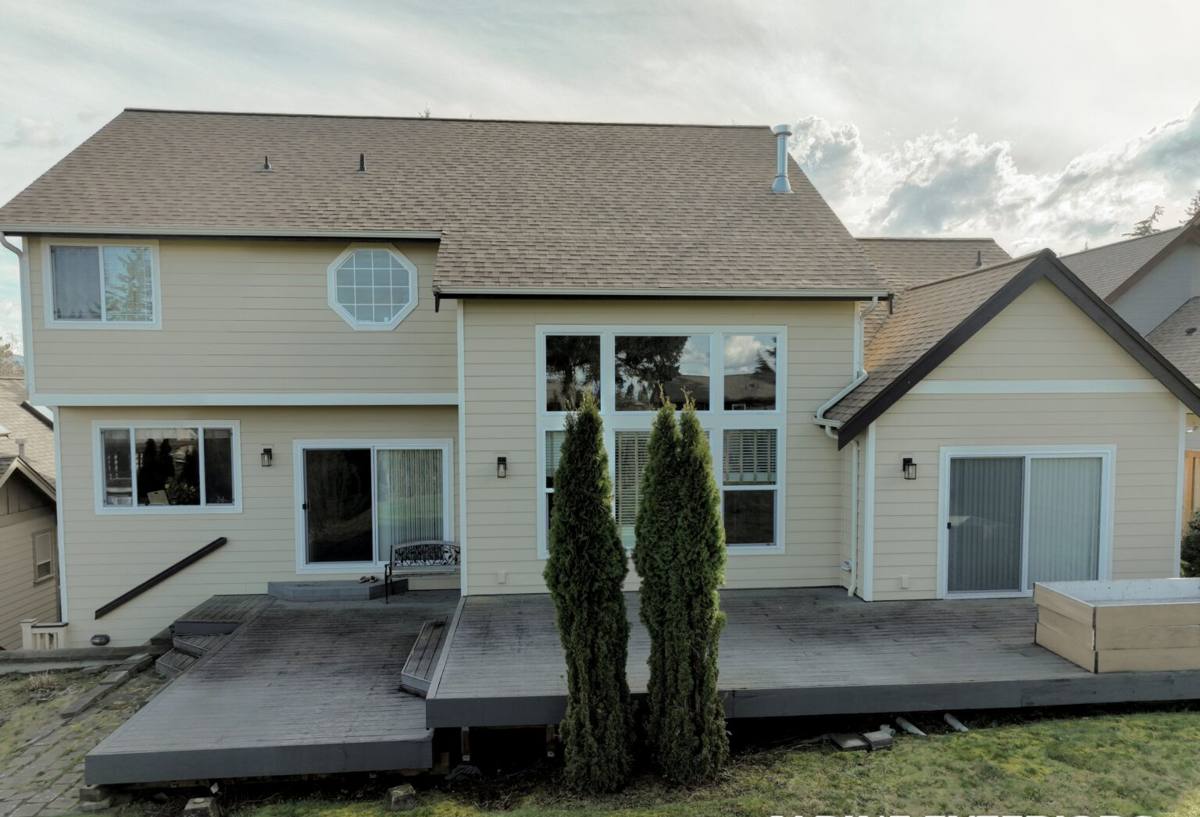
Signs Your Deck Needs Replacement, Not Another Repair
Homeowners often ask us to "just fix the bad boards." Sometimes that's the right call. Other times, patching one problem area is masking a structural issue underneath. A few signs tell us replacement is the honest recommendation:
- Soft, spongy, or spalling decking in multiple areas, not just one isolated board
- Rust streaking or crumbling around fastener heads and connector hardware
- The ledger board (where the deck attaches to the house) shows staining, gaps, or softness — this is the most common point of hidden rot on coastal homes
- Persistent green or black growth that returns within weeks of cleaning, even after pressure washing
- Railings or stairs that flex, wobble, or feel less solid than they used to
- Joists or beams that are visibly cupping, splitting, or discolored when viewed from underneath
If the framing underneath is compromised, resurfacing just the decking boards is a cosmetic fix on top of a structural problem. That's a bad trade for a deck exposed to Birch Bay's weather.
What a Correct Deck Replacement Actually Involves
Starting With the Structure, Not the Surface
A deck replacement done right starts underneath — the ledger board attachment, the posts and footings, and the joist framing. On a coastal property, we pay close attention to how the ledger board is flashed against the house. This is the single most common failure point we find: water working behind an improperly flashed ledger, rotting the rim joist and sometimes the wall framing behind it, out of sight until the deck starts to feel loose.
Flashing and Water Management
Proper deck construction routes water away from every horizontal surface. That means ledger flashing that laps correctly with the house's water-resistive barrier, joist tape over the tops of joists and beams to keep water out of end grain and fastener holes, and decking gaps sized to let water and debris pass through instead of pooling. In a spot that gets steady driving rain off the water, skipping any one of these steps shortens the life of the deck significantly.
Footings and Posts
We check that footings are set below frost depth and sized for the loads involved, and that post bases keep wood off standing water with a proper standoff connector rather than direct wood-to-concrete contact, which holds moisture against the post base and accelerates rot.
Choosing Decking Material for a Salt Air Environment
There's no single "best" decking material for every home — it depends on budget, maintenance tolerance, and how close the deck sits to salt spray and shade. Here's how the common options actually perform on a coastal Whatcom County lot:
| Material | Coastal Performance | Maintenance | Trade-Offs |
|---|---|---|---|
| Pressure-treated wood | Good if properly sealed and maintained; softwood still absorbs moisture at cut ends | Annual cleaning and resealing recommended | Lowest material cost, shortest lifespan without upkeep |
| Cedar | Naturally rot- and insect-resistant, ages well in coastal air | Needs regular cleaning; graying is cosmetic, not structural | Higher cost, softer surface than composite |
| Composite decking | Excellent moisture resistance, doesn't absorb salt spray the way wood does | Occasional washing; no sealing or staining | Higher upfront cost, quality varies significantly by brand and tier |
| PVC decking | Fully moisture-proof surface, strong choice for direct salt exposure | Lowest maintenance of the group | Highest material cost; can feel less "natural" underfoot |
For homes with heavy shade and persistent moss growth, we generally steer clients away from softwood species with minimal natural rot resistance unless they're committed to yearly maintenance. It's not that the material is bad — it's that a shaded, damp coastal lot asks more of it than a dry inland yard would.
Hardware and Fasteners: The Detail Most Decks Get Wrong
This is where we see the most corner-cutting on decks that fail early near the water. Standard coated deck screws and joist hangers are rated for general use, but salt air accelerates corrosion on anything less than marine-grade or stainless hardware. Once a fastener starts rusting, it loses grip strength long before it looks obviously bad, and a rusted connector hidden inside a joist hanger can go unnoticed until there's a real structural problem.
Our standard for coastal replacement jobs is stainless steel or heavy-duty coated fasteners rated for saltwater-adjacent exposure, along with corrosion-resistant structural connectors at every load-bearing point. It costs more than standard hardware. It's also the difference between a deck that holds up through Whatcom County winters and one that needs hardware replaced in five years.
Permits and Local Requirements
Deck replacement in the Birch Bay area typically falls under Whatcom County building permit requirements, and homes closer to the shoreline can be subject to additional shoreline management review depending on the property's location and the scope of the rebuild. Requirements vary by lot, by how much of the structure is being replaced, and by deck height and size, so we don't guess — we confirm what applies to your specific property before work starts and handle the permit process as part of the job.
Skipping this step is a common shortcut with unlicensed or out-of-area crews, and it can create real problems later — from stop-work orders to issues when you go to sell the home.
Our Deck Replacement Process
1. On-Site Inspection
We look at the whole system, not just the surface — ledger attachment, framing condition, footings, and how the current deck is handling water. We'll tell you honestly if repair is a viable option before recommending full replacement.
2. Plan and Material Selection
We walk through decking material options, hardware standards, and layout with you, factoring in sun exposure, shade, and how close the deck sits to salt spray.
3. Permitting
We confirm what Whatcom County requires for your property and pull the necessary permits before demolition begins.
4. Removal and Structural Assessment
Once the old decking and railings come off, we inspect the framing and ledger connection directly. This is often where hidden rot shows up, and we'll discuss any findings with you before proceeding.
5. Rebuild
Framing, flashing, joist protection, decking, and railings go in to current code, with coastal-rated hardware throughout.
6. Final Walkthrough
We review the finished deck with you, including basic care guidance for keeping it in good shape through the wet season.
Why It Matters to Hire a Crew That Already Works in Birch Bay
A contractor who mostly works inland can build a perfectly good deck that still underperforms near the water, simply because they're not used to designing for salt air and driving rain as a matter of course. A crew that regularly works Birch Bay and the surrounding coastal areas of Whatcom County already knows which fastener grades hold up, where ledger boards tend to fail first, and how much slope and drainage a coastal deck actually needs — because we've opened up enough old decks in this area to see the pattern repeat.
That local pattern recognition is hard to replicate from a general contractor who only sees a coastal job once in a while. It shows up in the small decisions — flashing details, hardware grade, material selection for shaded lots — that determine whether a deck lasts eight years or twenty-five.
Living With a New Deck Through Moss Season
Even a well-built deck benefits from a little seasonal attention in a climate like this. Keeping gutters and nearby drainage clear so water isn't sheeting onto the deck, sweeping off wet leaves and debris before they trap moisture, and giving the surface an occasional wash cuts down on moss and algae buildup significantly. Composite and PVC decking need less of this than wood, but no material is entirely maintenance-free in a marine climate — the goal is just keeping water moving instead of sitting.
If your deck is showing its age, or you're not sure whether it needs repair or full replacement, we're happy to take a look and give you a straight answer. Reach out for a free, no-pressure estimate using the form below.