 Lynden Siding
 Why New-Construction Windows in Acme Need to Be Planned, Not Just Ordered
Building a new home out toward Acme puts you in a different weather pocket than a lot of the surrounding lowlands. The lots out here tend to be larger, more wooded, and shadier, which is great for privacy but tough on a building envelope. Add in Whatcom County's mix of salt-tinged marine air, wind-driven rain off the foothills, and a moss season that can stretch for most of the year on shaded north walls and rooflines, and you've got a climate that punishes a window installation that was rushed or done out of sequence. On a new build, windows aren't just a product you pick out of a catalog — they're part of a system that has to work with your house wrap, your flashing, and your siding to keep water moving out and away from the structure, not into it.
We install new-construction windows in this part of the county regularly, and the jobs that hold up ten and twenty years later are the ones where the window install was treated as a sequencing problem, not just a product installation. That's the mindset behind everything below.
What This Climate Does to a Window Opening Over Time
Every window opening in a house is a hole in the weather barrier. In a dry climate, a mediocre flashing job might never get tested. Around Acme, it will be tested constantly — by driving rain hitting the wall at an angle, by moisture-laden air that doesn't dry out quickly under tree cover, and by moss and algae growth that holds dampness against siding and trim longer than direct sun ever would. A poorly flashed rough opening doesn't usually fail in year one. It fails quietly, over several wet seasons, as water finds its way behind the siding and into the sheathing and framing where nobody's looking.
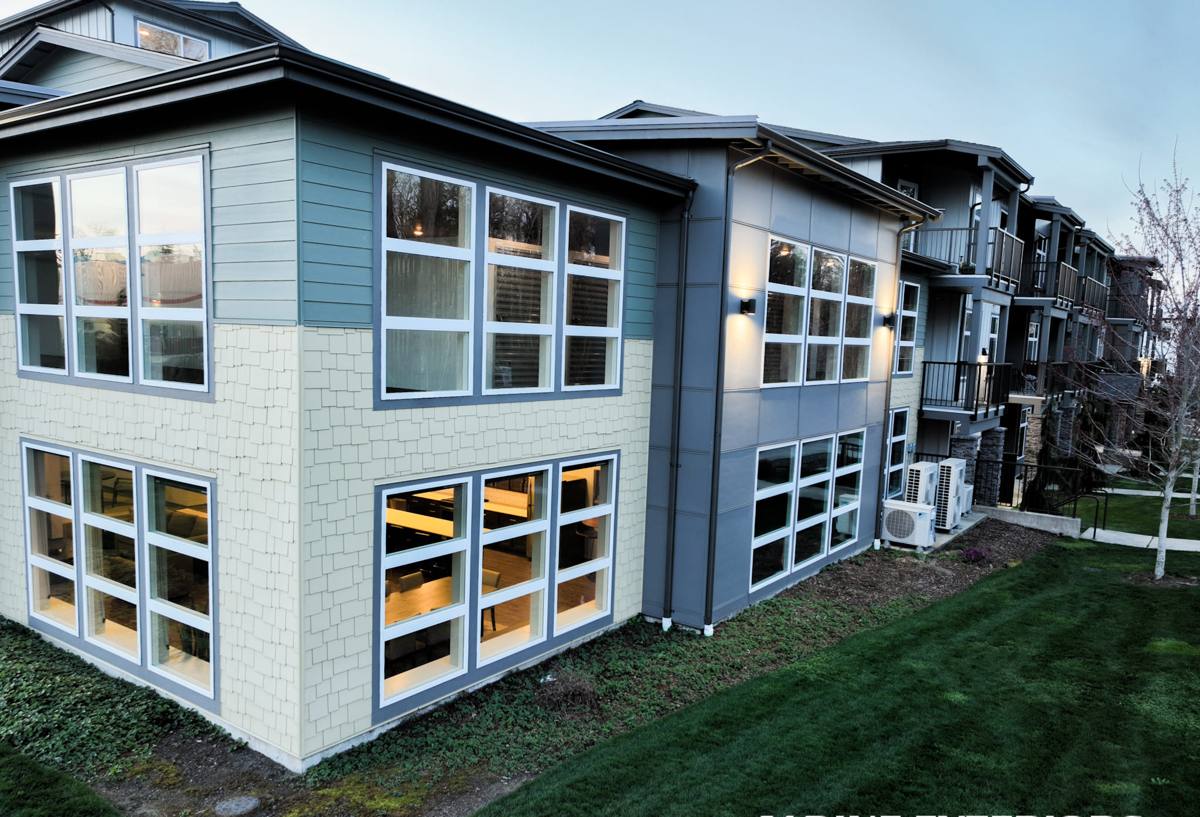
What a Correct New-Construction Window Install Actually Involves
New construction is different from a replacement window job because the wall isn't finished yet — which is an advantage if it's done right. You get to build the drainage plane correctly the first time instead of working around whatever's already there.
Rough Opening Prep and Sill Pan Flashing
Before a window ever goes into the opening, the rough opening itself needs to be square, properly sized per the manufacturer's instructions, and fitted with a sill pan — a sloped, flashed pan at the bottom of the opening that gives any water that gets past the window a way to drain back out to the exterior instead of pooling on the sill and soaking into the framing. Skipping the sill pan, or installing it flat instead of sloped, is one of the most common corners cut on production builds, and it's invisible once the siding goes on.
Integrating Flashing With the Weather-Resistive Barrier
The window's flashing tape and flanges have to be woven into the house wrap in the correct shingle-style order — wrap laps over the top flange, side flashing laps over the wrap below it, and so on — so that water draining down the wall always moves over the top of the next layer down, never behind it. This sounds simple, but the order matters, and it's easy for a crew that isn't paying attention to reverse a lap and create a spot where water gets funneled straight into the wall cavity.
Head Flashing, Kick-Out Flashing, and the Details That Actually Stop Water
Above the window, a head flashing (sometimes with a drip cap) sheds water away from the top of the frame. Where a roofline or lower wall section meets the siding above a window, a kick-out flashing directs the roof's runoff away from the wall instead of letting it sheet down behind the trim. These are small pieces of metal that get skipped constantly because they take extra time to fabricate and install correctly — and they are almost always the difference between a wall that stays dry and one that develops a rot problem five or ten years down the road.
Choosing the Right Window for an Acme-Area New Build
Frame material matters more here than it would in a drier climate, because the frame has to deal with sustained moisture exposure and, on shaded lots, long dry-out times after rain.
| Frame Material | Upfront Cost | Moisture Behavior | Maintenance | Good Fit for Acme New Builds |
|---|---|---|---|---|
| Vinyl | Lowest | Won't rot; can expand/contract with temperature swings | Low | Solid budget-friendly default |
| Fiberglass | Mid to higher | Very stable dimensionally, excellent moisture resistance | Low | Strong long-term choice for exposed or shaded walls |
| Wood with Clad Exterior | Higher | Good if the cladding and flashing are done right; interior wood still needs care | Moderate | Works well when appearance matters and install quality is high |
| Aluminum | Mid | Conducts heat and cold; can condensate more in cool, damp air | Low | Less common choice for residential in this climate |
Glass Packages Worth Asking About
For this climate, we generally steer new-construction clients toward a double-pane, low-E glass package with an argon fill and a U-factor on the lower end of what's available in their budget — the goal is to cut down on heat loss during our long stretch of cool, wet months and to reduce interior condensation on cold mornings, which is common in homes with wood stoves or forced air that isn't zoned well. Your window supplier can walk through the specific ratings for the products they carry; the important thing is asking for the U-factor and solar heat gain numbers up front rather than assuming all double-pane glass performs the same.
Coordinating Windows With Siding — Why Sequencing Matters
On a new build, the window install and the siding install are really one continuous job, not two separate trades that happen to touch the same wall. The flashing tape has to be in place and lapped correctly before the house wrap goes on, the house wrap has to be complete and integrated with the window flanges before the siding starts, and the siding has to be held off the window trim with the right gap and sealant joint so water can drain and the assembly can dry. When the window crew and the siding crew are the same people, or at least working from the same plan, these handoffs don't get missed. When they're different companies working off different schedules, that's where gaps in the flashing sequence tend to show up — usually discovered years later, from the inside, as a stain or soft spot.
Moss, Algae, and Long-Term Maintenance Around Windows
The wooded, shaded lots common around Acme mean less direct sun on north- and east-facing walls, which means moisture sits longer after a storm and moss and algae get a real foothold — especially on trim, sills, and the siding immediately around windows. This isn't just cosmetic. Moss holds water against the surface it's growing on, and around a window that moisture is sitting right next to caulk joints, trim seams, and flashing laps that are supposed to stay dry. A correctly installed window with good flashing and drainage detailing tolerates this fine; a window with marginal flashing gets pushed toward failure faster in a shaded, moss-prone spot than it would on a sunny south wall. Simple annual maintenance — clearing debris and moss off sills and trim, checking that caulk joints haven't cracked, keeping gutters clear so runoff isn't sheeting down the wall — goes a long way toward protecting the install underneath.
Our New-Construction Window Process
- Walk the plans with the builder or homeowner to confirm window schedule, egress requirements for bedrooms, and any structural header details before openings are framed.
- Verify rough openings are sized and squared correctly before any window arrives on site.
- Install sloped sill pan flashing at every opening, no exceptions.
- Set the window plumb, level, and square, shimmed at the manufacturer's specified points — not just at the corners.
- Integrate flashing tape with the house wrap in proper shingle-lap order, including head flashing and kick-out flashing wherever a roofline meets a wall above a window.
- Insulate the gap between the frame and rough opening with a compatible low-expansion product — never packed tight enough to bow the frame.
- Coordinate directly with the siding crew (often us, on the same job) on trim reveal, gap sizing, and sealant joints before siding installation begins.
- Final walk-through with the homeowner or builder to confirm operation, weatherstripping, and hardware before the job closes out.
Common Mistakes We See on New Builds in This Area
If you're working with a builder or a separate window supplier and want to know what to check for, here's what tends to go wrong most often:
- Sill pan flashing missing, flat instead of sloped, or improvised from house wrap tape instead of a proper flashing product.
- House wrap taped over the window flange instead of lapped under it, which reverses the drainage path.
- No head flashing or drip cap above the window, relying on caulk alone to keep water out.
- Kick-out flashing skipped where a roof edge or lower wall meets a wall above a window.
- Windows shimmed only at the corners, leading to frame bow and operational problems within a few years.
- Siding installed tight against window trim with no gap for drainage or expansion.
Why Hire a Crew That Already Works in Acme
A lot of window problems on new construction aren't the window's fault — they're a sequencing and detailing problem, and those are easiest to avoid when the crew already knows how this specific area behaves. We've worked new builds throughout the Lynden and greater Whatcom County area, including the wooded, shaded lots typical around Acme, and we know which walls need extra attention to flashing and drainage because of tree cover and sun exposure, how driving rain off the foothills tends to hit certain elevations harder than others, and why moss and algae control matters as much as the initial install. That local pattern recognition is hard to replicate if a crew is seeing conditions like this for the first time.
If you're planning a new build in or around Acme and want windows installed as part of a system that's built to handle this climate — not just dropped into a hole in the wall — we're happy to walk your plans and give you a straightforward, no-pressure estimate. There's a form below to get that started.