 Lynden Siding
 A Border-Area Climate That Doesn't Slow Down at the Line
The stretch of the Fraser Valley around Abbotsford, BC and the Whatcom County side of the border near Lynden shares one weather system, not two. Marine air moves in off the Salish Sea and pushes inland across this whole corridor, carrying enough salt to matter for exterior materials on both sides of the crossing. Rain in this region rarely falls straight down — it comes in sideways on wind, loads up wall assemblies and window trim, and finds every gap a siding installation left behind. Layer in mild temperatures and heavy tree cover, and you get a moss and mildew season that can run most of the year on shaded, north-facing walls. None of that changes because a property sits a few miles one direction or the other from the border crossing.
We install siding for homes in this area, and on siding specifically we install James Hardie fiber cement exclusively — not vinyl, not LP SmartSide, not primed wood, not a lower-cost fiber cement alternative. That's a professional standard we settled on after weighing how each option actually performs against this climate over decades, not just in the first few years. This page covers what fiber cement siding needs to do for a home in the Abbotsford–Lynden corridor, what a correct installation involves, and how our process works.
What This Climate Actually Puts a Siding System Through
Salt Air, Further Inland Than People Expect
Homeowners a few miles from open water often assume salt exposure isn't a real factor for them. It still is. Marine air carries salt well inland across the Fraser Valley and northern Whatcom County, and over years it accelerates corrosion on fasteners, flashing, and any lower-grade trim hardware. It's a slower process than at the immediate shoreline, but it's steady, and it shows up first at the weak points — exposed nail heads, cheap J-channel, hardware that wasn't rated for the exposure in the first place.
Driving Rain and Wind-Loaded Walls
Fall and winter storms in this corridor push rain sideways into wall assemblies rather than letting it run off a roof and down a flat face. That wind-driven load is what separates a siding job that holds up for decades from one that starts letting moisture in behind the cladding within a few wet seasons — and it's a detail that has more to do with how the siding was installed than what it's made of.
A Moss Season That Doesn't Really End
Mild, wet conditions and heavy tree cover across much of this area add up to a growth season for moss and mildew that runs close to year-round on shaded siding. Any material that's even slightly porous, or that holds moisture against the substrate instead of shedding it, becomes a growth surface over time — and once moss and mildew get a foothold, they hold moisture against the wall even longer, which compounds the problem.
Fiber Cement vs. Other Siding Options for This Climate
Every siding material available today can be installed correctly and can also fail if it's not. The differences that matter for a border-area home like this come down to how each material behaves under sustained moisture, salt exposure, and freeze-thaw cycling, and how forgiving it is of the small installation mistakes that happen on every job.
| Material | Behavior in Salt Air and Driving Rain | Moss/Mildew Resistance | Long-Term Maintenance |
|---|---|---|---|
| James Hardie fiber cement | Non-combustible, dimensionally stable, holds up to sustained moisture exposure when installed to spec | Dense, engineered composition resists moisture absorption better than porous materials | Factory ColorPlus finish reduces repainting cycles; occasional wash-down |
| Vinyl siding | Can warp, crack, or blow off in sustained wind-driven rain and gusts; seams are a moisture entry point | Smooth surface resists growth but trapped moisture behind panels can breed it unseen | Low upkeep on the surface, but panel replacement is common after storm damage |
| LP SmartSide (engineered wood) | Wood-based core is more sensitive to sustained moisture exposure at cut edges and seams | Requires diligent caulking and paint maintenance to keep moisture out long-term | Regular repainting and edge inspection needed to protect the wood substrate |
| Primed cedar or spruce | Natural wood movement and moisture absorption are a poor match for constant wind-driven rain | Most susceptible of the common options to moss, mildew, and rot without frequent upkeep | Highest maintenance burden — repainting, sealing, and spot repairs on a recurring cycle |
Fiber cement isn't the cheapest option up front, and it isn't magic — a poorly installed Hardie job will fail just like a poorly installed anything else. But its moisture behavior and dimensional stability are a strong match for exactly the conditions this corridor produces year after year, which is why it's the only material we put on a house.
What a Correct Fiber Cement Installation Actually Involves
Fastening and Flashing
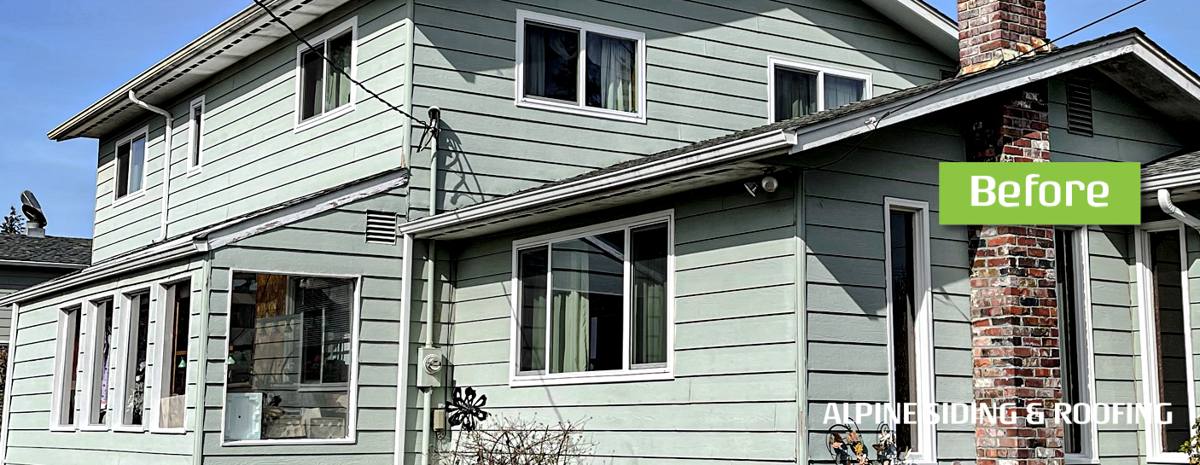
Fiber cement has to be fastened at the spacing and depth James Hardie specifies, into solid framing, with corrosion-resistant fasteners appropriate for a salt-exposed climate. Flashing at every horizontal transition — window heads, roof-to-wall junctions, deck ledgers — has to shed water outward rather than trap it against the sheathing. This is where most siding failures actually start, regardless of the material on the wall.
Clearances, Caulking, and Butt Joints
Fiber cement needs proper clearance from grade, roofing, and hard surfaces so it isn't sitting in standing water or splash-back. Butt joints need to be caulked or flashed correctly, not just butted tight and painted over, or they become a moisture entry point within a few wet seasons.
The ColorPlus Factory Finish
Most Hardie product on homes in this area gets specified with the factory-applied ColorPlus finish rather than field paint. It's baked on under controlled conditions, holds color and adhesion better than a job-site paint job exposed to this area's humidity during application, and it comes with its own finish warranty. Field-painted fiber cement is still fiber cement, but ColorPlus removes a variable that field painting introduces.
Cost Factors on a Fiber Cement Job in This Area
| Factor | Why It Moves the Price |
|---|---|
| Tear-off and disposal of existing siding | Old material, and how it was fastened, affects labor time and disposal volume |
| Sheathing condition underneath | Rot or water damage found during tear-off has to be repaired before new siding goes on |
| Home shape and trim detail | More corners, dormers, and window trim mean more cuts, flashing, and labor hours |
| Product line and profile | Lap width, texture, and whether you choose ColorPlus vs. field paint all affect material cost |
| Access and site conditions | Tight lots, fencing, or landscaping that limits staging area can add time |
We won't quote a number without seeing the house, since sheathing condition alone can swing a bid meaningfully once tear-off starts. What we can say honestly is that fiber cement generally costs more up front than vinyl and is comparable to or less than a well-executed wood or engineered-wood installation once you account for the paint and maintenance cycle those materials require over time.
How the Job Runs, From Estimate to Finish
- On-site evaluation of existing siding, trim, and any visible moisture or rot issues before we quote anything
- A written estimate that specifies product line, finish, and scope — not a vague allowance
- Tear-off of old siding, with sheathing inspected and repaired as needed before anything new goes up
- Installation of weather-resistive barrier, flashing at all penetrations and transitions, then fiber cement per Hardie's fastening and clearance specifications
- Trim, caulking, and touch-up work at seams and cut edges
- Final walk-through with the homeowner before we consider the job done
Permitting requirements vary by jurisdiction on either side of the border, and we handle that as part of the project scope so it isn't left for the homeowner to sort out mid-job.
Living With Fiber Cement Through a Moss Season
One of the practical advantages of fiber cement in this climate is how little ongoing maintenance it actually needs compared to wood-based options. It doesn't need repainting on the cycle that primed wood or engineered wood does, and its density makes it a poor substrate for moss and mildew to take hold on compared to more porous materials. That said, "low maintenance" isn't "no maintenance" — a home under heavy tree cover will still benefit from an occasional wash-down to keep organic growth from building up in shaded areas, and gutters and downspouts should stay clear so water isn't sheeting down the wall face unnecessarily.
Signs Your Current Siding Is Losing the Fight
- Soft or spongy spots when you press on the siding, especially near the bottom courses
- Paint that's bubbling, peeling, or failing faster than a normal repaint cycle would suggest
- Moss or dark streaking that returns quickly after cleaning
- Visible gaps at butt joints, trim, or window flashing
- Warping, cupping, or panels that have separated from the wall
- Rising interior humidity or musty odor near exterior walls, which can point to moisture already behind the siding
Any one of these on its own isn't necessarily an emergency, but a home showing two or three of them at once usually has a moisture problem that's been building for a while, not one that just started.
Why It Matters That We Already Work This Corridor
A contractor who doesn't work this specific border-area climate day to day can spec a technically correct product and still miss the details that matter here — the fastener grade that actually holds up to this level of salt exposure, the flashing detail that handles this region's wind-driven rain, the clearance that accounts for how long a shaded wall stays damp. We work jobs across this corridor regularly enough that those details aren't guesswork; they're the same conditions we account for on every project in the area. On siding, we install James Hardie exclusively because it's the material we trust to hold up to what this climate does to a wall, year after year, when it's put on correctly.
If you're weighing a siding replacement or repair on a home in the Abbotsford, BC or Lynden area, we're glad to take a look and give you a straight, no-pressure estimate — just fill out the form below.