 Lynden Siding
 Board & Batten Siding in Abbotsford: A Look That Demands More From the Install
Board and batten is one of the most requested siding profiles we get asked about from homeowners on the Abbotsford side of the border, and for good reason. The vertical lines read as clean, modern farmhouse, or classic West Coast depending on the trim and color choices around it, and it pairs well with the mix of newer builds and older character homes you find throughout the Fraser Valley. But board and batten is also one of the least forgiving siding profiles when it's installed wrong. The vertical battens create dozens of extra seams and fastening points compared to standard horizontal lap siding, and every one of those seams is a potential entry point for water if the crew doesn't detail it correctly.
We're based just south of the border in Lynden, Whatcom County, and we've been doing siding work on both sides of the line long enough to know that Abbotsford homes face a specific combination of weather stress that board and batten either handles well or fails at badly — there isn't much middle ground with this profile.
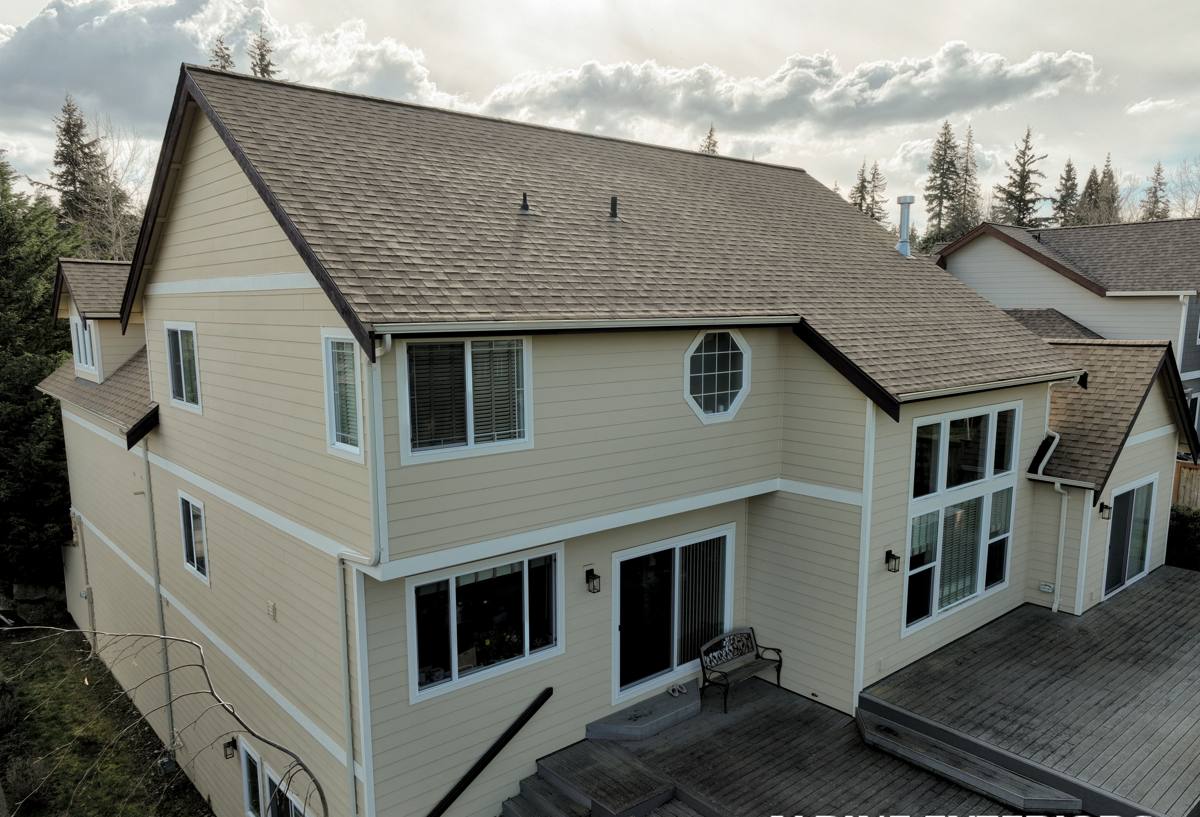
What Abbotsford's Climate Does to Board & Batten Siding
Abbotsford sits in the Fraser Valley, close enough to the Strait of Georgia and the Salish Sea that salt-laden air reaches inland on a regular basis, especially with the marine westerlies that push through the valley. Combine that with the region's long stretch of driving rain in the fall and winter, plus the shaded, damp conditions that let moss and algae take hold on north- and east-facing walls for much of the year, and you get a climate that actively works against any siding product with weak points at the seams.
Moisture Behind the Battens
Board and batten relies on vertical strips fastened over the joints between wider panels or boards. Every one of those battens is fastened through the substrate, and every fastener is a potential path for water if it isn't sealed and backed correctly. In a drier climate that's a minor risk. In Abbotsford, where driving rain can push moisture sideways into a wall assembly instead of just running down it, a poorly detailed batten becomes a slow, hidden leak point that can go undetected behind the wall for years.
Moss and the North-Facing Wall Problem
The long moss season in this region isn't just cosmetic. Moss and algae hold moisture against the siding surface far longer than a clean, dry board would, which extends the amount of time any given wall section stays wet. On wood-based products that means more time for rot to set in. On a product that isn't factory-sealed on all sides, it means more time for the substrate to absorb water it can't easily give back up. Board and batten's vertical grooves and shadow lines are exactly the kind of surface where moss likes to establish itself, which makes material choice and surface finish more important here than on a flat lap profile.
Why Material Choice Matters More With This Profile
Because board and batten has more seams, more fastening points, and more surface texture for moisture and moss to work with, the underlying material has to be able to take that punishment for decades, not just look good on install day. This is where we've drawn a hard line in our own business: we install James Hardie fiber cement exclusively. We don't run board and batten in vinyl, LP SmartSide, or primed wood, even though all three are available and even though some homeowners ask for them by name because of upfront cost.
It's not that those products don't have a place in the market. It's that we've seen how each one performs specifically in vertical, seam-heavy profiles in wet coastal climates, and we're not willing to put our name on an install we don't believe will hold up.
| Material | How It Handles Seams & Battens | Moisture Tolerance | Typical Maintenance |
|---|---|---|---|
| Vinyl board & batten | Battens are often decorative overlays with looser fastening tolerances; can warp or bow in temperature swings | Doesn't absorb water itself, but poor seam design lets water track behind panels | Low, but cracks and fades over time; hard to color-match if damaged |
| LP SmartSide | Engineered wood strand product; battens and panel edges are cut wood and depend heavily on field sealing | Vulnerable at cut edges and fastener penetrations if sealant fails | Moderate to high; edge sealing needs to be maintained over the product's life |
| Primed wood / cedar | Classic look but every batten seam is a wood-to-wood joint that moves seasonally | Absorbs and releases moisture constantly; performance depends on repainting schedule | High; repainting and caulk maintenance on a recurring cycle |
| James Hardie fiber cement | Engineered panel and batten system designed for this exact profile, factory finished on all faces | Non-combustible, dimensionally stable, resists moisture-driven warping | Low; occasional wash-down, no repainting cycle with ColorPlus finish |
What a Correct Board & Batten Installation Involves
The material is only half the equation. We've reworked failed board and batten jobs in this region where the product itself was fine but the install let water in anyway. A correct install accounts for the wall assembly, not just the visible surface.
- A drainage plane and rainscreen gap behind the siding so any water that does get past the surface can drain and dry instead of sitting against the sheathing
- Correct fastener spacing and placement per the manufacturer's published specs, not a generic pattern carried over from lap siding
- Flashing integrated at every window, door, and roofline intersection before the first board goes up, not caulked in after the fact
- Proper gapping and sealing at butt joints, with factory-cut or properly primed cut edges — no exposed raw fiber cement
- Batten spacing and reveal that's consistent across the whole elevation, which is as much a workmanship issue as a weatherproofing one
- Ground clearance and kick-out flashing at grade to keep splashback and standing moisture away from the bottom course
Skipping any one of these doesn't usually show up as a problem in year one. It shows up in year five or six, as staining, soft spots, or paint failure at the seams — right around when a driving-rain season and a heavy moss year happen to line up.
James Hardie's Board & Batten System
James Hardie makes this profile as an engineered system rather than a set of boards a crew improvises battens onto. Panels and battens are manufactured to work together, with consistent thickness and factory-primed or ColorPlus-finished surfaces on every face, including the edges that typically take the most abuse in a wet climate. The ColorPlus finish is baked on at the factory under conditions a job-site paint job can't replicate, which matters most on a profile with this many exposed edges and seams.
Hardie's HZ5 product line is engineered for climates with sustained moisture exposure and freeze-thaw cycling, which fits the Fraser Valley's wet-winter, damp-shoulder-season pattern well. Color options run from muted, traditional tones that suit older Abbotsford character homes to cleaner modern palettes for newer builds, and because the finish is factory-applied, the color performs consistently across every batten and panel on the wall rather than varying batch to batch the way field-applied paint can.
Our Process for Abbotsford, BC Homeowners
We're a Lynden-based crew working just across the border, and we treat that seriously rather than treating Abbotsford jobs as an afterthought squeezed between Whatcom County work. A few things we handle as a matter of course for cross-border jobs:
Estimating and Scheduling
We walk the home, measure the elevations, and give a written estimate based on the actual wall conditions — not a phone-quote guess. Because we already run material and crews across the border regularly, scheduling an Abbotsford project doesn't carry the delays or markups that come with a contractor unfamiliar with that logistics chain.
Permitting and Local Requirements
Exterior work in Abbotsford falls under its own local permitting process, separate from anything on the Washington side. We work through that process as part of the job rather than leaving it to the homeowner to sort out, and we build the project timeline around it instead of promising a start date we can't back up.
Installation
Same crew, same fastening and flashing standards, same attention to rainscreen detailing whether the job is in Lynden or Abbotsford. We don't run a "border version" of the install — the climate on both sides of that line is close enough that cutting corners on one side and not the other wouldn't make sense anyway.
Maintenance in a Moss-Prone, Salt-Air Climate
Even the right material and a correct install still benefit from basic upkeep in this climate. A rinse-down once or twice a year, focused on north- and east-facing walls and anywhere tree cover keeps a section shaded, keeps moss from establishing a foothold. Keeping gutters clear so water isn't sheeting down a wall section repeatedly, and keeping shrubs and landscaping trimmed back from direct contact with the siding, both reduce the amount of time any given section stays wet. None of this is unique to Hardie, but a factory-finished fiber cement surface tolerates this kind of routine maintenance far better than a product that depends on an intact paint or sealant layer to stay protected.
Why Hiring a Crew That Already Works the Abbotsford Corridor Matters
Board and batten punishes inexperience more than almost any other siding profile, because so much of what makes it fail is invisible on install day — a batten fastened a half-inch off spec, a butt joint sealed instead of properly gapped, a missing rainscreen gap behind a wall that looks perfect from the street. A crew that's done this profile repeatedly in this specific climate has already made and corrected those mistakes elsewhere, not on your home.
There's also a practical logistics side to hiring a crew that already crosses the border regularly for this kind of work: material deliveries, scheduling, and coordination all move faster when it's routine rather than a one-off. That translates into fewer surprises and a more predictable timeline for the homeowner.
Get an Estimate for Your Abbotsford Board & Batten Project
If you're weighing board and batten for a home in Abbotsford, we're happy to walk the property, talk through what the wall assembly and detailing would look like for your specific elevations, and give you a straightforward, no-pressure estimate. Use the form below to get started.