 Lynden Siding
 Why Siding in Deming Wears Differently
Deming sits in the kind of Whatcom County terrain that's hard on exterior materials. You've got heavy tree cover holding moisture against the house longer than it would in an open subdivision, low winter sun that leaves north- and east-facing walls damp for days at a stretch, and a long stretch of the year — call it fall through spring — where siding simply doesn't get a chance to fully dry out between rain events. Add in the salt-laden air that moves through the broader Whatcom County corridor off the Sound, and you've got a combination that pushes ordinary siding toward rot, delamination, and moss growth faster than it would in a drier inland climate.
None of that is unique to any one property. It's the baseline for homes in this part of the county, and it's why a siding replacement here has to be treated as a system problem, not a cosmetic one. The board itself matters, but so does the water-resistive barrier behind it, the flashing details around every window and door, and the gap left for the wall to breathe. Skip any one of those and the siding fails early no matter how good the product is.
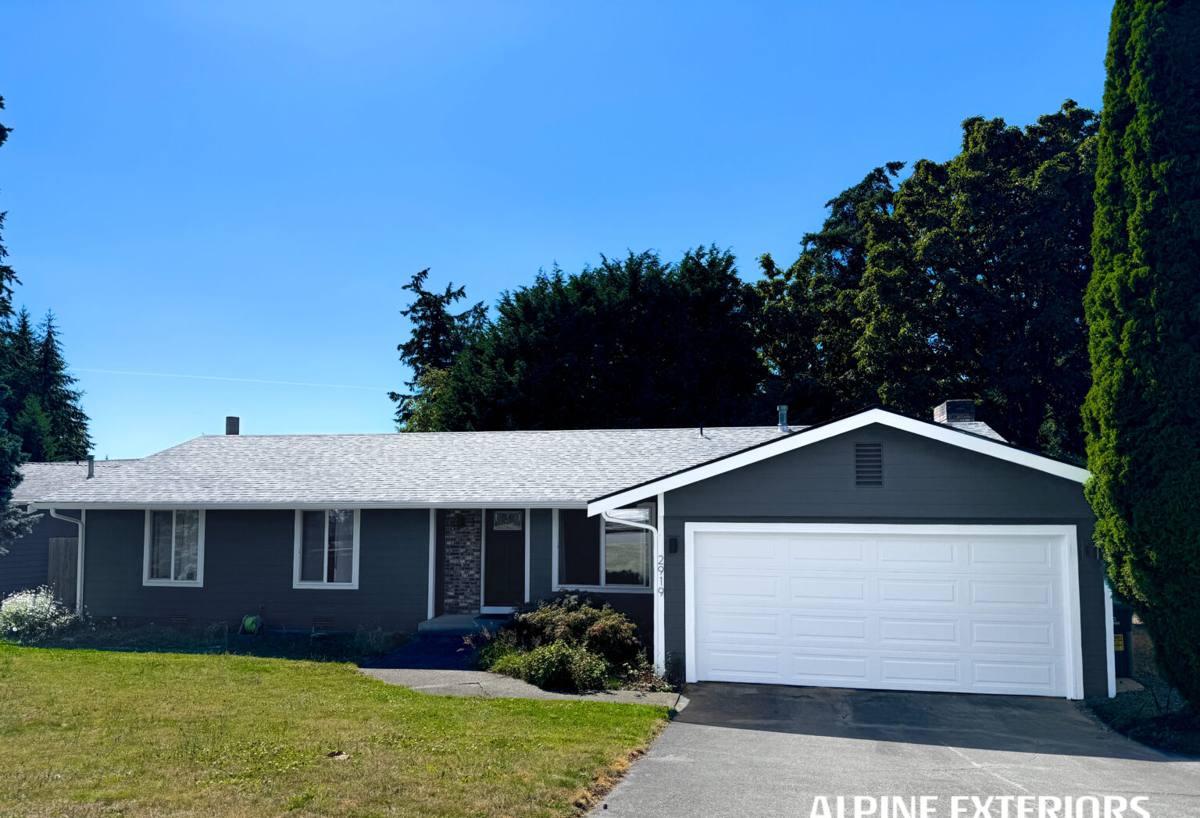
Signs a Deming Home Needs Siding Replacement
Most siding failures out here don't show up as one dramatic problem — they show up as a slow accumulation of small ones. If you're seeing more than one or two of these, it's worth a closer look before it turns into a sheathing or framing repair.
- Soft or spongy spots when you press on the siding, especially near the bottom courses or under windows
- Moss or dark green-black streaking that keeps coming back within weeks of cleaning
- Paint that's peeling, bubbling, or chalking heavily rather than just fading
- Visible cupping, warping, or separated seams in lap boards
- Gaps opening up around trim, window casings, or corner boards
- A musty smell in rooms along exterior walls, particularly after a stretch of rain
- Woodpecker damage or soft wood that gives way under light pressure
Any siding replacement job that starts with rot or moisture damage isn't really a siding job first — it's a sheathing repair with siding on top. We call that out plainly before we quote anything, because covering damaged wood with new siding just hides the problem for another few years.
What a Correct Siding Replacement Actually Involves
Full Tear-Off, Not a Layer On Top
We remove the existing siding down to the sheathing rather than installing over it. That's the only way to actually see what's underneath — soft sheathing, old moisture damage, or house wrap that's failed and needs replacing. It also lets the new siding sit flat and true instead of telegraphing every bump and warp from the old layer underneath.
Water-Resistive Barrier and Flashing
In a climate that sees this much sustained rain, the barrier behind the siding matters as much as the siding itself. We install a proper weather-resistive barrier and flash every penetration — windows, doors, hose bibs, light fixtures — so water that does get past the siding has a way to drain out instead of sitting against the wall.
Rain Screen Gap
On most Deming homes we build in a small ventilated gap between the barrier and the new siding. That gap lets any moisture that gets behind the boards dry out instead of staying trapped, which is one of the biggest differences between a siding job that lasts fifteen years and one that lasts forty.
Fastening and Trim Detail
James Hardie has specific fastening, clearance, and caulking requirements, and they exist for a reason — get them wrong and you void the manufacturer warranty and open the door to exactly the moisture problems the product is designed to resist. We follow the manufacturer's installation instructions to the letter, not as a formality but because that's what actually keeps water out.
Why We Install Only James Hardie Fiber Cement
We don't offer vinyl, LP SmartSide, cedar, primed spruce, or other fiber cement brands, and that's a deliberate standard, not a limitation in what we're capable of installing. In a climate with this much sustained moisture and a long moss season, the materials that struggle are the ones that either trap water (vinyl can flex and gap at seams over time), rely on wood-based cores that are more sensitive to sustained dampness (engineered wood products), or need repainting and recaulking on a tighter cycle to keep water out (cedar and primed wood).
James Hardie fiber cement is engineered specifically for climates like this one — the HZ5 product line is formulated for regions with freeze-thaw cycles and sustained moisture exposure. It's non-combustible, it holds a factory-applied ColorPlus finish that resists fading and doesn't need repainting on the same schedule as wood, and it doesn't provide a food source for the moss and mildew that thrive in Whatcom County's shade and rainfall. We standardized on it because after years of doing this work in this exact climate, it's what holds up with the least maintenance burden for the homeowner.
Comparing Siding Options in a Wet, Shaded Climate
| Material | Moisture Behavior | Maintenance in Whatcom County | Typical Lifespan Here |
|---|---|---|---|
| James Hardie fiber cement | Dimensionally stable, resists moisture absorption and moss adhesion | Occasional wash; factory finish reduces repainting | 30+ years with proper install |
| Vinyl | Can warp and gap at seams; doesn't resist moss buildup at laps | Regular cleaning; seams and fasteners loosen over time | 15-25 years, shorter in heavy shade |
| Cedar / primed wood | Absorbs moisture readily; prone to rot without diligent upkeep | Repainting/staining every few years, ongoing caulk checks | Highly maintenance-dependent |
| Engineered wood (LP SmartSide type) | Wood-based core is more sensitive to sustained dampness at edges/cuts | Edge sealing and paint maintenance matter more than with fiber cement | Varies widely with install quality |
This isn't a knock on every other product's engineering — it's a reflection of what tends to hold up best specifically in a climate that stays wet and shaded for months at a time, which is exactly what Deming delivers.
Our Process for a Deming Siding Replacement
- On-site assessment — we walk the exterior, check for soft spots and moisture damage, and look at drainage, grading, and roof overhangs that affect how the walls dry
- Written estimate — a clear scope covering tear-off, sheathing repair if needed, barrier and flashing work, and the Hardie product and profile we recommend
- Tear-off and sheathing inspection — old siding comes off, damaged sheathing gets identified and repaired before anything new goes on
- Barrier, flashing, and rain screen installation — the part that determines whether the new siding actually stays dry
- Hardie siding installation — installed to manufacturer spec for fastening, clearances, and joints
- Final walkthrough — we go over the finished work with you before calling the job done
Why a Crew That Already Works Deming Matters
Deming isn't a subdivision with uniform lots — it's a mix of wooded acreage, older homes, and properties with well systems, septic fields, and driveways that aren't always straightforward to stage a job around. A crew that's worked the area knows to ask about those things up front instead of discovering them the morning a truck can't get close to the house. We also know which parts of a property tend to hold moisture longest given the tree cover and terrain, which shapes where we pay extra attention during tear-off and sheathing inspection.
Whatcom County permitting and inspection requirements also apply here the same as anywhere else in the county, and having done this work across the area means we're not learning that process on your job. That familiarity translates into fewer surprises and a smoother timeline.
Warranty and Long-Term Value
James Hardie backs its siding with a strong, transferable limited warranty on the product itself, and the ColorPlus factory finish carries its own separate finish warranty. That matters if you sell the home — a transferable warranty is a real selling point in a climate where buyers are wise enough to ask what the siding is and how it's held up. We stand behind our installation work on top of the manufacturer's product warranty, because the two have to work together: a great product installed wrong still fails, and correct installation is what lets the warranty actually mean something.
What This Costs to Do Right
| Cost Factor | Why It Matters |
|---|---|
| Home size and wall complexity | More corners, dormers, and trim details mean more labor and material |
| Sheathing condition | Rot repair discovered during tear-off adds cost but prevents hidden failure |
| Siding profile and accessories | Lap width, panel style, and trim choices affect material cost |
| Access and site conditions | Tree cover, slope, and driveway access affect staging and labor time |
| Existing moisture damage | Homes with long-standing leaks may need more extensive barrier and framing work |
We don't quote a number without seeing the house first, because two homes of the same size in Deming can need very different scopes of work depending on how the old siding held up.
If your Deming home is showing any of the wear signs above, or you're just planning ahead before the next wet season sets in, we're happy to come take a look. The estimate is free, there's no pressure, and you'll walk away with a clear picture of what your home actually needs.