 Lynden Siding
 Replacing a Deck the Right Way for Acme
Acme sits in a part of Whatcom County that gets the full range of what Pacific Northwest weather can do to an outdoor structure — salt-laden air moving through the region, driving rain that comes in sideways more often than straight down, and a moss season that runs for most of the year rather than just the wettest months. A deck built or repaired without accounting for those conditions tends to look fine for a season or two and then fail in ways that are expensive to fix piecemeal: soft framing, corroding fasteners, boards that cup and split, railings that loosen at the post.
Deck replacement is a different job than deck repair, and it's worth being clear about that distinction up front. Repair patches specific failures — a rotted board here, a wobbly rail there. Replacement means the whole structure, from footings to surface, gets rebuilt to current standards rather than propped up around old problems. For homes in Acme, that's usually the more honest answer once a deck has been through enough wet seasons that the damage has worked its way into the framing rather than just the visible boards.
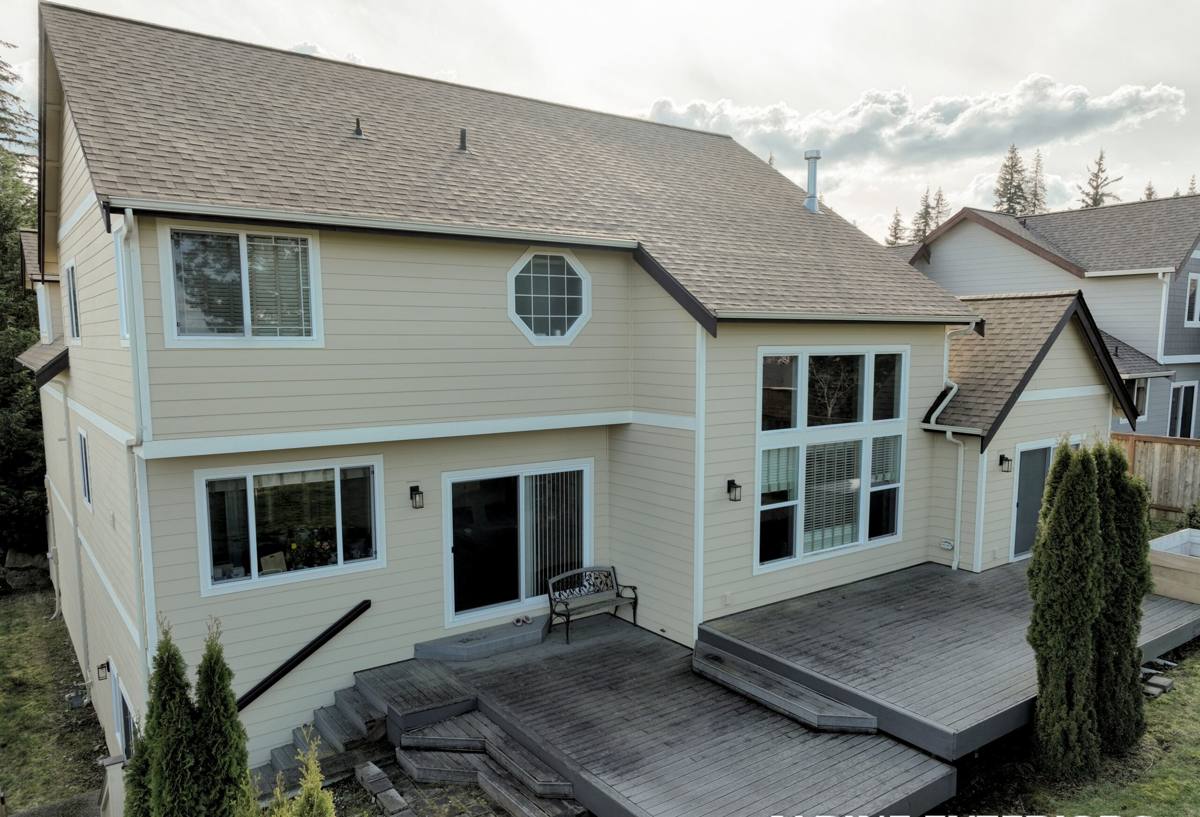
Why Decks in This Area Wear Out Faster Than Homeowners Expect
Salt Air and Metal Fatigue
Salt-laden air moving through Whatcom County accelerates corrosion in any exposed metal — deck screws, joist hangers, post brackets, railing hardware. That process starts well before rust is visible to the eye, and a fastener that's lost even some of its holding strength doesn't announce itself until a board lifts or a railing post shifts under weight. Standard hardware that wasn't rated for this kind of exposure is one of the most common reasons an older deck needs full replacement rather than a patch job.
Driving Rain Finding Its Way In
Rain here doesn't fall straight down as often as homeowners from drier climates expect. Wind pushes it sideways, up under railings, and into the gap where a deck ties into the house at the ledger board. That connection point is one of the most common places water gets into framing on an older deck, and once it does, the damage happens out of sight until a board or joist finally gives.
A Moss Season That Doesn't Really End
Mild temperatures and near-constant moisture give moss a long growing season in this part of Whatcom County, and a horizontal deck surface is exactly the kind of place it takes hold — it holds water longer than a vertical wall and stays damp between rain events. Shaded decks and north-facing surfaces usually show it first, but any decking material with surface porosity will eventually host it somewhere.
Signs a Deck Needs Replacing, Not Just Repairing
Homeowners often call about a specific problem — a soft spot, a wobbly rail — without realizing it's a symptom of something larger underneath. A few signs that point toward full replacement rather than a repair:
- Soft or spongy spots in the decking surface, especially if they show up in more than one area
- Joists or beams that feel soft, spongy, or show visible rot when probed underneath the deck
- Railing posts that wobble or have visibly pulled away from their connection points
- Visible gaps, staining, or soft wood at the ledger board where the deck meets the house
- Fasteners with heavy rust staining bleeding into the surrounding wood or decking
- A deck built more than 15-20 years ago with no major structural work since
- Persistent moss or mildew that comes back within weeks of cleaning, suggesting moisture is trapped rather than just sitting on the surface
- Any sign of movement or flex in the structure when walked on, especially near the edges or stairs
Any one of these on its own might be a repair. Two or three together usually means the deck has reached the point where patching individual problems costs more over time than a proper replacement.
What a Correct Deck Replacement Involves
A deck replacement done right starts below what anyone will ever see once the project is finished. For a home in Acme, that means:
- Full tear-out and disposal of the old structure, including inspection of the ledger connection and any framing that's been hidden behind the old decking
- Footing inspection or replacement where existing footings don't meet current code depth or bearing requirements for the site
- Framing material and spacing sized to the new decking product's actual span rating, not a generic layout carried over from the old deck
- Corrosion-resistant fasteners and hardware throughout — standard hardware that isn't rated for sustained moisture and salt exposure is one of the fastest ways a new deck develops the same problems as the old one
- Correct ledger flashing where the deck attaches to the house, since that connection is the single most common point of hidden water damage on a poorly built deck
- Proper board gapping for drainage and material movement, so wind-driven rain can actually clear the surface instead of pooling between boards
- Grading and airflow underneath the deck so moisture doesn't sit against the new framing between storms
Skip any one of those and a replacement deck can still look good on day one. The difference shows up years later, in exactly the same places the old deck failed.
Choosing Decking Material for a Replacement
Material choice matters more on a replacement than it might on a brand-new build, because the goal is usually to fix whatever wore out the last deck, not repeat it. The main options homeowners weigh are pressure-treated or cedar wood, capped composite, and cellular PVC.
| Material | Handling Salt Air & Moisture | Moss Resistance | Upkeep |
|---|---|---|---|
| Cellular PVC | Excellent — no wood fiber to absorb moisture | Strong, smooth non-porous surface | Occasional washing |
| Capped composite | Strong — cap layer resists moisture and staining | Good on most lines | Occasional washing |
| Uncapped composite | Moderate — some moisture absorption at exposed fiber | Fair; more prone to buildup over time | Periodic cleaning |
| Cedar | Moderate — natural resistance, but needs sealing | Fair when sealed and maintained | Regular oiling or sealing |
| Pressure-treated wood | Weak against sustained exposure without upkeep | Poor without regular treatment | Regular sealing or staining |
Wood costs less up front but asks for the most ongoing attention — sealing or staining on a schedule, with moss and graying showing up fastest if that upkeep slips. Capped composite trades a higher material cost for a plastic shell that resists moisture, staining, and fade far better than wood or uncapped composite, which is why it's become the common middle-ground choice for replacements in this climate. Cellular PVC costs more still and can flex more under concentrated point loads, but has no wood fiber at all to absorb moisture, which matters most on decks that sit in heavy shade or stay damp longer between dry spells.
Permitting and Code Considerations on a Rebuild
A deck built decades ago was permitted under standards that have since changed, and a full replacement is often the point where those gaps get addressed — footing depth, guardrail height and baluster spacing, and stair geometry are common areas where an older deck no longer matches current requirements. Whatcom County permitting for a deck rebuild generally covers structural review, setback compliance, and elevation where applicable, and we handle that process as part of the job rather than leaving it for the homeowner to navigate separately. Bringing an older deck up to current code during replacement isn't extra red tape — it's usually the difference between a deck that's actually safe for its current use and one that just looks the way it always has.
How Our Deck Replacement Process Works
We start with a site visit to look at what's actually there: condition of the existing structure, how the ledger connection has held up, drainage and grade around the deck area, and sun and moisture exposure through the day. That assessment tells us how much of the failure is cosmetic versus structural, which shapes whether replacement is really the right call or whether a more targeted repair could still make sense.
From there we walk through decking material options against the homeowner's budget and how the space actually gets used. Once material and layout are settled and permitting is squared away, the work follows the sequence above: tear-out and inspection first, then footings and framing sized and fastened for what the site actually sees, then the decking surface, railing, and any stairs or trim. We finish with a walkthrough covering what the specific material chosen actually needs going forward — for most modern decking that's minimal, but it isn't nothing.
Keeping a New Deck Performing in This Climate
A properly replaced deck still needs some routine attention to reach its full lifespan in Acme's conditions:
- Rinse the deck surface periodically to clear salt residue, pollen, and organic buildup before it works into the material
- Keep the gaps between boards clear of leaves and debris so water and airflow can move the way the design intends
- Check railing posts and hardware once a year for early corrosion or loosening, especially heading into the wet season
- Trim back overhanging branches or plants that hold moisture against the deck or block sun and airflow
- Address any soft framing or standing water underneath right away — it's a structural issue, not a cosmetic one, and it only gets worse with time
Why Hiring a Crew That Already Works Acme Matters
A crew that mostly works elsewhere in the county can still replace a deck competently, but a job in Acme has variables that come up more consistently here than they might in a drier or more sheltered location — corrosion-grade fastener requirements from sustained moisture and salt exposure, ledger flashing details that hold up against driving rain, and moss pressure that runs longer here than in less exposed parts of the county. Working this area regularly means we're not guessing at those requirements on your project. We've seen which decking lines and fastener grades actually hold up against this specific combination of conditions, and which details are worth the extra time rather than an unnecessary upsell.
That familiarity also shows up in smaller judgment calls — how to orient drainage and gapping for a particular lot's exposure, or being straightforward with a homeowner about what their deck actually needs to last versus what's just an added line item.
Get a Free Estimate on Your Deck Replacement
Whether your deck has an obvious problem or just feels like it's reaching the end of its life, we're happy to take a look and give you a straight read on whether replacement or repair makes more sense for your property. Reach out below for a free, no-pressure estimate.