 Lynden Siding
 Why Nooksack's Climate Is Hard on Ordinary Siding
Nooksack sits in one of the wetter corners of Whatcom County, and the siding on a home here works harder than siding almost anywhere else in the state. Long stretches of driving rain in the fall and winter, a marine air layer that keeps humidity high even between storms, and a moss season that can run from October through April all put steady pressure on the exterior of a house. Siding that would hold up fine in a drier part of Washington can start showing problems within a few years out here if it wasn't built or installed for this climate.
The failures we see most often on Nooksack homes aren't dramatic. They're slow: paint that chalks and fades faster than it should, seams that open up and let water behind the wall, moss and algae staining that keeps coming back no matter how many times it's cleaned, and soft spots at the bottom courses where splash-back and standing moisture never really dry out between rains. None of that is unusual for the area — it's just what happens when a product or an installation wasn't matched to local conditions in the first place.
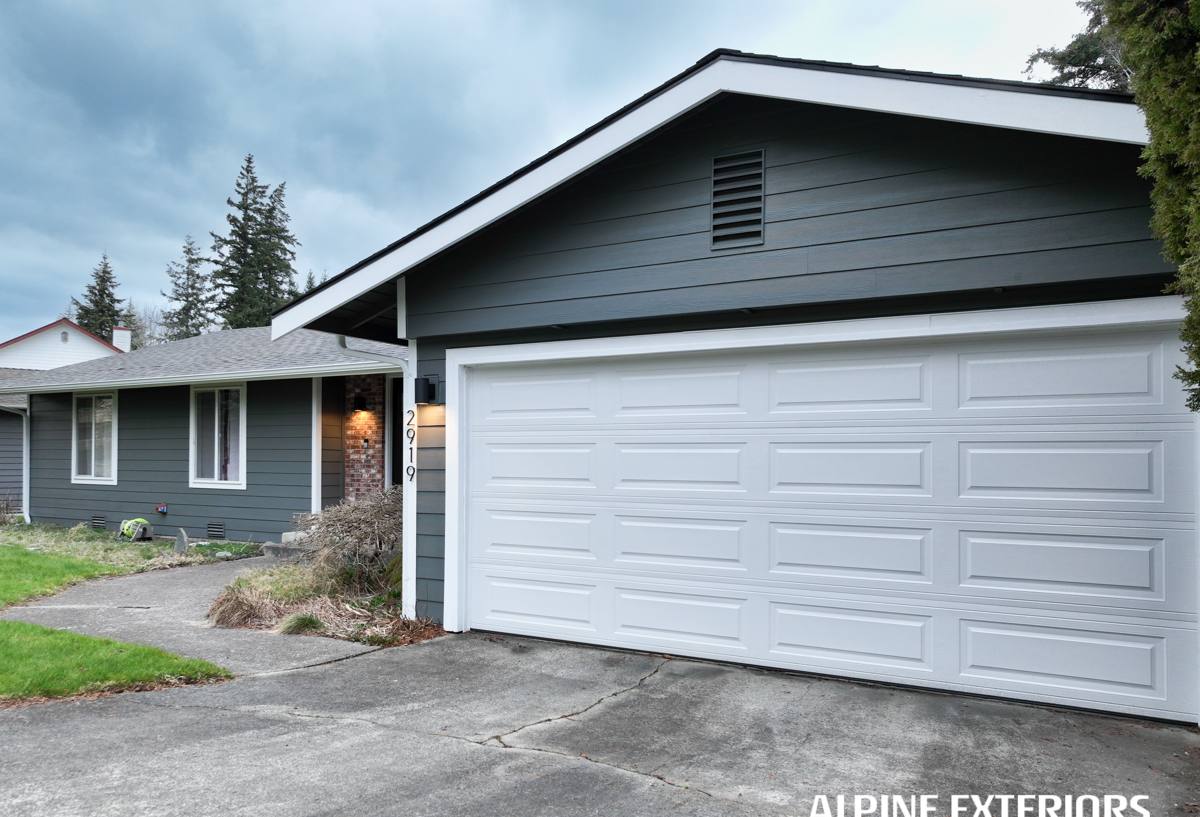
What a Correct Fiber Cement Installation Actually Involves
Fiber cement siding is a good match for this climate, but only when it's installed correctly. The material itself is dense, stable, and doesn't rot, but a sloppy installation can still let water in behind it — and once moisture gets trapped behind siding in a climate like ours, it doesn't dry out quickly.
Clearances and Drainage
Fiber cement siding needs proper clearance from the ground, roof lines, decks, and patios — typically several inches minimum — so splash-back and standing water don't sit against the bottom edge of the boards. It also needs a drainage plane behind it: a weather-resistive barrier and, ideally, a rain screen gap that lets any moisture that does get behind the siding drain and dry out instead of soaking into the wall assembly.
Flashing at Every Penetration
Windows, doors, hose bibs, light fixtures, vents — every penetration through the siding is a place water can get in if it isn't flashed correctly. In a climate with as much sustained rain as Nooksack gets, flashing details matter more than they would somewhere drier, because there are simply more hours of the year when water is actively testing every seam.
Fastening and Caulking
Fiber cement has specific fastening requirements — nail placement, spacing, and depth all affect how the boards perform over time and whether the factory finish stays intact. Manufacturer-approved caulking and sealants at joints and trim are part of the system too, not an afterthought. Skipping or rushing these steps is the single biggest reason fiber cement siding underperforms its expected lifespan.
Why We Install Only James Hardie Fiber Cement
We install James Hardie products exclusively — not LP SmartSide, not vinyl, not cedar, not other fiber cement brands. That's a deliberate standard, not a sales preference, and it comes down to how each option tends to perform in a wet, moss-prone climate like Nooksack's over the long run.
| Siding Type | How It Handles Sustained Wet Weather | Long-Term Trade-Off |
|---|---|---|
| James Hardie Fiber Cement | Non-combustible, dimensionally stable, factory ColorPlus finish resists fading and moisture damage | Higher upfront cost than vinyl; requires correct installation |
| Vinyl Siding | Sheds water on the surface but seams and panels can warp or gap over time in temperature swings | Shorter realistic lifespan, fading, brittleness in cold |
| LP SmartSide (engineered wood) | Treated to resist moisture but is still wood-based, so cut edges and damage are vulnerable points | Ongoing maintenance sensitivity, especially at seams |
| Cedar / Primed Spruce | Natural material that absorbs and releases moisture, feeding moss and mildew growth | Repainting, staining, and rot repair on a recurring cycle |
Cedar and primed wood look good on day one, but they're organic materials in a climate that stays damp for months at a stretch — that combination is exactly what feeds the moss and mildew problems homeowners around here already deal with on roofs and decks. Vinyl is inexpensive and low-maintenance in the short term, but it isn't fireproof, and it's more prone to visible warping and fading after repeated freeze-thaw and heat cycles than a cement-based product. LP SmartSide has improved over the years, but it's still wood fiber at its core, and any breach in the factory coating — a cut edge, a fastener hole, a ding from a ladder or a stray branch — becomes a point where moisture can get in.
James Hardie's fiber cement is cement, sand, and cellulose fiber — it doesn't feed mold or moss the way wood does, it won't warp, and it's non-combustible. The factory-applied ColorPlus finish is baked on under controlled conditions and holds color far longer than field-applied paint. Hardie's HZ10 product line is also engineered specifically for wetter, more humid climate zones like ours, and the transferable warranty backs that up. That combination — a stable substrate, a factory finish suited to sustained damp weather, and a warranty structure that means something — is why it's the only product we put on homes.
Our Process for Nooksack Siding Projects
Every project starts with a real look at the specific house, not a generic estimate. Here's how it typically goes:
- On-site assessment. We check the existing siding, sheathing, and trim for moisture damage, soft spots, or rot before quoting anything, since problems found after tear-off change the scope.
- Moisture and drainage plan. Given the rain load in this area, we confirm the water-resistive barrier and drainage details are right for the wall assembly before any new siding goes up.
- Tear-off and prep. Old siding comes off, sheathing is inspected and repaired where needed, and flashing at windows, doors, and penetrations is installed or corrected.
- Fiber cement installation. Hardie boards, panels, or trim go up to manufacturer specification — correct fastening, clearances, and joint treatment throughout.
- Final detailing. Caulking, trim work, and touch-up are finished, and we walk the job with the homeowner before calling it done.
Signs Your Nooksack Home's Siding Needs Attention
Because siding problems tend to develop slowly here rather than all at once, it's worth checking for these signs before they turn into bigger repairs:
- Moss or algae staining that returns quickly after cleaning, especially on north-facing or shaded walls
- Paint that's chalking, peeling, or fading unevenly across the wall
- Soft or spongy spots when you press on the lowest courses of siding
- Visible gaps at seams, corners, or where siding meets trim
- Warping, bowing, or panels that no longer sit flat against the wall
- Water stains or discoloration on interior walls near exterior corners
- Caulking that's cracked, shrunk, or pulled away from joints
Cost Factors for Fiber Cement Siding in Nooksack
Every home is different, so we don't quote a blanket number, but these are the main factors that move a project's cost up or down:
| Factor | Why It Matters |
|---|---|
| Home size and wall complexity | More corners, dormers, and trim detail mean more labor and material |
| Condition of existing sheathing | Rot or moisture damage found during tear-off adds repair scope |
| Siding profile and finish chosen | Lap, panel, shingle-style, and trim options carry different material costs |
| Access and site conditions | Steep grades, tight lot lines, or limited equipment access affect labor time |
| Scope of the project | Full re-siding versus a partial or single-elevation replacement |
We walk through all of this on-site so an estimate reflects the actual home, not a rough average.
Why Local Experience Matters for This Job
A siding crew that only occasionally works in this part of Whatcom County can still do competent work, but a crew that regularly works Nooksack and the surrounding Lynden area already knows what to look for: the moisture patterns typical to this stretch of the county, how the local weather windows affect scheduling a tear-off, and which parts of a wall assembly tend to take the most abuse from year-round rain. That familiarity shows up in fewer surprises during the job and a finished product that's set up to actually hold up here, not just on a spec sheet.
Caring for Your New Siding
Fiber cement is low-maintenance compared to wood, but "low-maintenance" doesn't mean "no maintenance." A yearly rinse to keep moss and organic buildup from taking hold, keeping gutters clear so water isn't running down the wall face, and trimming back vegetation that holds moisture against the siding will all extend the life of the job. Because the ColorPlus finish is factory-applied, you're not on a repainting schedule the way you would be with wood — but a quick visual check each fall, before the wet season sets in, is worth the ten minutes it takes.
If you're weighing your options for a Nooksack home, we're happy to take a look and give you a straightforward, no-pressure estimate — no invented urgency, just an honest read on what your siding needs and what it would take to do the job right. The form below is the easiest way to get that conversation started.