 Lynden Siding
 Metal Roofing in Ferndale Has to Answer to the Weather, Not Just the Warranty
Ferndale sits close enough to Bellingham Bay and the Strait of Georgia that salt-laden air is a real factor in how a roof ages here, not a theoretical one. Add Whatcom County's long wet season, driving rain off the water, and the shade and moisture that keep moss going most of the year, and you have a climate that's genuinely tougher on a roof than a lot of marketing material accounts for. Metal roofing can handle all of it — it's one of the better options for this exact combination of conditions — but only when the panel, fasteners, and flashing details are chosen with Ferndale's specific exposure in mind, not a generic Pacific Northwest install.
This page is about that one job: metal roofing on homes in and around Ferndale. Not a general overview of metal roofing everywhere, but what actually matters for a house that sits a few miles from saltwater and gets rained on sideways more often than most manufacturer literature assumes.
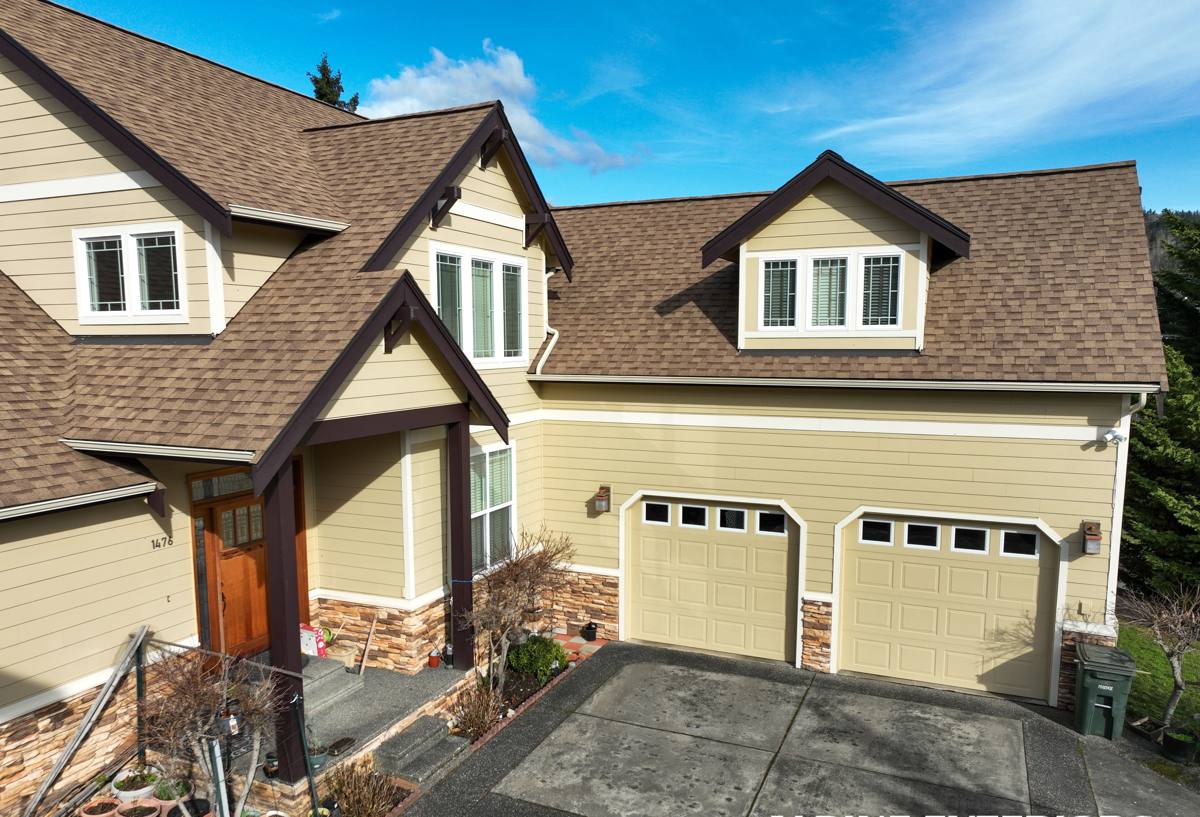
What Salt Air, Rain, and Moss Actually Do to a Roof Here
Salt air and corrosion
Airborne salt is corrosive to bare or poorly coated metal, and it doesn't need to be blowing straight off the water to matter — moist, salt-carrying air moves inland on wind and fog and settles on exposed surfaces, including roofs and the fasteners that hold them down. The failure point is rarely the panel itself; it's usually an exposed fastener head, a cut edge that wasn't sealed, or a lower-grade coating that starts chalking and losing its protective layer years before it should. Homes closer to the water see this faster, but it's a factor anywhere in the Ferndale area.
Driving rain and wind-driven water
Rain that comes in at an angle behaves differently than rain that falls straight down. It gets pushed up under panel laps, around poorly formed flashing, and into any gap that a calmer climate could get away with. On a metal roof, that means seam design, flashing at valleys and penetrations, and underlayment quality matter more here than they would in a drier, calmer region.
Moss and prolonged moisture
Whatcom County's damp shoulder seasons keep roof surfaces wet for long stretches, and shaded north-facing slopes or tree-covered lots barely dry out at all in winter. Moss doesn't damage metal the way it damages shingles, but it does hold moisture against the surface longer than it needs to sit there, and moss buildup at panel laps and around penetrations can interfere with drainage and accelerate wear on fasteners and sealants underneath it.
Choosing the Right Metal Panel for a Coastal-Influenced Property
Not every metal roofing product is a good fit for a property this close to salt air. The differences come down to the base metal, the coating, and how the panels are fastened and joined.
| Option | How it handles salt air | How it handles driving rain | Best fit |
|---|---|---|---|
| Standing seam steel (concealed fastener) | Very good — no exposed fastener heads for salt to attack | Excellent — interlocking seams shed wind-driven water well | Most Ferndale homes, especially closer to the water |
| Exposed-fastener steel panel | Fair — fastener heads and washers are the weak point over time | Good, if installed and re-torqued correctly | Outbuildings, budget-conscious projects, less exposed sites |
| Aluminum standing seam | Excellent — naturally corrosion-resistant, doesn't rust | Excellent — same seam advantages as steel | Properties directly exposed to salt spray or waterfront lots |
| Uncoated or poorly coated steel | Poor — this is where premature corrosion shows up first | Depends on install quality alone | Not something we recommend for this area |
We steer most Ferndale clients toward standing seam over exposed-fastener systems, and toward aluminum or a high-quality coated steel over anything with a thin or unrated finish. It's not that exposed-fastener panels can't work — they can, and they cost less — but the maintenance burden (checking and re-torquing screws, watching washers for wear) is higher in a salt-air environment, and that's a trade-off worth being upfront about before you buy.
What a Correct Installation Actually Involves
Most metal roofing problems we get called out to fix trace back to installation shortcuts, not the panel itself. A correct job in this climate includes:
- Full underlayment coverage — a synthetic or self-adhered underlayment rated for the exposure, not just felt, especially at valleys and eaves where wind-driven rain concentrates
- Properly formed flashing at every valley, wall intersection, chimney, and vent penetration — not generic trim bent to approximate fit
- Fastener selection matched to the panel — correct length, coating, and washer type for the metal being used, torqued to spec rather than overdriven or underdriven
- Panel layout that accounts for prevailing wind and rain direction on the specific roof, not a one-size layout
- Ventilation that keeps the underside dry — trapped moisture under a metal roof causes problems just as surely as water getting in from above
- Sealed cut edges on any field-cut panel, since a raw cut edge is where corrosion starts fastest
None of this is exotic. It's standard good practice done consistently, on every roof, without cutting corners on the details that don't show up until year three or four.
Our Process for Ferndale Metal Roofing Projects
We keep the process straightforward because a metal roof isn't a product you should have to decode on your own:
- On-site assessment — we look at your current roof, its exposure (how close to the water, how much tree cover, which way the weather typically comes from), and any existing trouble spots.
- Panel and finish recommendation — based on that exposure, we recommend a system and coating that fits your budget and your property's actual conditions, not a default upsell.
- Written scope and pricing — flashing details, underlayment, fastener spec, and ventilation plan are spelled out, not left as assumptions.
- Installation — done to the standards above, with attention to the specific weak points this climate creates.
- Final walkthrough — we go over the finished roof with you, including anything worth keeping an eye on over the first year.
What Affects the Cost of a Metal Roof in This Area
Metal roofing costs more upfront than asphalt shingles, and the final number depends on more than just square footage. Here's what tends to move the price on a real Ferndale project:
| Factor | Why it matters here |
|---|---|
| Panel material (steel vs. aluminum) | Aluminum costs more but resists salt-air corrosion without relying entirely on coating |
| Fastening system | Standing seam costs more than exposed-fastener but removes the long-term maintenance item |
| Roof complexity | Valleys, dormers, and multiple penetrations increase flashing work, which is where labor time really goes |
| Tear-off vs. overlay | Removing an old roof adds cost but lets us properly address decking and underlayment issues underneath |
| Site exposure | Properties with direct salt spray exposure may warrant a higher-grade coating or aluminum, raising material cost but reducing long-term upkeep |
| Access and roof pitch | Steeper or harder-to-access roofs take longer and require more safety setup |
We'd rather walk you through these trade-offs honestly than quote a number without explaining what's driving it.
Keeping a Metal Roof Sound Through Whatcom County's Wet Season
Metal roofing is low-maintenance compared to most alternatives, but "low-maintenance" isn't "no-maintenance" in this climate. A short annual check-in goes a long way:
- Clear moss, needles, and debris from valleys and around penetrations before the wet season sets in
- Check that gutters and downspouts are clear so water isn't backing up against eave flashing
- Look at exposed fasteners (if your system has them) for signs of loosening or coating wear
- Watch for streaking or dulling near the coast-facing side of the roof, which can be an early sign of coating breakdown
- Trim back overhanging branches that keep sections of the roof shaded and damp longer than the rest
Catching small issues during a quick seasonal check is a lot cheaper than dealing with a corroded fastener or a slow leak that's been working at the decking for a year.
Why Hiring a Crew That Already Works in Ferndale Matters
Metal roofing installed the same way everywhere doesn't hold up the same way everywhere. A crew that regularly works properties in Ferndale already knows which streets and neighborhoods sit closer to salt exposure, how the prevailing weather off the water tends to hit different roof orientations, and which coating and fastener choices have actually held up under those conditions over time — versus what looks fine on a spec sheet. That local pattern recognition is the difference between a roof that's simply installed correctly and one that's installed correctly for this specific place.
If you're weighing metal roofing for a home in Ferndale, we're glad to come take a look and talk through what fits your property, with no pressure and no obligation. Use the form below to request a free estimate.