 Lynden Siding
 Deck Replacement for Maple Falls Homes
Maple Falls sits up toward the foothills east of Lynden, in a part of Whatcom County where decks take a different kind of beating than they do closer to town. You've still got the same marine air moving in off the Sound, the same long stretches of driving rain through fall and winter, and a moss season that can run most of the year on anything shaded. Add in the tree cover and elevation that come with being closer to the mountains, and you get decks that stay damp longer after a storm, collect more debris from overhead branches, and grow moss faster on north-facing boards than a deck out in open farmland would. If you're looking at a deck that's cupping, springy underfoot, or growing green in the shady corners, that's not unusual for this area — it's what this climate does to a deck that's reached the end of its service life.
We do deck replacement work for homes in and around Maple Falls as part of our regular service area out of Lynden. This page covers what a correct deck replacement actually involves here, what local conditions mean for material choice and detailing, and how our process works from first look to final walkthrough.
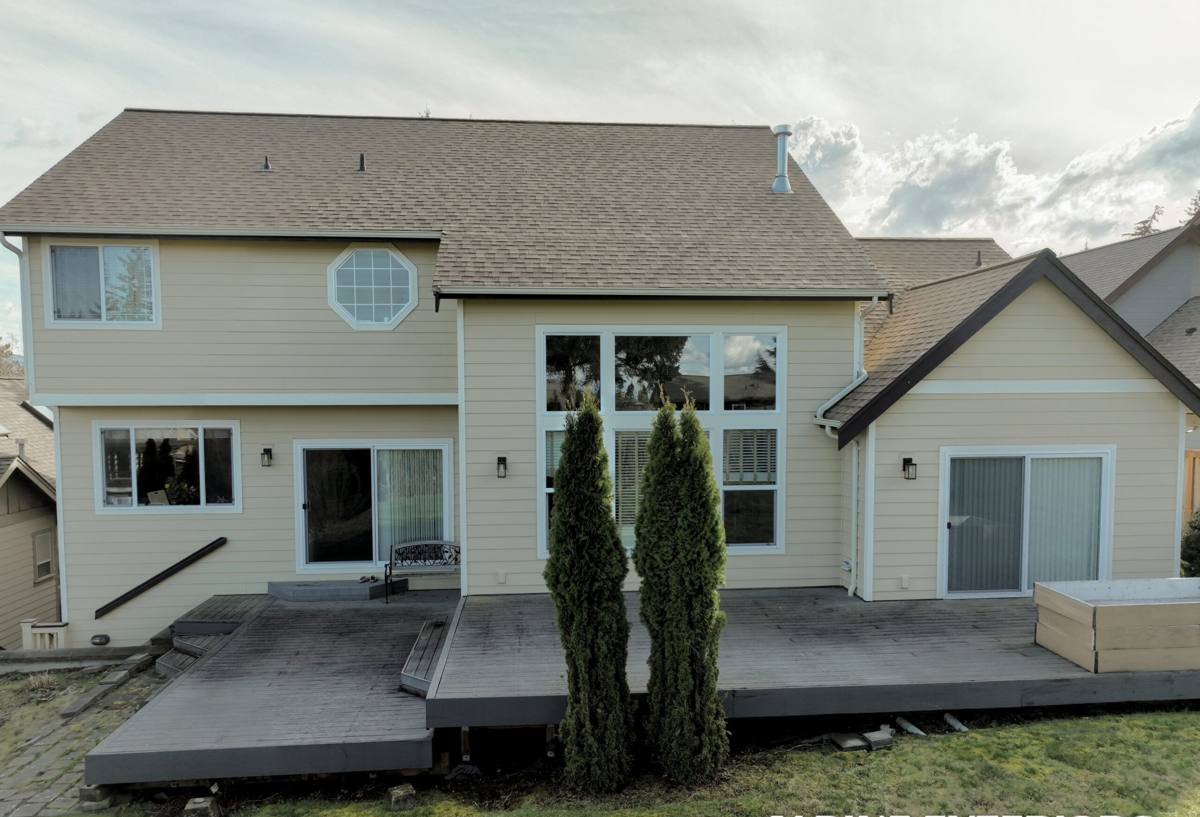
What This Climate Does to a Deck
Sustained Moisture and Slow Drying
A deck out in open sun dries out within a few hours after rain. A deck tucked under mature trees, or shaded by the house on one side, can stay damp for days at a time during a wet stretch. That extended moisture exposure is harder on wood fibers, harder on fasteners, and it's exactly the kind of condition that lets rot get started in ledger boards, joists, and post bases before anyone notices from the surface.
Moss and Organic Growth on Deck Surfaces
Moss doesn't just grow on roofs. It takes hold on shaded decking, especially where debris collects in board gaps or against a house wall, and it holds moisture directly against the wood or composite surface underneath it. On a wood deck that accelerates rot. On any decking material it makes the surface slick and, frankly, a fall hazard, especially on stairs.
Driving Rain at Ledger Connections
Wind-driven rain doesn't just fall on a deck's top surface, it gets pushed sideways into the ledger board connection where the deck ties into the house, and into any gap between decking boards and the rim joist below. That's one of the most common places we find hidden rot on a deck that still looks fine from a few feet away. A correct ledger flashing detail is not optional in this climate; it's the single most important waterproofing detail on the whole structure.
Freeze-Thaw at Elevation
Maple Falls sits at higher elevation than Lynden proper, which means it sees more freeze-thaw cycling through the colder months. Water that gets into a crack in a board, a post base, or a fastener hole and then freezes will expand that crack. Over a few winters, freeze-thaw cycling turns small problems into structural ones faster than it would at lower elevation.
Signs Your Deck Needs Replacing, Not Repairing
- Soft, spongy, or springy decking when you walk across it, especially near the house or stairs
- Visible cupping, splitting, or gray, weathered wood that no longer takes a finish evenly
- Rot or soft spots at the ledger board, posts, or where the deck meets grade
- Persistent moss or algae that comes back within weeks of cleaning
- Rusted, loose, or missing fasteners, especially joist hangers and ledger bolts
- Railings that flex or feel loose when leaned on
- A deck older than 20-25 years that hasn't had a full structural inspection
- Visible daylight or gaps opening up between the ledger board and the house siding
A few of these on their own might mean a repair is enough. Several at once, especially anything involving the ledger connection or the posts, usually means the structure has reached the point where a full replacement is the more honest recommendation, both for safety and for what it'll actually cost you over time in repeated patch repairs.
What a Correct Deck Replacement Involves
Full Structural Tear-Out and Inspection
We remove the old decking, railings, and structural framing down to what's actually sound, and we inspect what's underneath as we go, not just the parts you can see from the yard. Hidden rot at the ledger connection or post bases is common enough in this climate that we plan for the possibility rather than being surprised by it mid-project.
Ledger Flashing Done Right
The ledger board, where the deck attaches to the house, is the single highest-risk water entry point on any deck in a climate like this one. We flash that connection properly, with flashing that sheds water away from the house rather than trapping it against the rim joist. This is the detail that separates a deck that lasts decades from one that rots from the inside out within a handful of years, and it's worth asking any contractor exactly how they handle it.
Framing Sized and Spaced for This Climate
Joist spacing, beam sizing, and post footings all need to account for sustained moisture exposure and, at Maple Falls' elevation, freeze-thaw movement in the ground. We use pressure-treated or naturally decay-resistant framing lumber, and we don't shortcut joist spacing just to save a few boards.
Fasteners and Hardware
Salt-laden marine air moves further inland than most people expect, and it accelerates corrosion in lower-grade fasteners and hardware. We use corrosion-resistant, code-rated structural connectors and fasteners rated for exterior and treated-lumber contact, not standard hardware store screws that'll show rust streaks within a season or two.
Decking Material Selection
We'll walk you through the honest trade-offs between wood and composite decking for your specific site, factoring in how much shade and moss exposure your deck actually gets. Neither material is automatically the right answer everywhere; it depends on sun exposure, tree cover, and how much upkeep you want to take on.
Drainage and Grading Underneath
Standing water under a deck keeps the framing damp longer than it needs to be. We check that grading and drainage under the deck actually moves water away from posts and footings instead of pooling against them, which matters more on shaded, tree-covered lots than it does on open ground.
Wood vs. Composite Decking: The Honest Trade-Offs
| Factor | Wood Decking | Composite Decking |
|---|---|---|
| Upfront cost | Lower | Higher |
| Maintenance | Needs regular cleaning, staining or sealing, and moss treatment, especially in shade | Minimal; occasional washing, no staining or sealing |
| Moss resistance | Porous surface holds moisture, more prone to moss in shaded spots | Denser surface, generally sheds moisture better, though not immune to moss buildup |
| Appearance over time | Grays and weathers without upkeep; needs refinishing to hold color | Holds color and texture longer with less intervention |
| Lifespan in this climate | Long if maintained consistently; shorter if neglected | Generally longer service life with less maintenance-dependent variability |
| Repairability | Individual boards easy to replace | Board replacement possible but material and color matching can be harder over time |
Neither option is wrong. A well-maintained wood deck in a sunnier, more open spot can perform beautifully for decades. On a heavily shaded, tree-covered lot where moss and moisture are a bigger concern, composite often makes more sense simply because it demands less upkeep to stay ahead of the climate. We'll give you a straight answer based on your actual site, not a default recommendation.
Our Deck Replacement Process
- On-site assessment. We inspect the existing deck structure, ledger connection, posts, and footings, and check for hidden moisture or rot before quoting anything.
- Honest scope and estimate. You get a clear picture of what needs full replacement versus what can reasonably be reused, and a written estimate that reflects the actual condition we found, not a guess.
- Permitting. Deck replacements of most sizes require a permit through Whatcom County or the applicable local jurisdiction. We handle that process rather than leaving it on you.
- Tear-out. Old decking, railings, and unsound framing come out, with the site protected and debris hauled off.
- Framing and ledger flashing. New structural framing goes in to code, with proper ledger flashing as the first priority, not an afterthought.
- Decking and railing installation. Your chosen decking material and railing system are installed with attention to fastener spacing, board gaps for drainage, and a level, consistent surface.
- Final walkthrough. We go over the finished deck with you, confirm everything meets code, and answer any maintenance questions before we consider the job done.
Why a Crew That Already Works Maple Falls Matters
Maple Falls isn't identical to Lynden proper. The elevation, tree cover, and distance from open farmland change how moisture, shade, and freeze-thaw cycling actually behave on a given lot. A crew that's already done deck work in this specific area has a working sense of which sides of a house hold moss the longest, how much extra attention shaded ledger connections need, and how local permitting and inspection typically go for this part of the county. That's not something you get from a crew that's only ever worked in a different climate zone or a more open, sunnier part of the region.
We're based out of Lynden and treat Maple Falls as part of our regular service area, not a special trip. That matters for scheduling, for follow-up if you ever have a question after the job's done, and for knowing the material and detailing decisions that actually hold up on a property like yours.
What to Expect in Terms of Cost
Deck replacement cost depends heavily on size, framing condition, decking material, railing style, and how much of the existing structure has to come out versus what can be reused. A straightforward wood deck replacement generally costs less upfront than a composite deck of the same size, but the honest way to think about cost is total cost over the deck's life, not just the installation invoice.
| Cost Factor | What It Affects |
|---|---|
| Deck size and footprint | Directly drives material and labor quantity |
| Decking material (wood vs. composite) | Composite costs more upfront, less over time in maintenance |
| Structural condition found at tear-out | Hidden rot at ledger or posts can add scope once uncovered |
| Railing style and material | Custom or code-required guardrail details add cost |
| Height above grade and stairs | Multi-level or elevated decks need more structural framing |
| Permitting requirements | Larger or elevated decks typically require more inspection steps |
We don't quote a number without seeing the actual deck first, because guessing at scope before an inspection almost always leads to a change order later. A proper on-site look is the only way to give you a number you can actually plan around.
Maintaining Your New Deck in This Climate
- Clear leaves, needles, and debris from board gaps regularly, especially in fall and under tree cover
- Treat moss on shaded areas early, before it spreads or holds moisture against the surface
- Keep gutters and downspouts near the deck clear so runoff doesn't dump directly onto it
- Reseal or restain wood decking on the manufacturer's recommended schedule, not just when it looks worn
- Check the ledger flashing area annually for any sign of gapping or water staining on the siding above it
- Walk the deck periodically and note any new soft spots, squeaks, or movement in the railing
If your Maple Falls deck is showing its age, we're glad to take a look and give you a straight, no-pressure assessment of what it actually needs. Fill out the form below for a free estimate.