 Lynden Siding
 Why Deming Roofs Need to Be Built for This Climate
Deming sits in the foothills east of Lynden, in the part of Whatcom County where the terrain starts climbing toward Mount Baker. That location comes with a specific set of roofing problems. Moist air moves in off the Sound and gets pushed up against the foothills, which means more rain days, longer periods of standing dampness, and heavier tree cover than you'll find on the flatter ground closer to town. Add in the salt-laden air that reaches inland on prevailing winds and you have a combination that is hard on fasteners, flashing, and any roofing material that depends on granules or coatings to hold up over time.
A roof in Deming isn't fighting one bad season a year — it's fighting damp, shaded conditions for most of the year, with a short dry window in summer to actually get ahead of maintenance. That changes what "correct" roofing looks like here. It's less about surviving one big storm and more about how the roof performs day after day under trees, under cloud cover, and under near-constant low-grade moisture.
What Driving Rain and a Long Moss Season Actually Do to a Roof
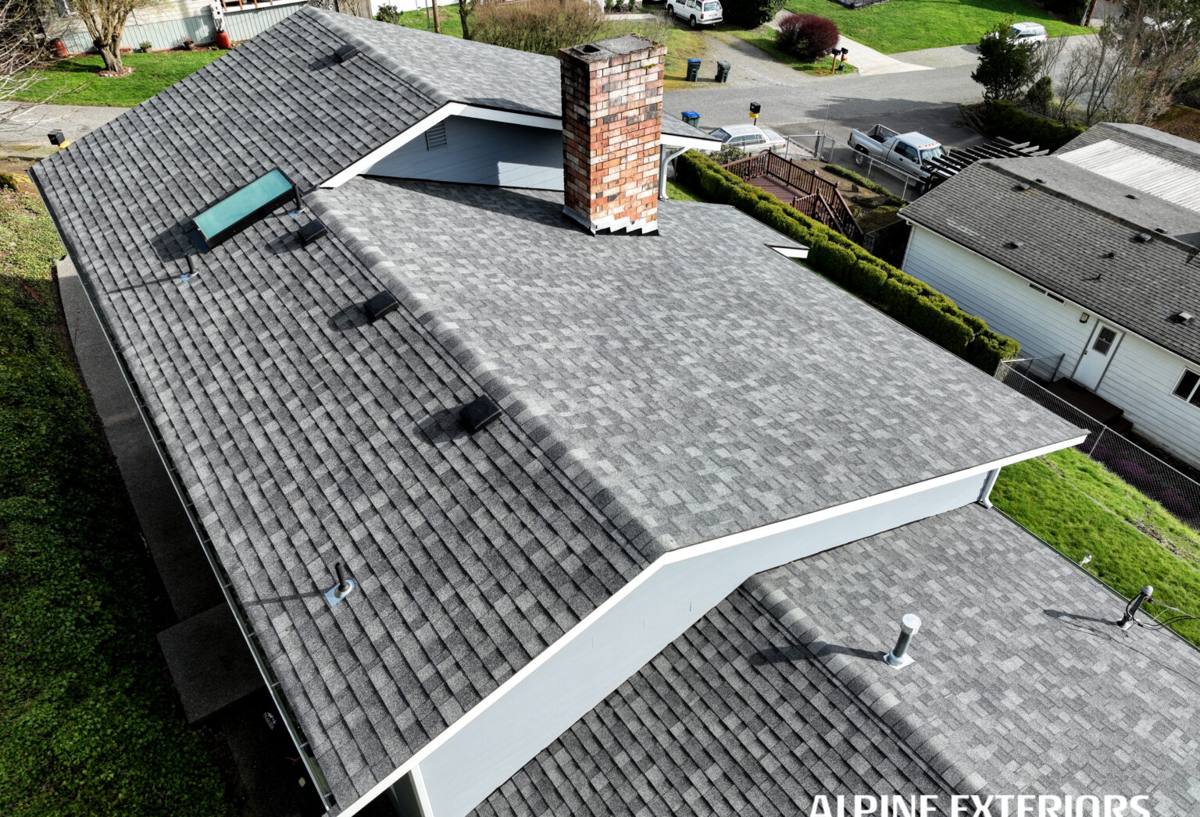
Moss doesn't just sit on top of a roof — it roots into whatever texture it can grab, and once it's established it holds water against the roofing material long after the rain has stopped. On asphalt shingles that means the mat underneath stays wet, granules loosen, and edges start to lift. Lifted edges are exactly what driving rain needs to work its way underneath the shingle course instead of over it.
Metal roofing doesn't give moss the same foothold. There's no granule texture for spores to anchor into, and a properly installed metal roof sheds water fast enough that surfaces dry out between rain events instead of staying saturated. That doesn't mean metal roofs are immune to moss — debris that collects in valleys, around penetrations, or in shaded low-slope sections can still hold moisture and give organic growth a place to start. It just means the roofing material itself isn't feeding the problem the way a granulated surface does.
Driving rain is a separate issue from moss, and it's mostly a flashing and fastening problem. Wind-driven rain doesn't fall straight down — it gets pushed sideways and upward under eaves, around chimneys, and into valleys. A roof that looks fine in a light rain can still leak in a sideways storm if the flashing details weren't done right in the first place.
Metal Roofing Options for Deming Properties
Not every metal roofing system is the same, and the right choice depends on the home, the budget, and how much maintenance the homeowner wants to take on over the years.
| System | Appearance | Moss/Debris Resistance | Typical Lifespan | Best Fit |
|---|---|---|---|---|
| Standing seam | Clean vertical lines, concealed fasteners | Excellent — smooth panel, minimal seams for debris to catch on | 40-60+ years | Homes wanting the longest service life and lowest long-term maintenance |
| Exposed-fastener (ribbed/corrugated) | Traditional ribbed profile | Good, but exposed screws need periodic checking | 25-40 years | Budget-conscious projects, outbuildings, shops |
| Stone-coated steel shingle | Mimics shingle or shake profile | Good, though textured coating collects more debris than smooth panel | 30-50 years | Homeowners who want a shingle look with metal's durability |
For most Deming homes under heavy tree cover, we lean toward recommending standing seam because the concealed fastening system and smooth panel surface hold up best against long-term moisture exposure and give debris the least to grab onto. That's a maintenance and longevity call, not a knock on the other systems — exposed-fastener panels and stone-coated steel are both legitimate options when the budget or the look of the home calls for them.
Coatings and Gauge
Panel gauge (thickness) and the coating system matter as much as the profile you choose. Heavier gauge steel resists denting and holds its shape better over decades. A quality paint system — the kind rated for long-term UV and moisture exposure — is what keeps the panel from chalking or fading in a climate that doesn't give a roof much of a break from moisture. We'll walk through gauge and coating options specific to your project during the estimate rather than pushing a single default.
What a Correct Metal Roof Installation Actually Involves
Metal roofing gets its reputation for longevity from the material itself, but a poor installation will undercut all of that. The details that actually determine how a metal roof performs in a wet, mossy climate are mostly invisible once the job is done:
- Deck inspection and repair — any soft, rotted, or water-damaged decking gets addressed before a single panel goes down. Installing over a compromised deck just hides a problem.
- Underlayment — a synthetic underlayment across the field, with ice-and-water membrane at eaves, valleys, and other vulnerable spots where wind-driven rain is most likely to intrude.
- Flashing details — valleys, chimneys, skylights, and wall intersections are where most roof leaks actually originate, metal or not. Flashing has to be formed and layered correctly, not just caulked and hoped for.
- Fastening and clip spacing — standing seam systems use concealed clips that allow the panel to expand and contract with temperature changes without stressing the fasteners. Spacing that's too wide or too tight both cause problems over time.
- Ventilation — metal panels need airflow underneath them to prevent condensation from forming on the panel's underside. Ridge and soffit ventilation isn't optional on a metal re-roof, it's part of doing the job correctly.
Our Process, Start to Finish
We keep the process straightforward because a roof project shouldn't feel like a mystery to the homeowner paying for it.
1. On-Site Assessment
We look at the existing roof, deck condition, pitch, tree cover, and any problem areas — valleys, chimneys, low-slope sections — that need particular attention given the local climate.
2. Material and System Walkthrough
We go over panel options, gauge, and coating choices in plain terms, with honest trade-offs on cost, appearance, and long-term maintenance rather than steering toward whatever is easiest to sell.
3. Written Estimate
A clear scope of work, materials, and timeline before anything is scheduled — no vague allowances that turn into surprise costs later.
4. Tear-Off and Installation
Old roofing comes off, the deck gets inspected and repaired where needed, underlayment and flashing go in, then the panel system goes on. On most Deming homes we aim to get the roof dried in the same day tear-off starts, since leaving a deck exposed overnight in this climate is asking for trouble.
5. Final Walkthrough and Cleanup
We walk the finished roof with the homeowner, confirm everything matches the agreed scope, and make sure the property is cleared of debris and old material before we consider the job done.
Cost Factors for a Deming Metal Roofing Project
Metal roofing costs more upfront than asphalt shingles, and the final number depends on more than just square footage. The honest range for a full metal roof replacement typically runs well above a comparable shingle job, but the gap narrows considerably when you account for how many fewer times you'll be re-roofing over the life of the home.
| Factor | Why It Matters |
|---|---|
| Panel system chosen | Standing seam costs more than exposed-fastener panel; stone-coated steel falls in between |
| Roof pitch and complexity | Steep pitches, multiple valleys, and dormers add labor time and material waste |
| Tear-off vs. new construction | Removing and disposing of old roofing adds cost that new-build projects skip |
| Decking repair | Rot or water damage found during tear-off has to be fixed before installation continues |
| Accessories | Snow guards, gutter integration, and custom flashing at chimneys or skylights all factor in |
We give a firm number after the on-site assessment, not a phone estimate — too much of the final cost depends on what we find once the old roofing comes off.
Maintenance: Staying Ahead of Moss Season
Metal roofing needs far less maintenance than shingle roofing in this climate, but "less" isn't "none." A few habits go a long way toward getting the full lifespan out of the system:
- Clear valleys, gutters, and any debris that collects around penetrations at least once a year, ideally before the wet season sets in
- Trim back overhanging branches where practical — less shade means faster drying and less leaf litter on the roof
- Check sealant and flashing at chimneys, vents, and skylights every couple of years, since these are the points most likely to need attention over time
- Keep gutters flowing freely so water isn't backing up under the eave edge during heavy rain
- Have the roof looked at after any major windstorm to catch loosened flashing or debris impact early
Why a Crew That Already Works Deming and Whatcom County Matters
A metal roof installed correctly in a dry inland climate can still underperform in Deming if the crew doesn't account for the amount of moisture this area deals with. Underlayment choices, flashing detail at valleys, and ventilation requirements all shift when you're dealing with near-constant dampness and heavy tree cover instead of a handful of rainy weeks a year.
Working in Whatcom County also means knowing the local permitting process, understanding typical roof pitches and construction styles found on homes in this area, and having already dealt with the specific problem spots — north-facing slopes, shaded valleys, low-slope sections — that show up again and again on properties out here. That familiarity shows up in fewer surprises during the project and a roof that's built for the conditions it actually has to survive, not conditions from a different climate.
What to Ask Before You Hire a Metal Roofing Contractor
- Are you licensed and insured to work in Washington State, and can you provide proof?
- Do you carry manufacturer certifications for the specific panel system you're proposing?
- Will you inspect and repair the deck before installing, or just install over what's there?
- What underlayment and ventilation approach do you use for homes with heavy tree cover?
- Is the estimate a firm scope of work, or will costs change after tear-off?
- Do you have experience with metal roofing specifically in Whatcom County, not just roofing in general?
If you're weighing a metal roof for a Deming property, we're glad to come take a look and put together a straightforward, no-pressure estimate. Use the form below to get started.