 Lynden Siding
 Decks Built for Laurel's Weather, Not Against It
Laurel sits close enough to Puget Sound and Bellingham Bay that salt-laden air is part of daily life, even miles inland. Add Whatcom County's driving rain and a moss season that can stretch from October well into April, and you have one of the tougher climates in the Pacific Northwest for an outdoor structure to survive year after year. A deck that looks great the first summer but starts showing corrosion streaks, soft spots, or a green film by its second winter wasn't built wrong on purpose — it was built for a drier, milder place than this one.
A deck built correctly for Laurel starts with different assumptions than a deck built for, say, eastern Washington. Everything from the fasteners to the footing depth to the gap between boards has to account for near-constant moisture, occasional salt spray, and long stretches where surfaces simply do not fully dry out. That's the standard we build to, not as an upsell, but because it's what actually lasts here.
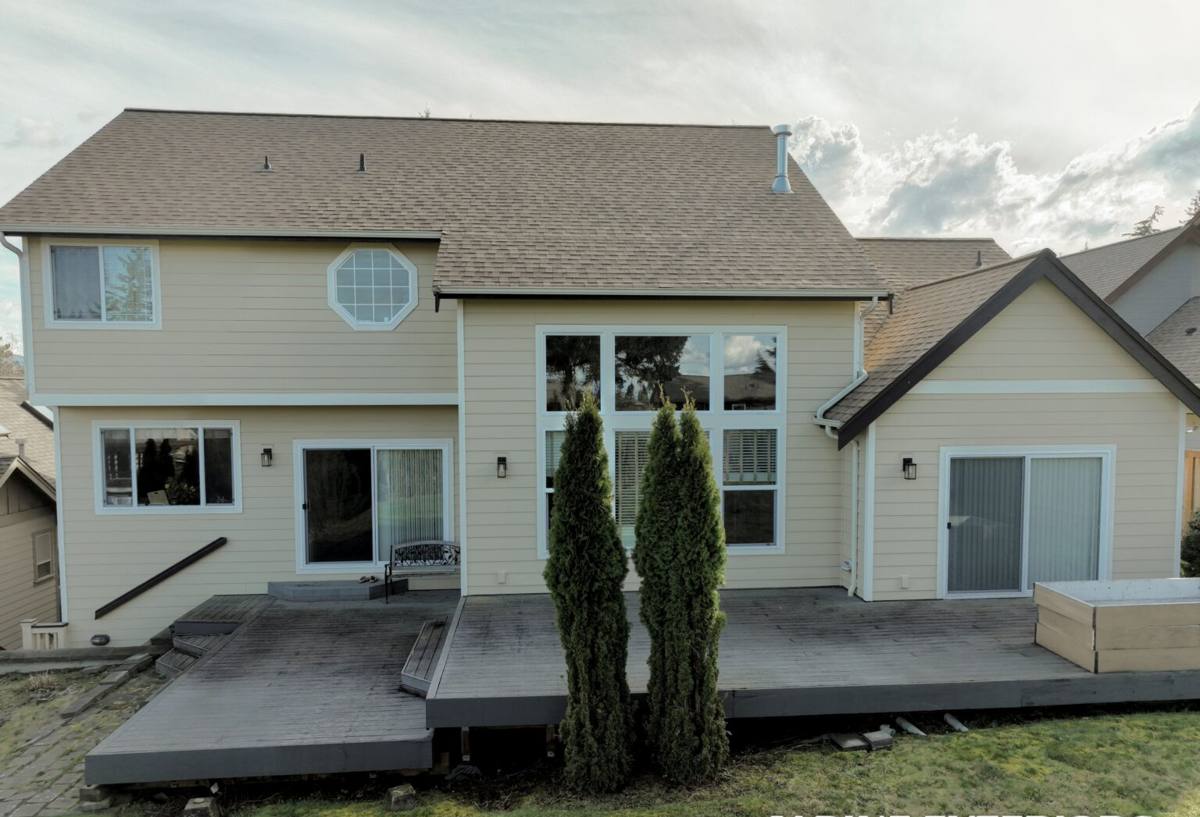
What Correct Deck Construction Looks Like Here
The Ledger and Home Connection
Most deck failures don't start in the decking boards — they start where the deck attaches to the house. The ledger board connection needs proper flashing that sheds water away from the rim joist, not just a bead of caulk and some lag bolts. In a climate with this much sustained rainfall, a poorly flashed ledger will trap water against the house framing, and rot can set in behind the siding long before anyone notices a problem on the deck surface itself.
Footings and Framing
Footings need to be poured to the correct frost depth and sized for the actual load, not just "what's always been done." Framing should be pressure-treated lumber rated for ground contact where it's close to grade, and every cut end and joist top should be protected — joist tape over the top of framing members keeps standing water from soaking into end grain, which is one of the fastest ways framing lumber fails in a wet climate. Grading and drainage underneath the deck matter too; water needs somewhere to go, not a place to pool and sit against posts and footings all winter.
Choosing Decking Material for a Wet, Salty Climate
There's no single "best" decking material — there's a best fit for your budget, your maintenance appetite, and how exposed your specific site is to rain and salt air. Here's how the common options actually compare for a Laurel property:
| Material | Moisture Behavior | Moss/Algae Resistance | Maintenance | Typical Lifespan |
|---|---|---|---|---|
| Pressure-treated wood | Absorbs and releases moisture; can cup or check if not sealed | Needs regular cleaning to resist growth | Annual cleaning, periodic staining/sealing | 15-20 years with upkeep |
| Composite decking | Low absorption; some early generations trapped surface moisture | Moderate; capped boards resist better than uncapped | Periodic washing, no staining needed | 25-30+ years |
| PVC/cellular decking | Does not absorb moisture | Good, especially with a textured cap | Lowest; occasional rinse | 25-30+ years |
| Cedar | Naturally moisture-resistant but still needs sealing here | Needs cleaning; moss takes hold if shaded/damp | Sealing every 1-2 years | 15-20 years with upkeep |
Wood costs less up front and has a warmth composite can't fully match, but it asks for real annual maintenance in this climate or it will show it. Composite and PVC cost more initially but make sense for homeowners who want to spend weekends doing something other than deck maintenance. We'll walk through the honest trade-offs for your specific site — sun exposure, shade, and how sheltered the deck is from wind-driven rain all affect which material makes sense.
Why We Don't Push Certain Wood Species
Some lower-grade or non-rated lumber shows up on the market priced to compete with proper decking, but it isn't rated for the ground-contact, high-moisture exposure a Laurel deck sees for most of the year. Our standard is to spec lumber and fasteners rated for the actual exposure category of your project, even when it costs a bit more, because replacing a deck in eight years instead of twenty isn't a trade-off we're willing to make on a customer's behalf.
Railings, Fasteners, and Hardware That Won't Corrode
Salt air is hard on metal, full stop. Standard zinc-coated fasteners can start showing surface corrosion within a few seasons this close to the water, which leads to unsightly staining on lighter decking and, eventually, weakened connections. We use stainless steel or high-grade coated fasteners rated for coastal exposure at every structural connection, not just where it's visible.
For railings, the material choice matters as much as the decking:
- Powder-coated aluminum — strong corrosion resistance, low maintenance, good choice for a clean modern look
- Cable railing — needs stainless cable and hardware specifically, otherwise it corrodes and loses tension faster than expected
- Composite railing — matches composite decking, resists moisture well, no painting or staining
- Wood railing — most traditional look, but requires the same sealing discipline as wood decking to hold up
Our Deck Building Process
Every project runs through the same sequence, whether it's a simple ground-level platform or a multi-level deck with stairs and built-in seating:
- Site visit and design — we look at drainage, sun/shade patterns, grade, and how the deck ties into the house before recommending materials
- Permitting and engineering — we handle the paperwork and, where required, structural engineering for guardrails, stairs, or elevated framing
- Footings and framing — footings poured to proper depth, framing built to span and load requirements, all connections flashed and protected
- Decking and railing installation — boards and railing installed with correct fastener spacing and gapping for drainage and material expansion
- Final walkthrough — we go over care and maintenance specific to the material you chose before we consider the job done
What Affects Your Deck Investment
Every deck is priced around a handful of real factors, not a flat per-square-foot number pulled out of the air:
| Factor | Why It Matters |
|---|---|
| Size and footprint | More square footage means more footings, framing, and decking material |
| Material choice | Wood, composite, and PVC carry different upfront costs and long-term maintenance costs |
| Elevation and stairs | A deck several feet off grade needs more structural framing and guardrails than a ground-level platform |
| Railing type | Aluminum, cable, composite, and wood railing systems all price differently by the linear foot |
| Site access and grading | Sloped or hard-to-reach sites take more labor to prep and frame correctly |
We'll walk your specific site and give you a real number based on what's actually there, not a generic estimate that changes once we start digging footings.
Keeping Moss and Algae From Taking Over
Even a well-built deck needs some seasonal attention in a climate where surfaces stay damp for months at a stretch. A few habits go a long way:
- Sweep debris out of board gaps regularly — trapped leaves and needles hold moisture against the decking
- Clean the deck surface at least once a year, more often in shaded or heavily wooded areas
- Trim back overhanging branches and vegetation to improve airflow and sun exposure
- Avoid high-pressure power washing on wood decking, which can damage the wood fibers and open it up to faster moisture absorption
- Check fastener heads and railing connections annually for early signs of corrosion or loosening
- Keep gutters and downspouts near the deck clear so runoff isn't dumping directly onto or under the structure
Permits and Site Considerations
Most new decks in this area require a building permit, particularly if the deck is attached to the house, elevated above a certain height, or includes guardrails and stairs. Setback requirements from property lines and easements can also come into play depending on your lot. We handle the permitting process as part of the job, including any engineering documentation the local jurisdiction requires for guardrails or elevated framing, so you're not the one tracking down requirements or submitting drawings.
Why Local Deck-Building Experience Matters in Laurel
A crew that already works in this part of Whatcom County has seen how the local climate actually plays out on real decks, not in a manufacturer's spec sheet. That means knowing which fastener grades hold up, which framing details fail first when they're skipped, and how drainage on a given lot behaves through a wet Pacific Northwest winter. It also means faster response if something needs a look after a big storm, and familiarity with the permitting expectations for projects in and around Lynden.
A deck is a long-term structure exposed to the harshest conditions your property sees all year. Building it to a standard that accounts for salt air, driving rain, and a long moss season isn't an extra — it's what determines whether you're maintaining a deck for twenty-five years or rebuilding one in eight.
If you're planning a new deck or replacing one that hasn't held up, we're happy to walk the site with you and put together a straightforward, no-pressure estimate. Use the form below to get started.