 Lynden Siding
 Building a Deck That Actually Holds Up in Acme
Acme sits in a part of Whatcom County where a deck doesn't just have to look good on a dry August afternoon — it has to survive a wet season that can run eight months out of the year, salt-tinged air drifting in off the bay, and enough shade from surrounding trees and hillsides that moss and algae get a real foothold on any horizontal wood surface. A deck built the same way you'd build one in Phoenix or Sacramento will not perform the same way here. The framing, the fasteners, the flashing details, and even the gap spacing between boards all need to account for what this climate does to a structure year after year.
This page is about one thing: building or rebuilding a deck for a home in the Acme area near Lynden, done right for our specific conditions. We're not going to walk through every deck in existence — just what matters for the ground you're standing on.
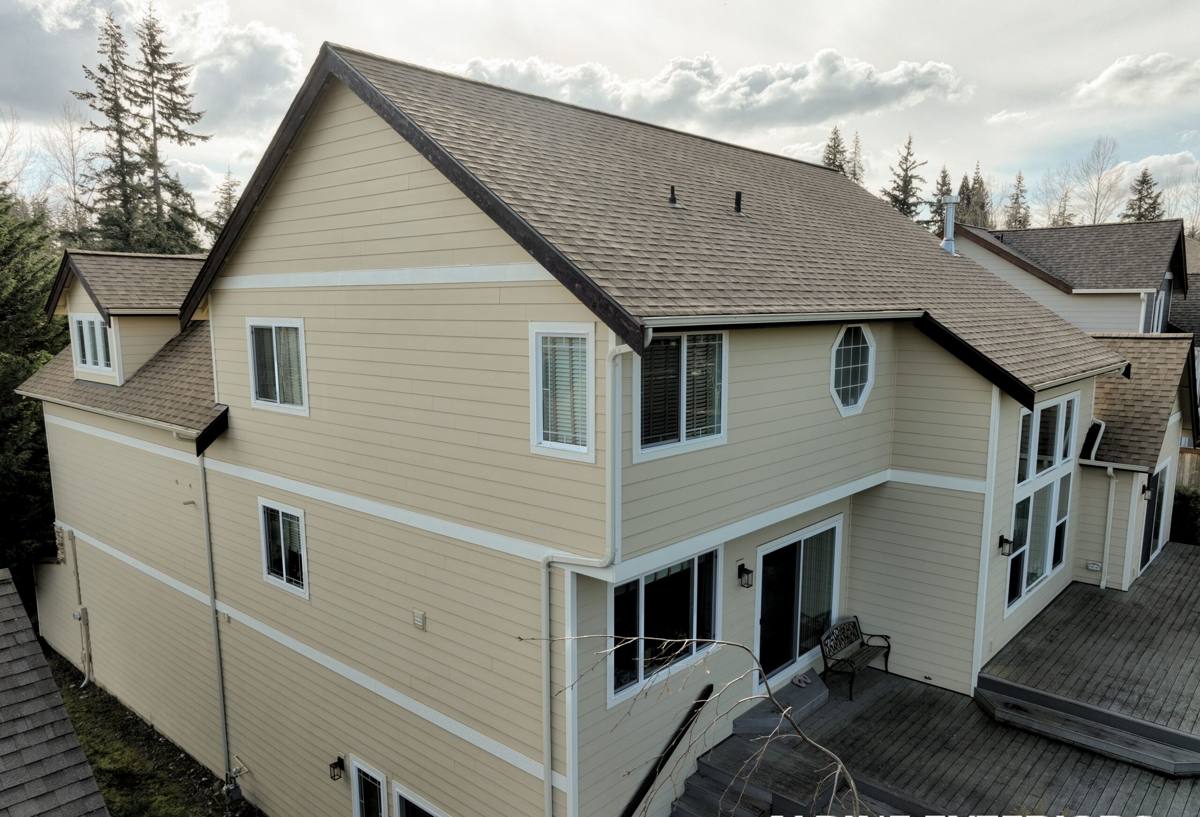
What Lynden-Area Weather Does to a Deck Over Time
Driving rain and standing moisture
Whatcom County rain rarely falls straight down — wind pushes it sideways into ledger boards, under poorly flashed rim joists, and into any gap where two pieces of wood meet without a drainage path. Over years, that moisture works its way into end grain and fastener holes, which is where rot almost always starts on a deck. It's not the face of the board that fails first; it's the hidden framing underneath.
Salt air and hardware corrosion
Being close enough to Puget Sound and Bellingham Bay to catch salt-laden air means metal hardware corrodes faster here than it would inland. Screws, joist hangers, and bolts that would last decades in a dry climate can start showing rust streaks and pitting in a fraction of that time if the wrong grade of fastener was used.
Moss, algae, and the long green season
Shade, moisture, and mild temperatures are exactly what moss and algae need to establish themselves. On a deck, that growth doesn't just look bad — it holds moisture against the board surface and turns smooth decking into a genuine slip hazard, especially on stairs. A deck built without moss in mind — tight board spacing, poor airflow underneath, north-facing exposure with no sun exposure to dry it out — will need pressure washing multiple times a year just to stay safe to walk on.
The Foundation Work Nobody Sees
A deck's long-term performance is decided before a single board of decking goes down. Footings need to be sized and set to the frost depth required in this part of Whatcom County, not just poured shallow because the soil looked firm that day. Undersized or shallow footings are one of the more common reasons an older deck starts to feel spongy, uneven, or visibly separated from the house over time — frost heave and saturated soil move the structure a little bit each winter until it's noticeably out of level.
Joist spacing and beam sizing also need to match the actual decking material and span, not a generic rule of thumb. Composite and PVC decking, in particular, often require tighter joist spacing than solid wood because they behave differently under load and temperature swings. Skipping that detail is a common corner cut that shows up as bounce or sag within a few years.
Ledger Board Attachment and Flashing
If there's one detail that determines whether a deck lasts 10 years or 30, it's how the ledger board — the piece that attaches the deck to the house — is fastened and flashed. This is also the single most common point of failure inspectors and contractors see on older decks in wet climates.
- The ledger needs to be through-bolted or lag-screwed with hardware rated for the load, not just nailed
- Proper flashing has to direct water away from the house sheathing, with a gap or drainage path so water can't collect behind it
- House wrap or building paper behind the ledger needs to be integrated with the flashing, not just covered over
- No caulk-only "flashing" — sealant fails long before a properly lapped flashing system does
Given how much driving rain this area sees, a ledger connection that's even slightly wrong will let water into the house's rim joist and framing, which is a far more expensive repair than the deck itself.
Choosing a Decking Material for This Climate
There's no single "best" decking material — there's a best fit for your budget, how much upkeep you want to do, and how much sun or shade your deck actually gets. Here's how the common options compare for a shaded, wet, salt-air environment like ours:
| Material | Moisture & Moss Behavior | Maintenance | Typical Lifespan Here |
|---|---|---|---|
| Pressure-treated wood | Absorbs water, prone to surface moss/algae in shade | Annual cleaning, re-staining every 2-3 years | 15-20 years with upkeep |
| Cedar | Naturally rot-resistant but still needs sealing; moss still grows on the surface film | Cleaning plus periodic sealant/stain | 15-25 years with upkeep |
| Capped composite | Won't rot or absorb water like wood; surface can still host algae/moss film that needs washing off | Occasional washing, no staining or sealing | 25-30+ years |
| PVC / cellular decking | Fully moisture-resistant core, best resistance to standing water and freeze-thaw cycling | Lowest — occasional washing only | 25-30+ years |
We install all of these depending on what a homeowner wants, but we'll always tell you honestly where a material's weak points are for our climate rather than just upselling the most expensive option. Composite and PVC cost more up front, but for a deck that gets heavy shade and rarely dries out, the reduced maintenance burden is real money and real weekends saved over 15-20 years.
Fasteners, Framing Hardware, and Board Spacing
Because of the salt air and near-constant humidity, we use stainless steel or heavy hot-dip galvanized fasteners and connectors rated for coastal/marine exposure — not the basic coated screws that are fine in a dry inland climate but will streak and weaken here within a few seasons. Joist hangers, post bases, and structural screws all get the same treatment; mismatched hardware (say, a stainless screw driven into a standard galvanized hanger) can actually accelerate corrosion through a reaction between the two metals, so the whole hardware system needs to be compatible, not just individually "good."
Board spacing matters more here than in a dry climate too. Gaps that are too tight trap moisture and organic debris, which speeds up both rot and moss growth. Gaps that are too wide feel unfinished and can be uncomfortable for bare feet or narrow shoe heels. We set spacing based on the specific board's expansion behavior — composite and PVC expand and contract with temperature more than most people expect, and a deck installed without accounting for that will show board buckling or gaps that open up unevenly within a year or two.
Railings, Stairs, and Code Requirements
Any deck more than a modest height off grade needs a code-compliant guardrail, and stairs need graspable handrails once they exceed a certain number of risers — the exact thresholds and spacing requirements are set by Washington's adopted building code and enforced locally. Baluster spacing, guardrail height, and stair rise/run all get checked at permit and inspection, and getting them wrong means costly rework after the fact. We build to these requirements as a baseline, not an afterthought bolted on to pass inspection.
Stairs deserve extra attention in a moss-prone climate specifically: tread material, nosing, and drainage on stair treads matter more than on the flat deck surface because a slick stair is a fall risk in a way a slick flat deck usually isn't. We think through stair tread choice and drainage separately from the main deck surface for that reason.
Our Process, Start to Finish
1. On-site assessment
We look at sun exposure, drainage, soil conditions, and how the deck will attach to the house before we talk materials or price. A deck plan that ignores your specific lot doesn't hold up.
2. Honest material conversation
We'll walk through wood versus composite versus PVC for your situation, including realistic maintenance expectations, not just the upfront number.
3. Permitting
Most deck construction in and around Lynden and unincorporated Whatcom County requires a permit once it exceeds a certain size or height — we handle that process rather than leaving it to you to sort out.
4. Framing and structural work
Footings to proper depth, correctly sized joists and beams, and a properly flashed ledger connection — the parts that determine whether the deck is still solid in fifteen years.
5. Decking, railing, and finish work
Installed with climate-appropriate spacing, marine-grade fasteners, and code-compliant railings and stairs.
6. Final walkthrough
We go over the finished deck with you, including what maintenance it actually needs and on what schedule — not a generic pamphlet, but specific guidance for your material and your site's sun/shade conditions.
Maintenance Checklist for an Acme-Area Deck
- Sweep debris (needles, leaves, seed pods) off the deck regularly — trapped organic matter holds moisture and feeds moss
- Wash the surface at least once or twice a year, more often on shaded sections, to remove algae and moss film before it builds up
- Check the ledger flashing area annually for any sign of water staining on the house siding just above or below the connection
- Inspect fastener heads and hardware yearly for rust streaks or corrosion, especially near the ground and on stair stringers
- Reseal or re-stain wood decking on the schedule appropriate to the product — don't wait until it visibly grays and cracks
- Keep gutters and downspouts near the deck clear so roof runoff isn't dumping extra water onto or under the deck structure
- Trim back overhanging branches where practical to reduce shade and debris load on the worst-affected sections
Why a Crew That Already Works in Acme Makes a Difference
A contractor who already works regularly in the Acme area around Lynden has a working sense of how the local soil drains, how much shade a typical lot gets from surrounding trees and terrain, and what the Whatcom County permitting process actually requires for a deck project — rather than learning all of that for the first time on your job. That familiarity shows up in fewer surprises during framing, fewer permit delays, and a finished deck that's built around how this specific area behaves rather than a generic regional average.
It also matters after the project is done. A crew based nearby can respond quickly if something needs a warranty check or a minor adjustment after the first winter, rather than you waiting on a contractor who has to schedule a special trip out from farther away.
Get a Straight Answer on Your Deck Project
If you're planning a new deck or need to replace one that's showing its age, we're happy to come take a look, walk the site with you, and give you an honest read on what it'll take — no pressure, no hard sell. Use the form below to request a free estimate for your Acme-area deck project.