 Lynden Siding
 Wiser Lake's Climate Asks More of Your Siding Than People Expect
Wiser Lake sits in the mix of open farmland and tree-lined residential lots that's typical of this stretch of Whatcom County, with some homes close to the water and others set back on quieter rural roads outside Lynden. It looks calm most of the year, but the exterior of a house here works harder than homeowners moving in from drier climates usually assume. Marine-influenced air pushes inland off the Strait of Georgia and Puget Sound for most of the year, driving rain comes in sideways during fall and winter storms, and the shaded, moisture-heavy conditions around tree cover and low-lying water create a moss season that can run longer than most siding products are built to tolerate.
None of that is dramatic on its own. The problem is cumulative. Siding on a Wiser Lake home isn't dealing with one hard winter — it's dealing with decades of repeated wetting and drying, shaded north walls that never fully dry out, and windblown moisture finding every seam, corner, and fastener point. This page is specifically about fiber cement siding for homes in this area: what the climate actually does to a wall system over time, what a correctly installed job looks like, and why we install only James Hardie fiber cement — not vinyl, not LP SmartSide, not cedar or primed spruce — on every home we work on, including here in Wiser Lake.
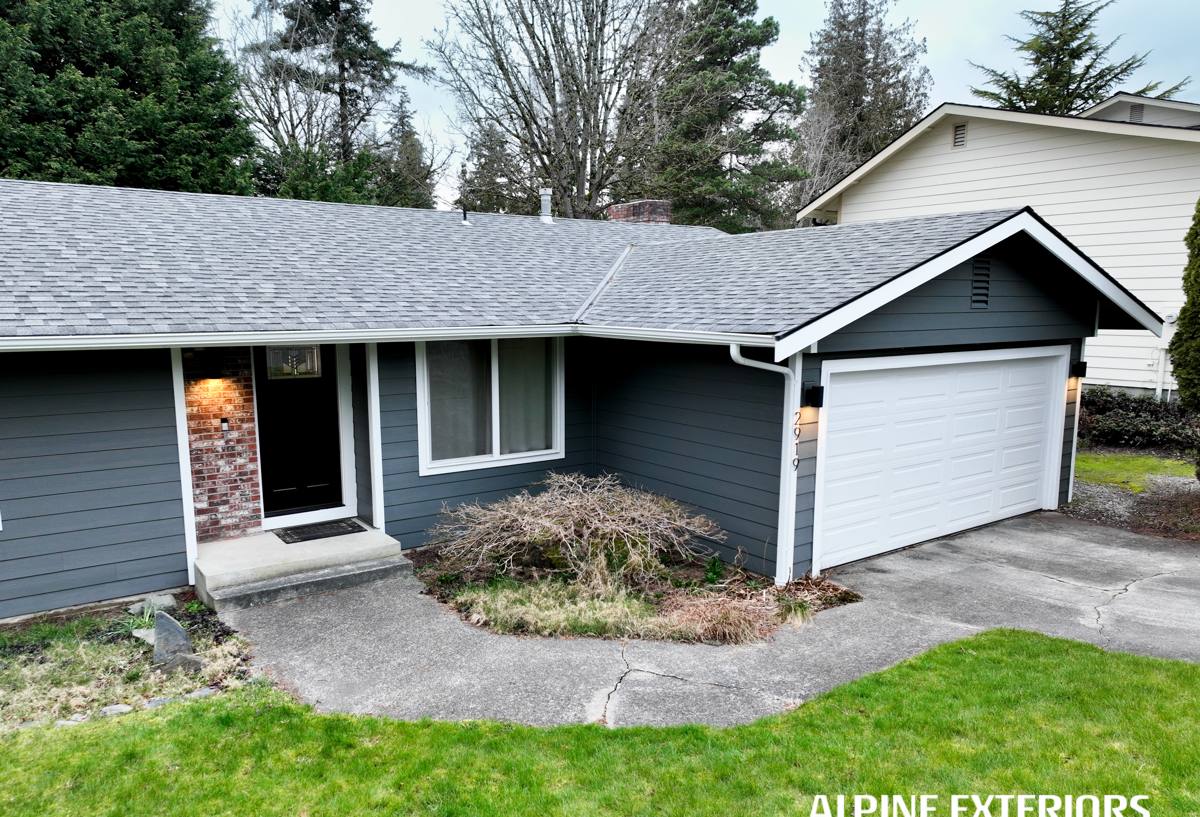
What the Local Climate Does to Siding Over Time
Moisture Load
Whatcom County gets a long wet season, and Wiser Lake's setting — closer to standing water and mature tree cover than a lot of in-town Lynden lots — tends to hold humidity a little longer after a storm passes. Siding here spends more days per year damp than siding on a drier, more exposed lot. Any product that absorbs water into its core, swells, or delaminates when wet is going to show it eventually, usually first at butt joints, corner boards, and anywhere caulking has started to fail.
Driving Rain and Wind-Driven Water
Storms coming off the water don't just fall straight down — wind pushes rain sideways into wall assemblies, especially on west- and south-facing elevations. That means water testing every lap, seam, and penetration in the siding, not just the flat field of the wall. A siding system is only as good as its weakest joint, which is why installation detailing matters as much as the material itself.
Moss, Algae, and Shaded Walls
Tree cover and lake-adjacent humidity create ideal conditions for moss and algae growth on north-facing and shaded walls. Some siding materials feed that growth — wood-based products in particular give organic material something to root into. Moss holds moisture against the wall surface long after the rest of the house has dried, which accelerates rot, paint failure, and fastener corrosion underneath.
Temperature Swings and UV
Whatcom County doesn't get extreme heat, but siding still goes through repeated expansion and contraction cycles across the seasons, and summer UV exposure breaks down cheaper factory or field-applied finishes faster than most homeowners expect. A finish that chalks, fades, or cracks lets moisture behind it, which starts the whole cycle over again.
Why We Install Only James Hardie Fiber Cement
We don't install vinyl, LP SmartSide, cedar, primed spruce, or other fiber cement brands. That's a deliberate standard, not a sales pitch, and it's worth explaining honestly rather than just asserting it. Each of those products has real strengths — vinyl is inexpensive and low-maintenance in mild climates, engineered wood products install quickly, and cedar has a look some homeowners genuinely prefer. But in a climate like Wiser Lake's, each one carries a trade-off we're not willing to put our name behind:
- Vinyl can warp, crack in cold snaps, and fade unevenly, and it relies on gaps and laps rather than a sealed surface, which lets moisture track behind it during driving rain.
- LP SmartSide and other engineered wood products use a wood-strand core that performs well when installation and caulking are perfect and degrades if either slips — and moss-heavy, high-moisture sites like this one leave little margin for error.
- Cedar and primed spruce are genuinely handsome but need ongoing refinishing, are attractive to moisture and insects, and in a long wet season require a maintenance commitment most homeowners underestimate when they buy the house.
James Hardie fiber cement is cement, sand, and cellulose fiber — it doesn't have an organic core for moss or rot to attack, it doesn't warp or crack from freeze-thaw cycling the way vinyl can, and its ColorPlus factory finish is baked on and warrantied against fading and peeling, rather than relying on a field-applied coat that starts degrading the day it's sprayed. It's also non-combustible, which matters on properties with more open land and, in some cases, closer tree lines. None of that means Hardie is maintenance-free — it still needs correct installation and periodic upkeep — but it's the product we've found actually holds up to this specific climate without asking homeowners to fight it every year.
What a Correct Fiber Cement Siding Job Actually Involves
Fiber cement is only as good as its installation. A rushed or under-detailed job can fail in this climate almost as fast as a lesser product, which is why the process matters as much as the material.
Water Management Behind the Siding
Before a single course of siding goes up, the wall needs a correctly lapped weather-resistive barrier, properly integrated flashing at every window, door, and penetration, and a drainage plane that lets any moisture that does get behind the siding find its way back out instead of sitting against the sheathing. This is the part of the job nobody sees once it's finished, and it's the part that determines whether the house stays dry for the next 30 years or starts rotting from the inside in year eight.
Clearance and Spacing
Hardie's own installation instructions call for specific clearances from grade, roof lines, decks, and other siding terminations — typically a minimum of several inches depending on the detail — precisely because standing water and splash-back are what cause premature failure at the bottom of a wall. On lake-adjacent and low-lying lots, we don't treat these clearances as a suggestion.
Fastening
Fiber cement needs to be fastened correctly — right fastener type, right spacing, right depth — to avoid cracking the board or leaving a loose panel that works itself free in wind. Over-driven or under-driven nails are one of the most common causes of early siding failure we see on homes that were sided by a crew unfamiliar with the product.
Joints, Caulking, and Trim
Every butt joint, corner, and trim intersection is a potential water entry point. Correct installation uses factory-mitered or properly caulked joints with a compatible, high-quality sealant — not a bead of whatever caulk was on the truck — and trim details that shed water away from the wall rather than trapping it.
Finish
We install Hardie's ColorPlus prefinished boards wherever possible, which gives a factory-baked finish with a longer, stronger warranty than field painting. Where field painting is unavoidable (custom colors, trim matching, repairs), it needs to be done with a paint system rated for fiber cement, not a generic exterior latex.
Choosing the Right Hardie Product for a Wiser Lake Home
Not every Hardie product is the right fit for every wall. Part of the estimate visit is looking at each elevation — how much shade it gets, how exposed it is to wind-driven rain, whether it's close to grade or water — and matching the product to the exposure.
| Product | Best Use | Why It Fits This Climate |
|---|---|---|
| HardiePlank lap siding | Primary field siding, most elevations | Classic lapped profile sheds driving rain well when installed with correct overlap and clearance |
| HardiePanel vertical siding | Accent walls, gables, modern designs | Fewer horizontal laps for water to catch on, often paired with battens for a clean look |
| HardieTrim boards | Corners, window and door surrounds, fascia | Dense, moisture-resistant trim that holds paint and caulk lines longer than dimensional lumber |
| ColorPlus factory finish | Any of the above | Baked-on finish resists the fading and peeling that shaded, damp walls accelerate |
Our Process From Estimate to Finished Job
- On-site walkthrough: We look at your home's specific exposures — shaded sides, low-clearance areas, existing moisture or rot damage — before recommending a product mix.
- Written estimate: A clear scope covering water-resistive barrier, flashing details, product selection, and finish, so you know exactly what's being installed and why.
- Removal and inspection: Old siding comes off and the sheathing underneath gets inspected for hidden rot or moisture damage before anything new goes up — this is often where a previous product's failures actually show up.
- Water management installed first: House wrap, flashing, and drainage details go in and get checked before the first course of siding is hung.
- Siding installation to spec: Correct fastening, clearances, and joint treatment throughout, following Hardie's published installation requirements.
- Final walkthrough: We go over the finished job with you, including what maintenance to expect and when.
What Drives Cost on a Job Like This
Every home is different, and we don't quote sight unseen, but these are the main factors that move a Wiser Lake fiber cement job up or down in price:
| Factor | Impact on Cost |
|---|---|
| Extent of existing damage or rot found at tear-off | Hidden sheathing repair is the most common source of change orders |
| Home size and wall complexity | More corners, dormers, and roof lines mean more trim and labor |
| Product mix (lap vs. panel vs. trim detail) | Vertical panel and custom trim work add labor over straightforward lap siding |
| ColorPlus vs. field-painted finish | Factory finish costs more upfront but avoids a repaint cycle later |
| Access and site conditions | Tree cover, slope, and proximity to water can affect staging and scheduling |
Maintaining Fiber Cement Siding in This Climate
Fiber cement is low-maintenance compared to wood, but "low-maintenance" isn't "no-maintenance," especially with the moss and moisture load around Wiser Lake. A short annual routine keeps a correctly installed job performing for decades:
- Rinse siding annually, focusing on shaded north- and east-facing walls where moss and algae take hold first
- Keep gutters clear so overflow isn't running down the wall face or pooling at the base of the siding
- Trim back tree branches and shrubs that keep a wall shaded and damp longer than necessary
- Check and refresh caulking at joints and trim every few years, before gaps open up
- Watch for any staining, bubbling paint, or soft spots at the bottom courses and near grade — early signs are cheap to fix, late ones aren't
- Repaint field-finished trim or siding on the manufacturer's recommended cycle rather than waiting for visible failure
Why Hiring a Crew That Already Works This Area Matters
A siding crew that mostly works drier, in-town lots can install a technically correct job that still underperforms on a lake-adjacent or shaded rural property, simply because they're not used to sizing up moss risk, water table proximity, or wind exposure specific to sites like this. Knowing which walls around Wiser Lake need extra attention to clearance and drainage, and which product details actually hold up to a long Whatcom County wet season, comes from doing this work locally and repeatedly — not from a generic install checklist. That local pattern recognition is part of what you're paying for as much as the labor itself.
If you're planning a siding project on a home in or around Wiser Lake, we're happy to walk the property, look at your specific exposures, and put together a straightforward estimate — no pressure, no obligation. Use the form below to get started.