 Lynden Siding
 Siding Installation Built for Bellingham's Coastline, Not a Generic Spec Sheet
Bellingham sits directly on Bellingham Bay, and that location shapes almost everything about how siding performs here. Homes closer to the water take a steady dose of salt-laden air across their walls, trim, and fasteners. Homes further up the hillsides and out toward the county line get less direct salt exposure but make up for it with more tree cover, more shade, and correspondingly longer stretches of damp siding through fall, winter, and spring. Add in driving rain that comes off Puget Sound sideways rather than straight down, and a moss season that can run most of the year on north-facing walls, and you end up with a climate that is genuinely tougher on exterior cladding than most siding products are designed to handle over the long run.
This page is about one job in one place: installing siding correctly on a Bellingham home. Not a general overview of siding materials, not a company-wide service list — the specific work of removing or preparing an existing wall assembly, installing James Hardie fiber cement to spec, and leaving a home that's actually ready for what this stretch of Whatcom County throws at it year after year.
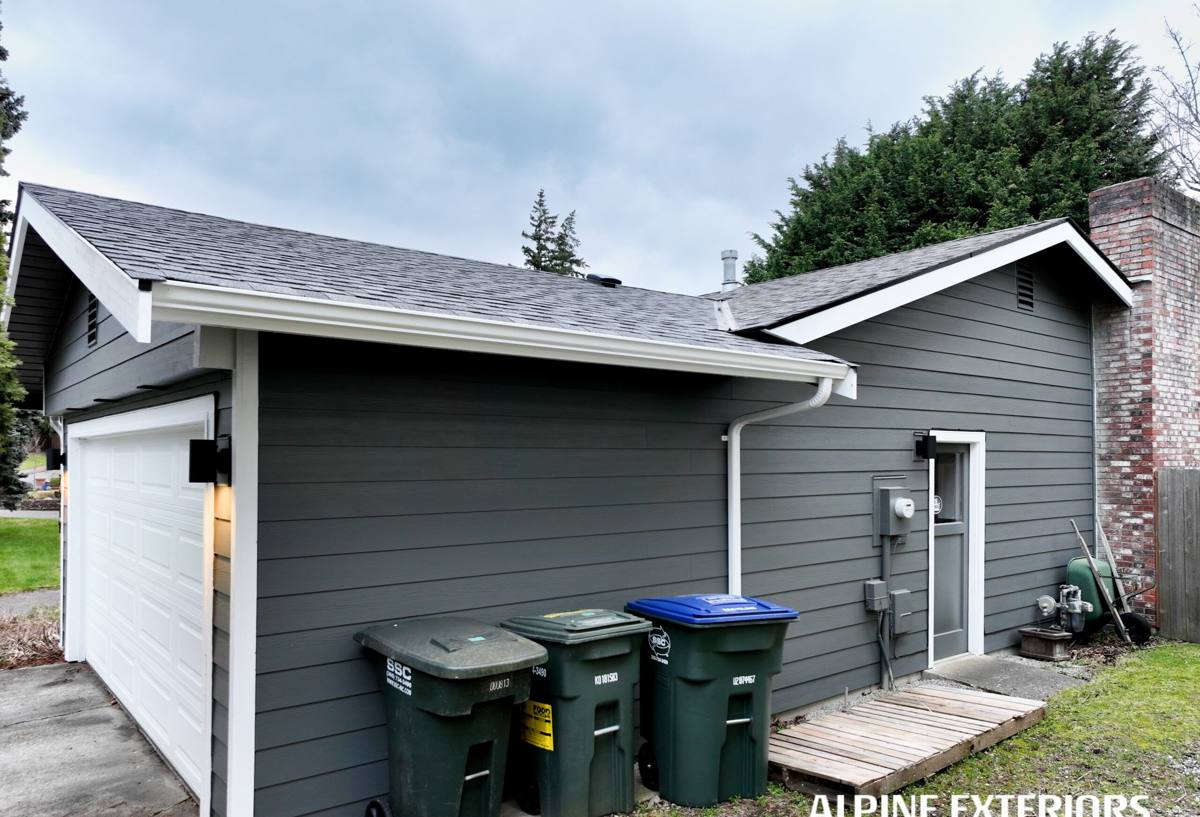
What Bellingham Homes Actually Need From a Siding Installation
Moisture Management Comes Before Material Choice
Long before the first piece of siding goes up, a correct installation depends on what's happening behind it. Bellingham's rain volume and duration mean a wall assembly needs a functioning weather-resistive barrier, correctly lapped flashing at every window and door, and a drainage plane that actually lets incidental moisture escape instead of trapping it against the sheathing. This is true for any siding material, but it matters more here than in drier parts of the state because the assembly gets tested by real weather almost every month of the year, not just during a few storm events.
Salt Exposure Changes Hardware and Fastener Choices
On homes closer to the bay, we pay close attention to fastener material and coating, along with flashing and trim hardware. Salt air accelerates corrosion on lower-grade fasteners over years, and a corroding fastener eventually loses its grip on the siding it's holding — a slow failure that's easy to miss until paint starts telling on it. This is a detail that gets skipped by installers who don't work this coastline regularly, because it doesn't show up as a problem in year one or two.
Shaded Walls Need Siding That Actually Sheds Moisture
Bellingham's mix of waterfront exposure and tree-covered residential streets means moss and mildew pressure varies a lot from wall to wall on the same house. A south-facing wall that gets sun and wind might dry out within a day of a storm. A shaded, tree-lined wall on the same home can stay damp for a week. Any siding material that's porous, or that holds water against the substrate rather than shedding it, becomes a long-term growth surface on those shaded exposures — which is a material-selection issue as much as an installation one.
Why James Hardie Fiber Cement Is the Right System for This Job
We install James Hardie fiber cement siding exclusively, and Bellingham's climate is a large part of the reason. We don't install LP SmartSide, vinyl siding, Cemplank, Allura, primed spruce, or cedar. Each of those products has a place in the broader market and plenty of satisfied homeowners elsewhere — our decision is a professional standard built around what holds up in sustained coastal moisture, not a claim that competing products are defective.
- Non-combustible fiber cement core: A real consideration for both fire safety and insurance underwriting, independent of climate.
- Factory-applied ColorPlus finish: Baked on under controlled conditions rather than field-applied, so it holds color and adhesion far longer under year-round moisture and UV exposure than a field-painted finish typically does.
- HZ5 climate-engineered formulation: Built specifically for regions with heavy moisture exposure and freeze-thaw cycling, which describes Bellingham and the surrounding Whatcom County coastline well.
- Dimensional stability: Fiber cement doesn't swell, cup, or warp the way engineered wood siding products can after repeated wetting-and-drying cycles across a wet season.
- Strong transferable warranty: Hardie backs the product with a robust warranty, provided installation follows their published specifications — which is where the installer matters as much as the material.
How the Common Alternatives Compare on This Coastline
| Material | What it gets right | Real-world trade-off in Bellingham's climate |
|---|---|---|
| Vinyl siding | Low upfront cost, low maintenance in mild climates | Can warp or become brittle with UV and temperature swings; seams and J-channels give salt-laden wind-driven rain more entry points |
| LP SmartSide (engineered wood) | Workable, familiar installation for many crews | Wood-based core is more moisture-sensitive; edge swelling shows up faster in a climate this wet if any cut edge isn't sealed perfectly |
| Cedar | Natural appearance many homeowners like | Needs ongoing refinishing to keep moisture out; shaded, damp walls accelerate rot and moss growth without regular upkeep |
| Primed spruce | Lower material cost | Field-primed finish is more vulnerable than factory-cured coatings; moisture intrusion at cut ends is a common long-term failure point |
| Cemplank / Allura (other fiber cement) | Similar core material to Hardie | We standardized on Hardie's specific product lines and warranty structure; running one system means our crew's expertise and stocked details are all built around it |
| James Hardie HZ5 fiber cement | Non-combustible, factory-finished, engineered for wet coastal climates | Higher material cost than vinyl or primed wood; requires correct installation to realize the warranty |
What a Correct Siding Installation Involves
Installing Hardie siding correctly is not simply nailing panels to a wall. The manufacturer's published installation specifications exist because fiber cement performs exactly as designed only when a handful of details are followed on every wall, every time.
- Tear-off and substrate inspection: Removing existing siding (where applicable) and inspecting the sheathing underneath for rot, soft spots, or prior water damage before anything new goes up.
- Weather-resistive barrier and flashing: Installing or verifying a continuous drainage plane, with flashing correctly lapped — shingle-style, top over bottom — at every window, door, and penetration.
- Rainscreen or furring where called for: On walls with heavy moisture exposure, a small air gap behind the siding lets any incidental moisture drain and dry instead of sitting against the panel.
- Correct fastener placement and spacing: Hardie specifies fastener type, spacing, and edge distance precisely; getting this wrong is one of the most common causes of premature siding failure.
- Proper joint and butt-seam treatment: Sealed or flashed correctly so seams don't become water entry points over years of wind-driven rain.
- Trim, corners, and transitions: Roof-to-wall intersections, deck ledger connections, and window returns are where most real-world leaks originate — these get extra attention, not an afterthought.
- Caulking and touch-up to ColorPlus standards: Using manufacturer-approved sealants and touch-up products so the factory finish isn't compromised at cut edges and joints.
How the Process Works on a Bellingham Home
Assessment and Estimate
We start with an on-site look at the home's current siding, the condition of the sheathing where accessible, and any problem areas — shaded walls with moss, trim that's showing water staining, or windows with a history of leaks. That assessment shapes a written estimate, including whether tear-off, sheathing repair, or a rainscreen detail is needed for that specific home.
Material and Color Selection
Hardie's ColorPlus lineup and profile options (lap siding, shingle-style panels, board-and-batten, and trim) get selected based on the home's style and the homeowner's preference, with an eye toward how a given color and sheen will hold up under this area's UV and moisture exposure.
Installation
Our crew installs to Hardie's published specifications on every wall — flashing, fastening, joint treatment, and trim details included — rather than a stripped-down version that looks the same on installation day but performs differently five years in.
Final Walkthrough
Before we call a job finished, we walk the exterior with the homeowner, checking seams, trim, and transitions, and answering any questions about care or warranty registration.
Why Hiring a Crew That Already Works This Area Matters
A siding installer who works Bellingham and the surrounding Whatcom County coastline regularly has already made the judgment calls that a crew unfamiliar with this climate has to learn on your house. That includes knowing which walls on a typical Bellingham lot need a rainscreen detail and which don't, what fastener grade holds up near the bay, and which roof-to-wall transitions tend to leak first in this rain pattern. None of that is exotic knowledge — it's just the accumulated result of doing this work, on this coastline, over and over.
It also means a crew that's still going to be around if a warranty question comes up years later, rather than one that bid the job once and moved on to the next region.
Signs Your Bellingham Home May Need New Siding
- Visible moss or dark streaking on shaded walls that returns shortly after cleaning
- Soft spots, bubbling, or warping in the current siding material
- Paint that's failing faster than expected, especially on walls facing the water or prevailing wind
- Gaps opening at trim, corner boards, or window casings
- Water staining on interior walls near exterior corners or window headers
- Siding that's simply reached the end of its expected service life and is due for replacement before it fails
What This Work Typically Costs
Cost on any given Bellingham home depends on square footage, the number of stories, how much trim and detail work the home has, whether tear-off and sheathing repair are needed, and color and profile selection. Rather than quote a number that doesn't reflect your specific home, we provide a written estimate after an on-site assessment, broken out so you can see what's driving the cost.
If you're weighing a siding project on a Bellingham home, we're glad to come take a look and put together a straightforward, no-pressure estimate — use the form below to get started.