 Lynden Siding
 James Hardie Siding for Laurel-Area Homes
Laurel sits in the farm country northeast of Lynden, in a part of Whatcom County where the weather doesn't announce itself with a single obvious threat the way a coastal storm town's might. Instead it wears a house down slowly, in three overlapping ways: rain that blows in sideways during a real system rather than falling straight down, marine air carrying a trace of salt that pushes inland off Bellingham Bay and the Georgia Strait during wet weather, and a moss and mildew season that runs longer here than most homeowners expect. None of those three is dramatic on its own. Together, over years, they're exactly what determines whether a home's siding is still doing its job at year fifteen or already failing at year eight.
This page is about one thing specifically: James Hardie fiber cement siding, installed correctly, on a home in the Laurel area. We install Hardie exclusively — not as a marketing position, but because after years of exterior work across Whatcom County, it's the material we trust to actually hold up to what this specific climate does to a wall.
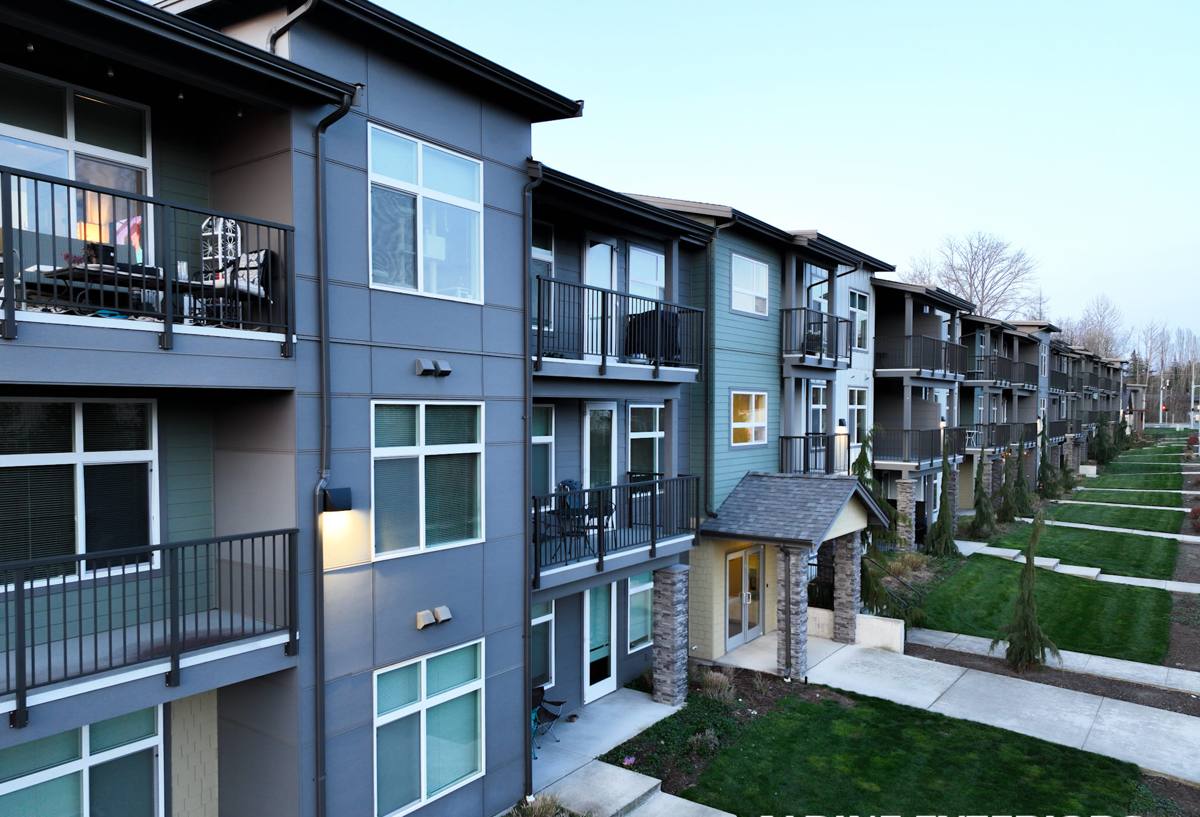
What Laurel's Climate Does to Siding
Driving Rain
Storm systems moving through this part of Whatcom County don't drop rain straight down as often as homeowners assume. Wind pushes it sideways into walls, corners, and window trim, which means siding here has to shed water that's actively being driven at it, not just falling on it. Lap siding installed with tight, correct overlap and properly flashed joints handles that fine. Siding installed with shortcuts on overlap or flashing tends to show its first water staining at exactly those pressure points — seams, corners, and anywhere trim meets a wall.
Salt-Tinged Marine Air
Laurel isn't a waterfront property, but it's close enough to Bellingham Bay and the broader Puget Sound marine layer that moisture-laden, salt-tinged air moves through on a regular basis, especially during and after storm systems pushing in off the water. That air doesn't hit a Laurel home as hard as it hits a place sitting right on the shoreline, but it's a real factor in how fast exposed fasteners, trim, and lower-grade siding materials age compared to a home further inland or further from the water's influence.
A Long Moss Season
Mild, wet weather that lingers for much of the year gives moss and mildew a season that stretches well beyond a couple of rainy months. Shaded walls, north-facing elevations, and anywhere tree cover blocks sun and airflow are the first places it shows up as staining or green growth. It's not just cosmetic — moss and mildew hold moisture directly against a wall, and a siding material with any surface porosity gives that growth something to grip onto and keep wet.
Freeze-Thaw Cycling
Whatcom County sees genuine winter cold snaps, and Laurel's inland setting means it can run a few degrees colder on a hard-frost night than a home closer to the moderating effect of the water. Moisture that's worked its way into a porous or poorly sealed siding material and then freezes expands as ice, and that expansion accelerates cracking in a way that a purely wet-but-mild climate wouldn't produce on its own.
Why James Hardie Is the Only Siding We Install
We narrowed our siding work to one system after years of watching which materials actually held up under this exact combination of driving rain, marine-influenced humidity, and freeze-thaw, and which ones quietly turned into maintenance problems for homeowners a few years after installation. For a property in the Laurel area, the case for fiber cement over the alternatives is a practical one, not a brand preference.
- Non-combustible core: Fiber cement doesn't feed a fire the way wood-based or wood-derived siding can, which matters for household safety and can matter for insurance underwriting too.
- Factory-applied ColorPlus finish: Color is baked on under controlled factory conditions rather than brushed on in the field, so it resists fading, chalking, and moisture intrusion far longer than site-applied paint on wood or engineered wood siding.
- Climate-engineered HZ formulations: Hardie builds different product formulations for different climate zones, including versions engineered for regions with sustained moisture exposure — a genuine match for a Whatcom County property that sees this much rain and humidity.
- Dimensional stability: Fiber cement doesn't swell, cup, or warp the way engineered wood siding can after repeated wet-season moisture cycles, which matters more here given how long the wet season actually runs.
- A real, transferable warranty: Hardie backs its products with a solid warranty structure when installation follows spec, giving a homeowner actual protection instead of a line in a sales brochure.
We don't install LP SmartSide, vinyl siding, Cemplank, Allura, primed spruce, or cedar. Each has its place in the broader market, and plenty of homeowners elsewhere are satisfied with them. But we made a professional decision that standing behind one system we trust completely, installed correctly, serves a homeowner better than offering a cheaper option that tends to shift maintenance burden — and sometimes hidden repair costs — back onto them a decade down the road.
Choosing the Right Hardie Product for a Laurel Home
| Product Line | Best Use | Why It Fits This Area |
|---|---|---|
| HardiePlank lap siding | Most single-family homes, traditional and farmhouse styles | Classic lap profile sheds wind-driven rain effectively when overlap and flashing are done correctly |
| HardiePanel vertical siding | Gables, accent walls, modern or board-and-batten looks | Clean vertical lines that suit the rural and farmhouse-style homes common around Laurel and Lynden |
| HardieShingle siding | Craftsman-style homes and accent sections | Textured, shingled appearance without the moisture absorption and upkeep of real wood shingle |
| HardieTrim boards | Corners, window and door casing, fascia | Factory-finished trim resists the same rain and freeze-thaw cycling as the field siding around it |
The right profile and color come down to the individual home, its style, and the homeowner's preference. But the underlying product family and how it's detailed for wind and moisture exposure stay consistent — we spec what actually fits a Laurel property rather than defaulting to whatever's fastest to install.
What a Correct Installation Involves
The siding material only gets a Laurel home halfway there. The rest comes down to installation details that determine whether that material actually performs the way it's engineered to over 20, 30, or more years. A correct install here includes:
- Fastening patterns and nail placement that follow Hardie's spec for the specific product and climate zone, not a generic pattern used on every job regardless of exposure
- Correct clearance between the bottom of the siding and grade, so it isn't sitting close enough to wick up ground moisture during the wet season
- Joints that are properly lapped, blocked, and sealed rather than simply butted together and caulked over
- A house wrap and flashing system doing the actual work of keeping water out, with caulk used to finish details rather than to cover gaps that shouldn't be there
- Careful flashing and sealing around every window, door, and penetration, since those are the points where wind-driven rain finds its way in first
- Attention to ventilation behind the siding so moisture that does get past the outer layer has a way to dry out instead of sitting against the sheathing
Skip any one of these and the siding can still look fine for a year or two. On a property that sees this much sustained moisture, the shortcuts usually surface as staining, soft trim, or a failed seam well before the material itself would have worn out on its own.
Repair vs. Full Replacement
Not every siding problem on a Laurel home calls for a full tear-off. A section damaged by impact, an isolated trim failure around a window, or storm damage to a limited area can often be repaired and matched into existing Hardie siding without redoing the whole exterior. But if water has been tracking behind the wall for a while, or the home still has an older, non-Hardie product that's reaching the end of its service life, patching it usually just delays a larger job while hidden rot keeps spreading behind the surface. We'll tell you plainly which situation you're actually looking at before we recommend anything.
Siding Readiness Checklist
- Walls checked for soft spots, staining, or visible gaps at seams and corners
- Trim and flashing around windows and doors inspected for cracking or separation
- Shaded and north-facing walls checked for moss, mildew, or persistent dark staining
- Grade clearance confirmed so siding isn't sitting too close to wet ground
- Caulk lines inspected for cracking, since failed caulk is often the first visible sign of a bigger problem underneath
- Recent energy bills reviewed for signs the wall assembly may no longer be sealing as well as it should
How Our Process Works
We start with a walk of the home to look at the current siding, trim, and any visible trouble spots, and to talk through what you actually want out of the project — full replacement, a repair, or an honest opinion on which one you're looking at. From there we go over product and profile options that fit the home's style and the budget, and explain why we're recommending a particular Hardie line for that specific wall or elevation.
Once a scope is agreed on, the work follows the sequence that actually protects a home in this climate: removing the old siding and inspecting the sheathing underneath for hidden moisture damage, repairing anything compromised before new material goes up, installing house wrap and flashing correctly at every window, door, and penetration, then installing the Hardie siding itself to spec — correct fastening, correct overlap, correct clearance from grade. We finish with trim, caulking at the details that actually need it, and a walkthrough of what the finished product needs from you going forward, which for properly installed Hardie siding is minimal.
Cost Factors for a Laurel Siding Project
| Factor | What It Affects | Why It Matters in This Area |
|---|---|---|
| Substrate condition | Repair costs before new siding goes on | Long-term trapped moisture from driving rain and moss can rot sheathing that isn't visible until the old siding comes off |
| Full tear-off vs. partial replacement | Labor scope and timeline | Tear-off is the only way to confirm what's actually happening behind older, non-Hardie siding |
| Product line and profile | Material cost | Lap, panel, and shingle profiles carry different material and labor requirements |
| Trim and detail work | Labor time | Farmhouse and craftsman-style homes common around Laurel often have more trim detail than a simple box home |
| Site access | Labor time and equipment needs | Rural properties around Laurel can have longer driveways or more staging distance than an in-town Lynden lot |
Exact pricing depends on the specific home, its current condition, and the scope once we've actually looked at it — which is why we walk the property in person before giving a real number rather than quoting off a generic price sheet over the phone.
Why It Matters That We Already Work in Laurel
A crew that mostly works in-town jobs closer to downtown Lynden can still install Hardie siding competently, but a rural property out toward Laurel has a few things that don't come up as consistently elsewhere — longer driveways and different staging needs, farmhouse and outbuilding-style architecture with more trim detail, and the same driving rain, marine-influenced humidity, and moss pressure that shapes exterior work across this part of Whatcom County, just on a property that sits a little further from town. Working this area regularly means we're not guessing at those variables on your job. We've seen which fastening details and flashing approaches hold up here and which ones are worth the extra time rather than an unnecessary upsell.
That familiarity also shows up in smaller judgment calls — which wall orientations on a typical Laurel property stay wet longest through the winter, or being straightforward with a homeowner about what their home's siding actually needs versus what's just an extra line item on an invoice.
Get a Straight Answer About Your Siding
Whether you're dealing with visible siding damage, planning ahead for a full re-side, or just want an honest read on what condition your home's exterior is actually in, we're glad to take a look. Reach out using the form below to schedule a free, no-pressure estimate for your Laurel-area home.