 Lynden Siding
 Building Decks That Actually Hold Up in Ferndale
Ferndale sits close enough to the Salish Sea that salt-laden air reaches yards and decks year-round, and it sits squarely in the same wet, gray stretch of Whatcom County weather that soaks Lynden, Bellingham, and everywhere in between. A deck built here has to survive a combination most manufacturers' spec sheets don't fully account for: airborne salt that accelerates corrosion on fasteners and hardware, months of driving rain that finds every gap in flashing and framing, and a long moss season where anything shaded or low to the ground stays damp far longer than it would inland. We build custom decks specifically with that combination in mind, not a generic "deck package" pulled from a catalog.
This page is about one service, in one place: custom deck design and construction for homes in and around Ferndale. If you're comparing decking materials, thinking through layout, or trying to figure out why a deck built five years ago is already showing rot, this is written for that conversation.
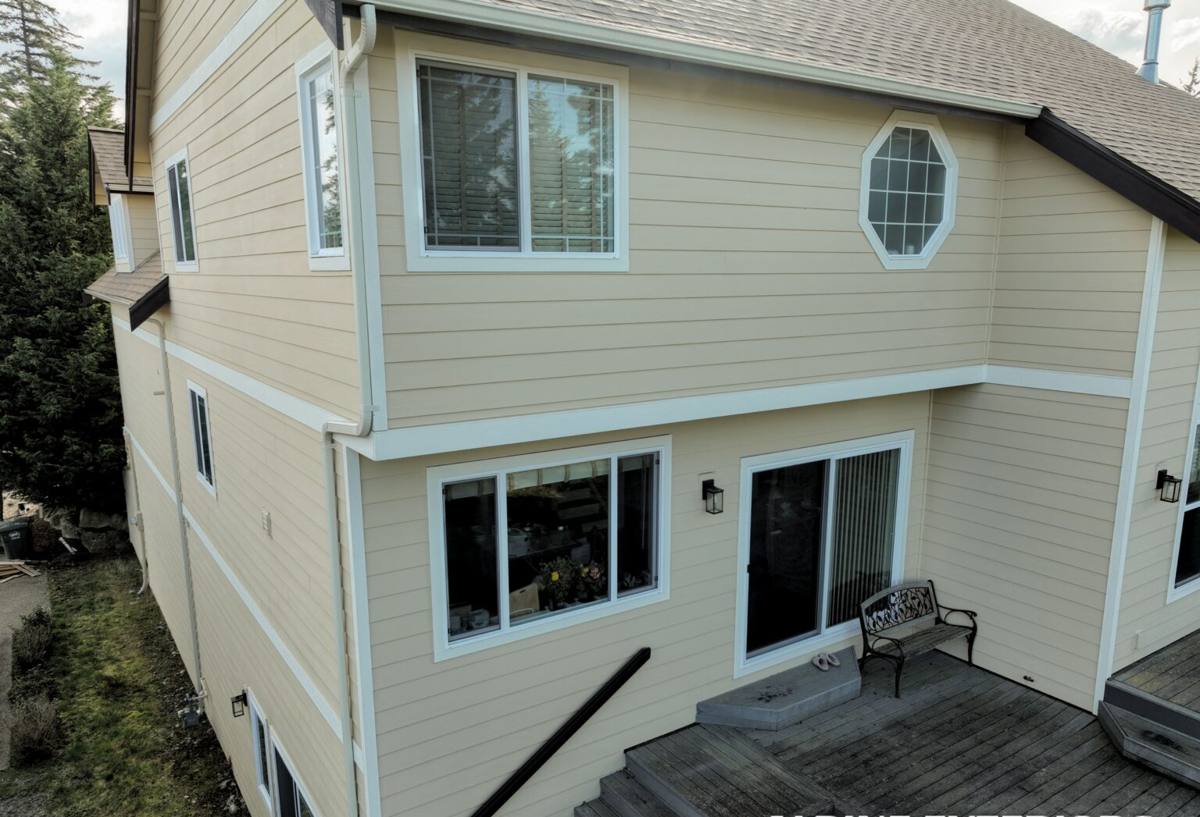
What Ferndale's Climate Actually Does to a Deck
Every coastal Whatcom County property deals with some version of the same three stressors. Understanding them changes how a deck should be designed, not just what it's built from.
Salt Air and Hardware Corrosion
Salt air doesn't just affect properties directly on the water. Wind carries fine salt particles inland, and they settle on any exposed metal — screws, joist hangers, post bases, railing brackets. Standard galvanized fasteners can start showing rust streaks within a couple of seasons in a salt-exposed yard. That streaking isn't just cosmetic; it means the fastener is corroding from the inside, which is a structural issue over time, not just an appearance one.
Driving Rain and Water Intrusion
Whatcom County rain often comes in sideways, pushed by wind off the water. That matters for ledger board flashing, stair stringer connections, and any point where the deck meets the house. A deck that would be fine under straight-down rain can still take on water at these joints when rain is driven horizontally against the structure.
Moss and Prolonged Dampness
Long gray stretches mean surfaces stay wet for days at a time, and shaded or north-facing decks may never fully dry between rain events. Moss and algae take hold on any surface that holds moisture, and beyond making boards slippery, trapped moisture underneath moss growth is what actually feeds rot in real wood decking.
What a Correct Deck Build Looks Like Here
None of the climate factors above are exotic — they're just constant. A deck built correctly for Ferndale accounts for all three from the framing stage forward, not as an afterthought.
- Stainless or coated fasteners rated for coastal/marine exposure, not the standard galvanized hardware used in drier inland regions.
- Proper ledger flashing with a drip cap and self-adhering membrane behind it, sealing the single most common failure point on any attached deck.
- Joist tape on top of framing lumber so fasteners don't create a direct path for water into the wood grain.
- Airflow underneath the deck — adequate ground clearance and post spacing so the underside can dry out between rain events instead of staying damp.
- Board spacing tuned to the decking material, wide enough for drainage and airflow without creating a trip hazard or gaps that trap debris.
- Footings set below frost depth and on stable bearing soil, verified for the specific lot rather than assumed from a standard plan.
Skipping any one of these doesn't usually cause an obvious problem in year one. It shows up in year four or five, as soft spots near the house, rust bleeding through composite boards at fastener points, or a railing post that's gone spongy at the base.
Choosing a Decking Material for This Climate
There isn't a single "best" decking material — there's a best fit for how you'll use the deck, your maintenance appetite, and your budget. Here's how the common options actually perform under Ferndale's specific conditions.
| Material | How it handles salt air & rain | Moss/algae resistance | Maintenance |
|---|---|---|---|
| Pressure-treated wood | Good if fasteners and flashing are done correctly; wood itself is durable | Needs regular cleaning and sealing to resist moss | Annual cleaning, re-sealing every 2-3 years |
| Cedar | Naturally rot-resistant, but softer and more sensitive to fastener choice | Better natural resistance than pressure-treated pine, still needs upkeep | Regular sealing to maintain appearance and protection |
| Composite decking | Excellent — doesn't absorb water or corrode | Surface algae can still grow; needs periodic washing | Low — occasional washing, no sealing or staining |
| PVC decking | Excellent — fully synthetic, no wood fiber to hold moisture | Very good; smoother surfaces shed moss more easily | Lowest — wash as needed |
We install all of these depending on what a homeowner wants, but we'll always tell you honestly where a material's weak point is for your specific yard. A heavily shaded, moss-prone lot is a different conversation than an open, sunny one, even a few streets apart.
A Note on Composite and PVC Warranties
Composite and PVC manufacturers offer strong warranties, but those warranties are typically conditioned on correct installation — proper spacing, approved fasteners, and manufacturer-specified substructure ventilation. An installer unfamiliar with a given product line can void that warranty without realizing it. Part of what you're paying for with an experienced crew is installation that actually keeps the manufacturer warranty intact.
Our Process for Ferndale Deck Projects
- On-site assessment. We look at sun exposure, drainage, existing grade, and how exposed the site is to prevailing wind and salt air, since that varies even within Ferndale depending on elevation and tree cover.
- Design and material conversation. We talk through layout, railing style, stairs, and decking material honestly, including trade-offs, not just upsells.
- Permitting. Most deck projects in Whatcom County require a permit, particularly for attached decks above a certain height or footprint. We handle that process rather than leaving it to the homeowner.
- Framing and flashing. This is where the climate-specific details — ledger flashing, joist tape, fastener grade — actually get built in, and it's the stage that determines how the deck performs in year five, not year one.
- Decking, railing, and finish work. Final surface installation, railing systems, and any stairs or lighting.
- Final walkthrough. We go over maintenance expectations specific to your material choice and site conditions before we consider the job done.
Cost Factors for a Ferndale Deck Project
Every deck project is different, so we're not going to pretend there's one number that fits all of them. What we can do is walk through what actually moves the cost.
| Factor | Why it affects cost |
|---|---|
| Decking material | Pressure-treated is the lowest upfront cost; PVC and premium composites cost more but need far less long-term maintenance |
| Height and grade | A deck built well above grade needs more substructure, railing, and often stairs, which adds material and labor |
| Attached vs. freestanding | Attached decks need ledger flashing work tied into the house; freestanding decks avoid that but need their own independent footing layout |
| Railing style | Basic wood or metal railing costs less than glass panel or cable rail systems |
| Site access and prep | Sloped, wet, or hard-to-access yards add labor time for excavation and footing work |
| Permit requirements | Larger or higher decks may need engineered plans in addition to standard permitting |
We'll walk through these specifics for your property during the estimate rather than quoting a rough number sight unseen.
Signs an Existing Deck Needs Attention
If you're not building new but wondering whether your current deck needs repair or replacement, a few signs are worth checking for before another wet season sets in.
- Soft or spongy decking, especially near the house or in shaded corners where moisture lingers longest.
- Rust staining around fastener heads, which signals hardware that's corroding under a coastal salt-air load.
- Persistent moss or algae that returns quickly after cleaning, which often points to poor airflow underneath rather than just a surface issue.
- Gaps or separation where the deck meets the house, a common entry point for driving rain.
- Railing posts that flex or feel loose at the base.
Some of these are simple repairs. Others mean the framing underneath has already been compromised and a rebuild is the more honest recommendation — we'll tell you which is which rather than defaulting to the bigger job.
Why a Crew That Already Works Ferndale Matters
Building codes, permit requirements, and typical soil conditions vary by jurisdiction, and Whatcom County's coastal communities have their own patterns worth knowing before the first footing goes in. A crew that already works in Ferndale isn't guessing at how exposed a given lot is to salt air and wind, or which yards tend to hold moisture longest through the winter — that's information you only get from doing the work here repeatedly, not from a spec sheet. It also means we're a known, reachable local business if a warranty question or maintenance question comes up years down the line, not a crew that drove in from out of the area for one job and is hard to reach afterward.
Get a Free Estimate for Your Ferndale Deck
Whether you're planning a new deck from scratch, replacing one that's past its prime, or just want an honest opinion on what your current deck needs, we're happy to take a look. Use the form below to request a free, no-pressure estimate for your Ferndale property.