 Lynden Siding
 Deming's Climate Is Hard on Siding — Here's Why
Deming sits in the Nooksack River valley, tucked between dense evergreen tree cover and the foothills leading up toward Mount Baker. That setting is beautiful, and it's also a tough environment for exterior building materials. Homes here deal with driving rain that comes sideways during winter storms, salt-tinged marine air that pushes inland from the Sound on prevailing winds, and long stretches of shade and dampness that keep moss and algae established on roofs and walls far longer than in drier parts of the state.
Add in heavy tree canopy on a lot of Deming properties — more shade, more standing moisture, more organic debris collecting against siding and trim — and you have conditions that will find every weak point in a siding system. Caulk joints crack and let water behind the cladding. Untreated cut edges wick moisture. Paint film fails years before the manufacturer's warranty says it should. None of this is unique to Deming, but it's more pronounced here than in a lot of Whatcom County because of the combination of rainfall, shade, and river-valley humidity.
That's the backdrop for every siding decision on a Deming home: what you install, and how it's installed, has to hold up to sustained moisture exposure and moss growth year after year, not just look good on install day.
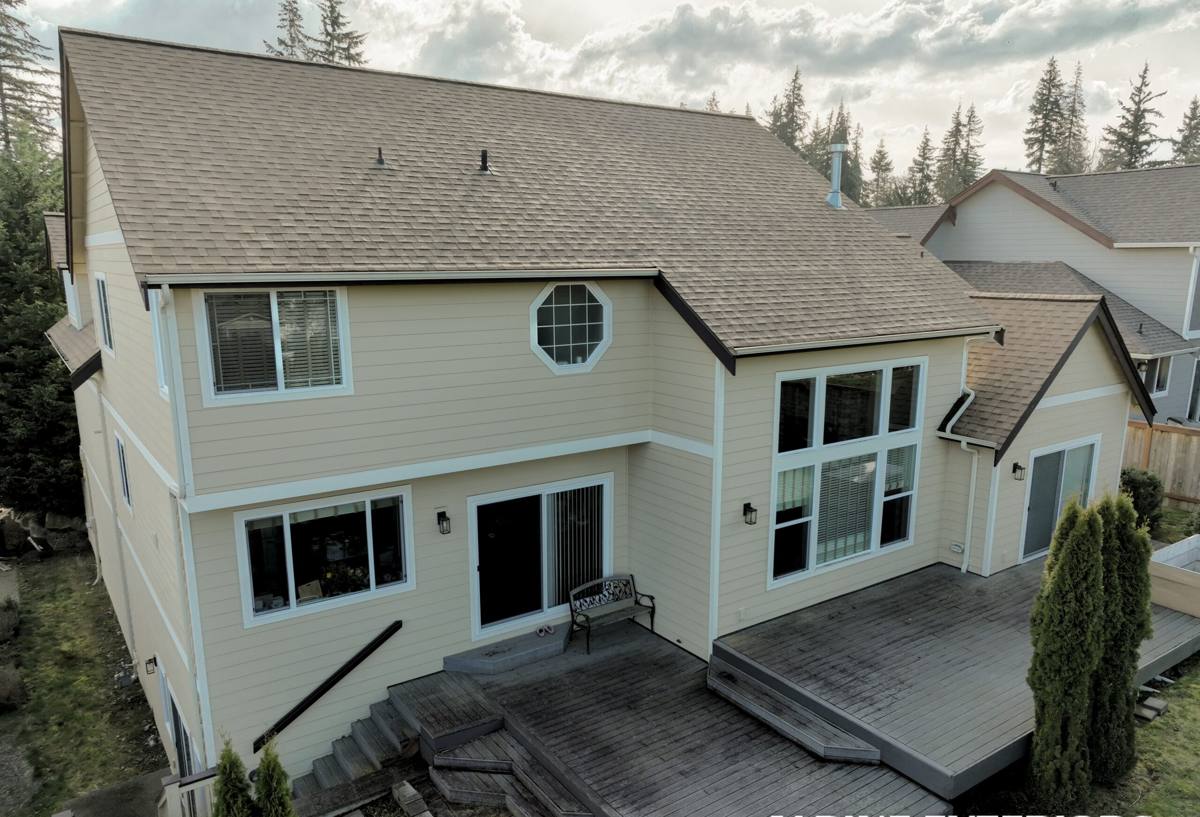
Why Fiber Cement Is the Right Call for This Kind of Weather
Fiber cement siding is made from cement, sand, and cellulose fiber, pressed and cured into a dense, dimensionally stable board. Unlike wood-based products, it doesn't swell, rot, or delaminate when it stays wet for extended periods — which matters a great deal in a valley that sees long, damp winters and slow-drying shaded walls. It's also non-combustible, which is a real consideration for properties near the wooded foothills east of Lynden, where wildfire risk during dry summer stretches is part of the conversation for rural and semi-rural homes.
Where fiber cement earns its keep in Deming specifically is moisture stability. A wall that stays damp for days after a storm needs a cladding material that won't absorb that moisture into its structure and start breaking down from the inside. Fiber cement resists that kind of degradation far better than wood, engineered wood, or many composite products, and it holds paint and factory finishes longer in a climate where UV exposure is low but moisture exposure is constant.
What a Correct Fiber Cement Installation Actually Involves
Fiber cement is only as good as the installation behind it. The board itself is durable, but the assembly — flashing, water management, fastening, and joint treatment — is what actually keeps water out of the wall. This is where a lot of siding jobs, on any product, quietly fail.
Water Management Behind the Board
Every fiber cement installation we do starts with a weather-resistive barrier and correctly lapped flashing at every window, door, and penetration. In a high-rainfall environment like Deming, we also look hard at whether a drainage plane (rainscreen) makes sense for the specific wall assembly, so any moisture that does get past the cladding has somewhere to go instead of sitting against the sheathing.
Clearances and Cut Edges
Manufacturer specs call for specific clearances above rooflines, decks, and grade, and for sealing or priming every field-cut edge before it goes up. Skipping either of these is one of the most common ways fiber cement siding fails early — moss and standing water find the one edge that was left raw, and it starts wicking moisture from there.
Fastening and Joints
Fasteners have to be the right type, spaced and set to manufacturer specification — overdriven nails crack the board's face over time, and underdriven ones leave gaps that work loose. Butt joints get sealed or shielded correctly rather than just caulked and hoped for, since caulk-only joints are usually the first thing to fail in a valley climate with this much sustained rain.
Get all of this right and fiber cement siding performs for decades. Get pieces of it wrong and even a top-tier board will fail early — which is why we treat installation, not just material choice, as the whole job.
James Hardie: The Only Fiber Cement System We Install
We install James Hardie fiber cement exclusively — not as a brand preference, but because it's the system we're willing to stand behind on homes in this climate. Hardie's HZ5 product line is engineered specifically for the wetter, cooler climate zone that includes Western Washington, with a formulation built to hold up to prolonged moisture exposure rather than a one-size-fits-all national product.
The factory-applied ColorPlus finish is a big part of why we standardized on Hardie. It's baked on under controlled conditions rather than field-sprayed, which means better adhesion and a finish that resists fading and moisture intrusion at the surface far longer than a job-site paint job. Combined with Hardie's transferable warranty, that gives Deming homeowners a siding system with a real track record in this exact climate, not a product we're hoping performs.
We don't install LP SmartSide, vinyl, or other fiber cement brands. That's a deliberate standard, not a matter of availability — after years of doing this work in Whatcom County's weather, Hardie is the system we trust to still look and perform correctly ten and twenty years out.
Signs Your Current Siding Is Losing the Battle
A lot of Deming homeowners call us after noticing something specific, not because they were already planning a siding project. These are the signs worth acting on before they become structural problems.
| What You're Seeing | What It Usually Means |
|---|---|
| Dark streaking or thick moss on north- and shade-facing walls | Sustained moisture retention; siding surface or finish is breaking down |
| Soft or spongy spots when pressed | Water has gotten behind the cladding and is affecting the sheathing underneath |
| Paint peeling in sheets rather than fading evenly | Moisture is pushing out from behind the siding, not just UV wear on the surface |
| Visible gaps or cracked caulk at joints and trim | Failed water management points — the most common entry spot for moisture |
| Warping, cupping, or separation at board edges | Material breakdown, common with wood-based products that have absorbed water repeatedly |
If more than one of these is showing up on your home, it's worth a look before the next wet season rather than after.
Our Process, Start to Finish
1. On-Site Assessment
We walk the property, check current siding condition, look at moisture exposure by elevation (shaded sides versus sun-exposed sides matter a lot here), and note any trim, flashing, or structural issues that need addressing before new siding goes on.
2. Written Estimate
You get a clear scope of work and pricing — what's included, what Hardie products and colors are being used, and what the timeline looks like. No pressure, no vague allowances.
3. Prep and Water Management
Old siding comes off, damaged sheathing gets addressed, and the weather-resistive barrier and flashing details go in correctly before a single piece of Hardie board is installed.
4. Installation to Manufacturer Spec
Fastening, clearances, cut-edge treatment, and joint detailing are done to James Hardie's installation requirements — which is also what keeps the manufacturer's warranty intact.
5. Final Walkthrough
We go over the finished work with you directly so you know what was done and what to expect from the finish over time.
What Fiber Cement Siding Costs in Deming
Every home is different, but the same factors drive cost on nearly every fiber cement project in this area. We go over all of these during your estimate so there are no surprises.
| Factor | Why It Matters |
|---|---|
| Home size and wall complexity | More corners, gables, and trim detail mean more labor and cut edges to treat |
| Condition of existing sheathing | Water-damaged sheathing found during removal has to be repaired before siding goes on |
| Siding profile and Hardie product line | Lap, shingle, and panel styles carry different material and labor costs |
| ColorPlus finish vs. field-painted | Factory finish costs more upfront but avoids a repaint cycle down the road |
| Access and site conditions | Tree-heavy or sloped lots, common in Deming, can affect staging and labor time |
Why It Matters That We Already Work in Deming
A crew that regularly works this part of Whatcom County already knows how the local moisture and moss patterns behave on different exposures, what shaded, river-valley lots tend to need in terms of drainage detailing, and how local permitting and inspection processes work. That's not something you get from a crew that's installing siding here for the first time.
It also means we're not guessing at product performance. We've seen how Hardie siding installed correctly holds up through repeated wet winters in this exact climate, and we've seen what happens when installation shortcuts get taken on other jobs. That experience shapes every detail of how we install, from flashing choices to fastener spacing.
Before You Hire Anyone — A Quick Checklist
- Ask what siding brand and product line they install, and why — a real answer should reference climate suitability, not just price
- Confirm they carry manufacturer certification or documented experience installing fiber cement to spec
- Ask specifically how they handle flashing, cut-edge sealing, and drainage — vague answers are a red flag
- Get the warranty terms in writing, including whether it's transferable if you sell the home
- Ask for a written scope of work, not just a price — you want to know exactly what's included
- Confirm they're licensed and insured to work in Washington
If you're seeing moss buildup, soft spots, or failing paint on your Deming home's siding, or you're planning ahead for a replacement, we're happy to take a look and give you a straightforward, no-pressure estimate — just fill out the form below.