 Lynden Siding
 Aldergrove sits just across the line from Lynden, close enough that a lot of the homes there deal with the exact same weather our Whatcom County customers do. When homeowners in Aldergrove ask us about composite decking, the conversation isn't really about which color board looks best — it's about what actually survives a Fraser Valley winter without turning gray, spongy, or slick with moss by March.
The Climate Aldergrove Decks Have to Survive
Like the rest of the lower Fraser Valley and Whatcom County, Aldergrove sits in a marine climate zone. Winters are long, wet, and mild, which sounds gentle until you realize it means months of standing moisture instead of a hard freeze that dries things out. Add in air that carries a faint salt tang off the regional coastline, driving rain that gets pushed sideways into siding and deck ledgers during fall and winter storms, and shaded, tree-covered yards that stay damp long after the rain stops, and you have a climate that is genuinely hard on outdoor structures.
A deck built to a generic national spec — the kind you'd see in a drier climate — is not built for this. It's built for occasional rain, not five or six months of it in a row.
What That Means for the Structure Underneath
The boards on top get most of the attention, but the framing underneath takes the real beating. Ledger boards bolted to the house are a common failure point because driving rain drives water behind them if the flashing isn't done correctly. Fasteners and hardware corrode faster in salt-tinged, damp air if they're not rated for it. And joists that stay wet for weeks at a time rot from the inside out long before the surface boards show any sign of trouble.
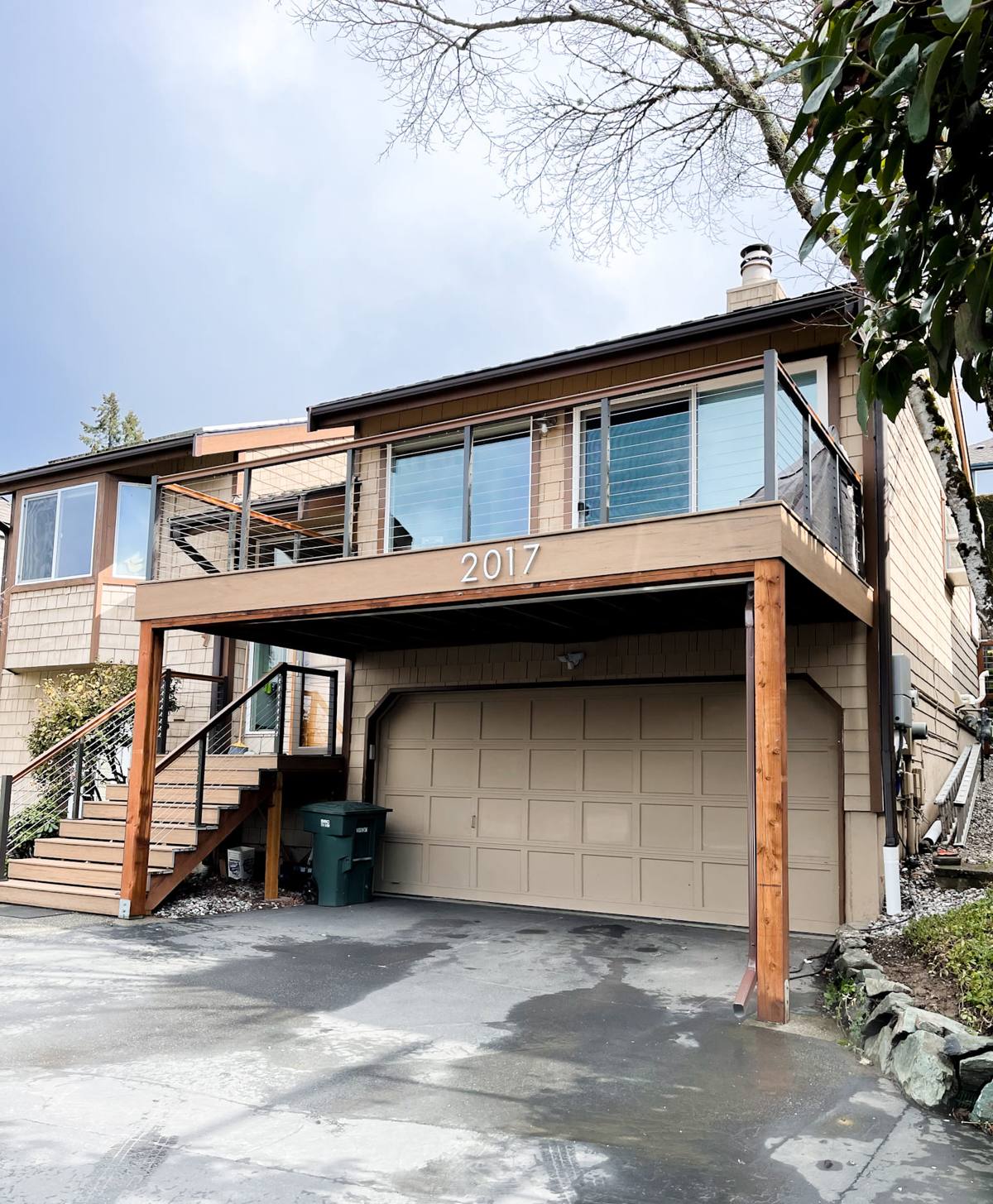
Why Composite Outperforms Wood in This Climate
Wood decking isn't a bad product — it's a maintenance-heavy one. In a climate that stays wet for most of the year, that maintenance burden gets steep fast: annual sealing, sanding out splinters, and constant vigilance against rot at the fastener holes and board ends. Miss a year of sealing in a place like Aldergrove and you're often playing catch-up the next spring.
Capped vs. Uncapped Composite
Not all composite decking is built the same, and this is where we're honest with homeowners instead of just selling the cheapest option. Capped composite boards have a plastic polymer shell wrapped around a wood-plastic core, which is what actually resists moisture absorption, staining, and moss growth. Uncapped composite — older technology, still sold at a lower price point — exposes more of the wood-fiber core to the elements and can absorb moisture and fade faster, especially on shaded, north-facing decks that don't get much sun to dry out between storms. For Aldergrove's climate, we generally steer customers toward capped boards; it costs more up front but it's the difference between a deck that needs real maintenance and one that mostly just needs cleaning.
Where Wood Still Struggles
Even well-maintained wood decking in this climate tends to develop soft or gray patches in shaded corners, gaps that trap wet leaves, and screw holes that become entry points for moisture. Composite doesn't solve every problem — it still needs airflow and drainage to perform — but it removes the organic material that rot and moss actually feed on.
What a Correct Composite Deck Installation Actually Involves
A composite deck is only as good as what's underneath it and how it was fastened together. Corners get cut in ways that don't show up for a year or two, which is exactly when they become expensive to fix. A correct installation includes:
- Proper ledger board flashing where the deck attaches to the house, so wind-driven rain can't work its way behind it
- Joist spacing that matches the manufacturer's specification for the board pattern being installed, not just a generic layout
- Hidden fastener systems where the product calls for them, instead of face-screwing boards that then trap water in the screw heads
- Corrosion-resistant fasteners and hardware throughout — not just at the visible surface
- Consistent board gapping for drainage and expansion, which also happens to be one of the best defenses against moss taking hold between boards
- Ventilation and drainage underneath the deck so moisture doesn't just sit trapped against the framing
Skip any one of these and the deck can still look fine on installation day. The problems show up eighteen months later, usually as soft spots near the house or moss creeping in along shaded edges.
Fascia, Railings, and Edge Details That Actually Hold Up
The deck surface gets most of the attention, but the trim and railing choices around it matter just as much in a climate this wet. A picture-framed edge — where a perpendicular border board wraps the outer edge of the deck — looks clean and also protects the cut ends of the field boards, which are the most vulnerable point on any composite board for moisture intrusion. We miter those corners tightly and finish the cut ends per manufacturer guidance rather than leaving raw edges exposed to the weather.
Railings deserve the same scrutiny. Wood railings on an otherwise low-maintenance composite deck defeat the purpose — they'll need the same sanding and sealing a wood deck would, right next to boards that don't. Composite or aluminum railing systems keep the whole structure consistent, both in appearance and in how little upkeep it demands.
Skirting underneath the deck is a judgment call that depends on the site. Enclosing the underside of a low deck can look tidy, but it also cuts off airflow to framing that's already dealing with a long wet season. When we skirt a deck in this climate, we build in vents or gaps so moisture underneath has somewhere to go instead of sitting trapped against the joists.
Composite vs. Other Decking Materials: What It Actually Costs You
There's no single "best" decking material for every budget, but in a climate like Aldergrove's, some trade-offs matter more than others. Here's how the common options stack up on the factors that actually affect a homeowner's experience over time:
| Material | Upfront Cost | Ongoing Maintenance | Moss & Moisture Resistance | Typical Lifespan |
|---|---|---|---|---|
| Pressure-treated wood | Lowest | Annual sealing/staining | Poor without upkeep | 10–15 years |
| Cedar | Moderate | Regular sealing, more sensitive to splitting | Fair with diligent upkeep | 12–18 years |
| Uncapped composite | Moderate | Low, occasional cleaning | Fair — can stain or fade in shade | 15–20 years |
| Capped composite / PVC | Highest | Low, mostly rinsing and sweeping | Good, resists staining and rot | 25+ years (warranty-backed) |
Exact pricing depends on deck size, framing condition, height off the ground, and board selection, so we don't quote broad numbers on a page — that's what the free estimate is for. What we can tell you honestly is that capped composite carries a real upfront premium over pressure-treated wood, and in this climate it tends to earn that premium back in avoided maintenance and repair.
Our Process, From First Look to Finished Deck
- Site visit and structural check. We look at the existing framing, if there is any, the ledger attachment to the house, drainage around the footprint, and how much sun or shade the deck actually gets.
- Material selection. We walk through board options and price points honestly, including where uncapped composite is a reasonable choice and where it isn't.
- Permitting and site prep. Depending on the scope, structural decks often require permitting — we coordinate that rather than leaving it on the homeowner's plate.
- Framing and structure work. This is where flashing, joist spacing, footings, and fastener selection get done correctly, before a single deck board goes down.
- Decking installation. Boards go in with correct gapping, hidden fasteners where called for, and clean edge, railing, and stair details.
- Cleanup and walkthrough. We clear the site and walk the finished deck with the homeowner, including basic care guidance for the specific board we installed.
Keeping a Composite Deck Moss-Free Through the Wet Season
Composite is genuinely lower-maintenance than wood, but "low-maintenance" isn't "no-maintenance" — especially with a moss season as long as this region's. A little seasonal attention keeps a composite deck looking like it did on day one:
- Sweep leaves and debris out of the board gaps before fall storms set in — trapped organic matter is what moss actually grows in, not the composite itself
- Rinse shaded, north-facing sections during the wet months rather than waiting for spring cleanup
- Keep gutters and downspouts clear so they aren't dumping extra water directly onto the deck surface
- Skip the high-pressure setting on a pressure washer up close — it can etch or streak composite surfaces; a garden hose and stiff broom handle most buildup
- Check board ends near the house each fall for staining, which can signal a flashing or drainage issue worth catching early
- Have the framing and fasteners glanced at every year or two, even though the boards themselves need little attention
Why It Matters That We Already Work in Aldergrove
A deck built by a crew that normally works somewhere dry doesn't automatically ask about ledger flashing detail, doesn't default to corrosion-resistant hardware, and doesn't think twice about board choice in a shaded, moss-prone yard. That's not a knock on those crews — it's just not what they build every day.
We already cross the border regularly to work in Aldergrove and the surrounding communities, so the logistics of scheduling, permitting coordination, and material delivery on that side of the line aren't a first-time hassle for us — they're routine. More importantly, the build details we treat as standard — flashing, fastener choice, drainage, board gapping — are the same details that matter for every deck we build on our side of the border in this same wet, salt-tinged, moss-heavy climate. It's the same weather working on the same materials, whichever side of the line the house sits on.
If you're weighing composite decking for a home in Aldergrove, we're happy to take a look and walk through honest options — no pressure, no pushy upsell. Reach out using the form below for a free estimate.