 Lynden Siding
 Roofing in Blaine: A Different Set of Problems Than Inland Homes
Blaine sits right on the water at the northwest corner of Whatcom County, and that location changes what a roof has to deal with day to day. Homes just a few miles inland in Lynden get plenty of rain, but Blaine adds salt-laden air off the Strait of Georgia, more direct exposure to wind-driven rain, and a moss season that runs longer than most homeowners expect. A roof that would hold up fine in a more sheltered spot can wear out faster here if it wasn't built for these conditions in the first place.
We work throughout Whatcom County, including Blaine and the surrounding coastal areas, and we see the same failure patterns repeat on older roofs: fasteners and flashing corroding faster than the shingles around them, moss working into butt joints and lifting shingle edges, and wind-driven rain finding its way past underlayment that wasn't designed for lateral water movement. Replacing a roof in Blaine isn't just swapping old shingles for new ones — it's addressing why the last roof failed.
What Salt Air Actually Does to a Roof
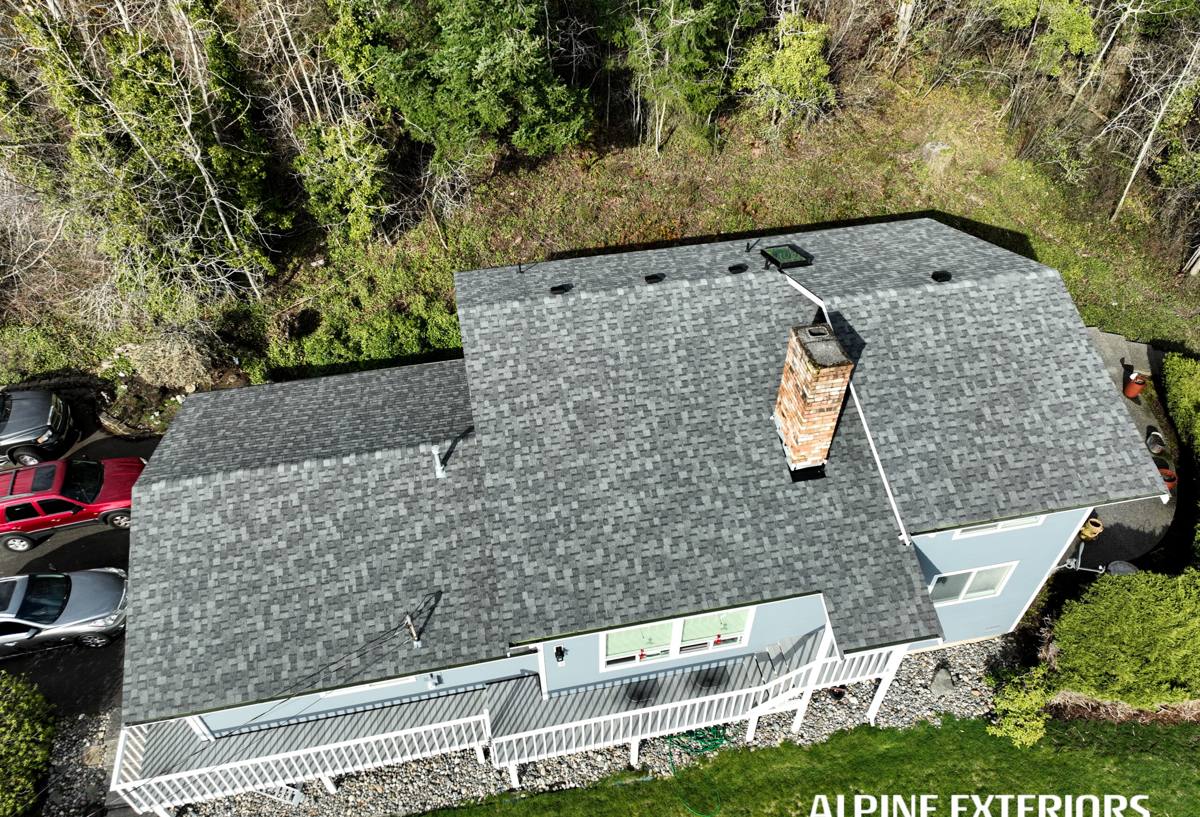
Salt air is corrosive to unprotected metal, and a roof has more metal in it than most homeowners realize: nails, flashing, drip edge, vent caps, and often a ridge vent or two. On homes close to the water, standard galvanized fasteners can start showing rust streaks years before the shingles themselves are due for replacement. Once flashing starts to corrode at the seams, water finds a path underneath it — usually at valleys, chimneys, and roof-to-wall transitions, which are exactly the spots where leaks are hardest to trace back to their source.
Where We Adjust the Build for Coastal Exposure
- Corrosion-resistant fasteners rated for coastal or marine exposure, not standard interior-grade galvanized
- Metal flashing material chosen for longevity in salt air, not just up-front cost
- Extra attention to valley and step flashing detailing, since these are the first points of failure in salt exposure
- Vent and pipe boot hardware checked for corrosion resistance, not just the boot material itself
Moss: The Slow Damage Most Homeowners Underestimate
Whatcom County's damp, mild climate is close to ideal moss-growing conditions for a large part of the year, and Blaine's proximity to the water keeps humidity and moisture on roof surfaces even longer than in some inland neighborhoods. Moss isn't just cosmetic. As it grows, it holds moisture against the shingle surface, works into the butt joints between shingles, and gradually lifts the shingle edges as it thickens. That lifting is what lets wind-driven rain get underneath the shingle instead of running off of it.
On an older roof, heavy moss growth is often a sign that granule loss and shingle degradation are already underway underneath it, even if the roof doesn't look obviously damaged from the ground. Part of a proper replacement is evaluating not just the shingles but the decking underneath in areas where moss has been established for years — sometimes that plywood has taken on moisture damage that needs to be addressed before new roofing goes down.
What We Do Differently for Moss-Prone Roofs
- Inspect and, where needed, replace decking in areas with long-term moss exposure — not just patch over it
- Install zinc or copper strips near the ridge on request, which discourage moss regrowth over time
- Recommend shingle products with algae-resistant granules where it makes sense for the home
- Talk through a realistic moss-maintenance schedule so the homeowner isn't caught off guard a few years in
Driving Rain and Wind-Driven Water Intrusion
Blaine's coastal exposure means storms often come with a horizontal component to the rain, not just straight-down volume. That matters for roofing because standard shingle installation assumes water runs downhill in a fairly predictable way. When rain is being pushed sideways by wind, water can get pushed uphill under shingle edges and around flashing laps that would otherwise shed water fine.
This is one of the biggest reasons we don't cut corners on underlayment in coastal work. A synthetic underlayment with proper lap and fastening, combined with self-adhered membrane at vulnerable points — valleys, eaves, around penetrations — gives the roof a real second line of defense instead of just a formality between the decking and the shingles.
What a Correct Roof Replacement Involves
A roof replacement done right isn't just about the shingles you see. It's a system, and each layer matters for how the roof performs in Blaine's specific conditions.
| Layer | What It Does | Why It Matters Here |
|---|---|---|
| Decking inspection/repair | Provides a solid, dry base for everything above it | Moss and long-term moisture exposure can quietly rot plywood over years |
| Ice and water shield / self-adhered membrane | Seals vulnerable points against wind-driven water | Coastal wind patterns push rain in directions standard shingles aren't built to resist alone |
| Synthetic underlayment | Second layer of water protection under the shingles | Backup protection for the long rain seasons Whatcom County gets |
| Flashing (valleys, chimneys, walls) | Directs water away from seams and transitions | Salt air accelerates corrosion on lower-grade metal |
| Fasteners | Holds every layer down through wind events | Corrosion-resistant fasteners resist rust streaking and loosening near the coast |
| Shingles or roofing material | Primary weather barrier and appearance layer | Algae-resistant options help slow moss and staining in this climate |
| Ventilation | Moves moisture and heat out of the attic | Poor ventilation traps moisture that feeds moss and rot from the underside |
Our Process for a Blaine Roof Replacement
1. On-Site Inspection
We walk the roof and the attic where accessible, looking at the current shingle condition, decking, ventilation, flashing, and any signs of past leaks or moisture damage. In Blaine specifically, we pay close attention to moss buildup patterns and any corrosion on existing metal components — both are early indicators of what the new roof needs to address.
2. A Straightforward Estimate
We explain what we found, what it means for the scope of work, and what materials make sense for the home's exposure and the homeowner's budget. No pressure tactics, no inflated urgency — just an honest breakdown of what's needed and why.
3. Tear-Off and Deck Assessment
Once the old roofing is off, we get eyes on the actual decking condition. Any soft or water-damaged plywood gets replaced before anything new goes down — this step gets skipped by crews trying to move fast, and it's the single biggest factor in whether a new roof lasts.
4. Installing the System
Underlayment, flashing, and shingles or roofing material go down in that order, with extra attention at valleys, penetrations, and roof-to-wall transitions where coastal weather causes the most problems.
5. Final Walkthrough
We walk the finished roof and go over what was done, what maintenance (if any) makes sense going forward, and answer questions before we consider the job complete.
Signs a Blaine Homeowner Shouldn't Ignore
- Heavy moss growth across large sections of the roof, especially on north-facing slopes
- Rust streaking below metal flashing, vents, or fasteners
- Shingle edges that look lifted or curled, particularly along valleys
- Granules collecting in gutters in noticeably larger amounts than in past years
- Water stains on interior ceilings after wind-driven storms specifically, even if the roof seems fine in calm rain
- A roof approaching or past 20 years old that has never had a full inspection
Why a Crew That Already Works Blaine Matters
Roofing crews that mostly work drier, inland areas don't always think about salt exposure or moss the way a coastal job demands — it's not part of their everyday routine, so it's easy to default to standard specs that work fine elsewhere but fall short here. Working regularly in Blaine and along the Whatcom County coastline means we're not guessing at what holds up; we're applying what we've seen actually wear out on roofs in this exact environment, and building the replacement to hold up better than what it's replacing.
It also means we're familiar with the practical side of working in Blaine — access considerations near the water, weather windows that work with the local rain patterns, and coordinating a tear-off and install without leaving a home exposed longer than necessary.
Get a Straightforward Estimate
If your roof in Blaine is showing moss, corrosion, or signs of wind-driven leaks, it's worth having someone look at it before those problems get worse. Reach out for a free, no-pressure estimate — we'll walk the roof, tell you honestly what we see, and lay out your options with no obligation.