 Lynden Siding
 Deck Building in Blaine: A Coastal Job, Not a Standard One
Blaine sits right on the water at the northern edge of Whatcom County, near enough to Semiahmoo Bay and Drayton Harbor that salt air reaches most homes in town, not just the ones with a waterfront view. That position, combined with storm systems coming ashore off the Strait and a border-town exposure that inland Whatcom County doesn't share, makes a deck one of the harder exterior projects to get right here. We're based just up the road in Lynden, and Blaine is regular territory for our crew, which means we've watched decks age in this specific climate for years rather than guessing at how they'll hold up.
A deck is mostly horizontal. That single fact changes almost everything about how it needs to be built compared to a wall or a roof plane. Horizontal surfaces hold water and moss longer, take direct sun and rain on the same boards day after day, and put fasteners and framing connectors in constant contact with moisture instead of shedding it away quickly. In a town where salt air, driving rain, and a long moss season are the baseline climate rather than the exception, those details are what separate a deck that lasts from one that needs board replacement in five or six years.
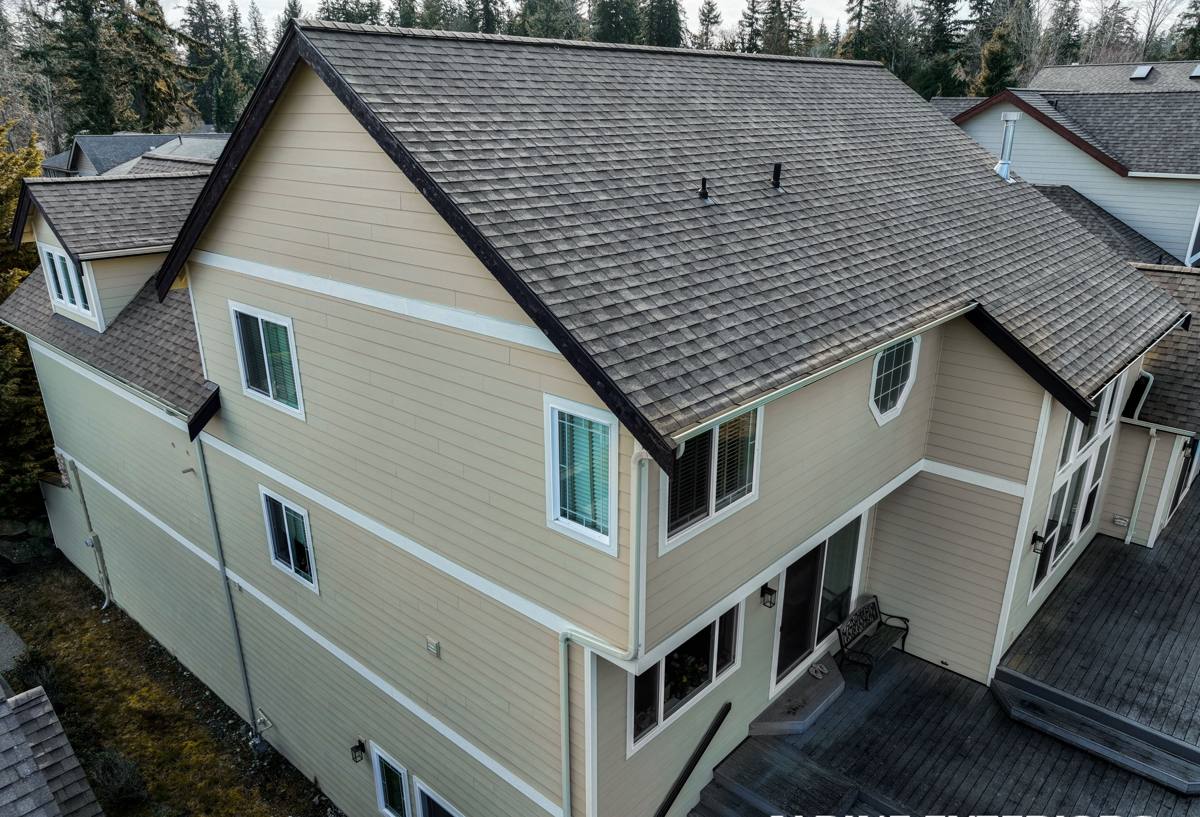
What Blaine's Climate Does to a Deck Specifically
Salt Air and Metal Fasteners
Every deck depends on hidden metal: joist hangers, structural screws, post bases, and ledger bolts that carry real structural load. Salt-laden air accelerates corrosion on standard-grade hardware faster than it does further inland, and a deck's fasteners get more sustained exposure than most other parts of a house because they sit in a horizontal assembly that stays damp longer after a storm. Using the correct corrosion-resistant hardware isn't an upgrade in Blaine — it's the difference between structural connections that hold for decades and ones that start weakening well before the visible boards show any wear.
Driving Rain and Standing Moisture
Storms coming off the water don't just fall straight down on Blaine; wind pushes rain sideways and pools it on flat surfaces in a way that inland lots rarely see to the same degree. A deck surface that doesn't drain and dry efficiently between storms stays wet longer, and that extended moisture exposure is what drives rot in framing, cupping in boards, and the kind of soft, spongy spots that show up on decks built without real drainage in mind.
A Long Moss Season
Mild temperatures and near-constant moisture give moss a growing season that can run most of the year on shaded or north-facing decks, and a flat, horizontal deck surface is an easier place for moss to establish than a vertical wall. Beyond looking bad, moss on a deck holds moisture against the boards and turns slick underfoot, which is a real safety issue on stairs and landings, not just a maintenance annoyance.
What a Correctly Built Deck Requires in This Climate
None of the following is exotic or optional in our book. It's the baseline for a deck that's going to sit outside in Blaine's weather for the next few decades rather than the next few years.
- Corrosion-resistant structural hardware: Joist hangers, structural screws, and post bases rated for exterior and coastal exposure, not general-purpose fasteners that were never meant for sustained salt air.
- Proper ledger flashing: Where a deck attaches to the house, the ledger board and its flashing have to shed water away from the wall assembly, not trap it behind the siding — this is one of the most common failure points we find on older Blaine decks.
- Board spacing for drainage and airflow: Consistent gapping between boards lets water pass through and air circulate underneath, which slows both rot and moss growth on the walking surface.
- Footing depth and post setting appropriate to the site: Correct footing depth keeps the structure stable through freeze-thaw cycling and wet soil conditions, which is more of a factor on some Blaine lots than homeowners expect.
- Material choice matched to sun and shade exposure: A deck on a shaded, tree-covered lot needs different maintenance expectations and sometimes different material choices than one that gets full sun most of the day.
Framing and Structure
The framing is the part of a deck nobody sees once it's finished, and it's also the part that determines whether the deck is still solid in fifteen years or starting to sag and flex. We size joists and beams to the actual load and span, not to the minimum the boards happen to require, and we pay particular attention to ledger attachment since a poorly flashed ledger is where a deck project can quietly turn into a siding or wall moisture problem down the line.
Decking Material
Composite decking, pressure-treated lumber, and cedar all show up on Blaine homes, and each has real tradeoffs in a coastal climate. Composite resists moss and moisture better than wood but costs more upfront and can hold heat differently in full sun. Pressure-treated lumber is the most budget-friendly option but needs more regular cleaning and periodic sealing to keep moss and graying in check. Cedar has a natural look many homeowners want, but it's the most maintenance-intensive of the three in a wet, mossy climate and needs consistent upkeep to hold its color and resist decay. We'll walk through the honest tradeoffs of each for your specific lot rather than pushing whichever material has the best margin.
Railings, Stairs, and Fasteners
Railings and stair stringers take the same moisture and salt exposure as the deck surface, sometimes worse, since end grain and joint connections are where water tends to sit longest. We use fastener types and connection details built for that exposure, and we treat stairs as a safety detail worth extra attention given how quickly a shaded stair tread can pick up a moss film in this climate.
Our Deck Building Process
- Site walk and design conversation: We look at your lot's sun and shade exposure, drainage, and how the deck will connect to the house before talking materials or layout.
- Material and layout decisions: We go over composite, pressure-treated, and cedar options honestly, including maintenance expectations for each, and settle on a layout that fits how you'll actually use the space.
- Framing and structural work: Footings, posts, beams, and joists go in to the load and span the design calls for, with ledger flashing detailed to protect the house wall.
- Decking, railing, and stair installation: Boards, railings, and stairs go in with drainage spacing and corrosion-resistant fasteners throughout.
- Final walkthrough: We go over the finished deck with you, including what routine maintenance looks like for the material you chose.
Deck Cost Factors for Blaine Homes
| Factor | What Drives Cost | Coastal Climate Consideration |
|---|---|---|
| Size and layout | Square footage, multiple levels, stair count | Larger decks need more drainage planning to avoid standing water |
| Decking material | Composite vs. pressure-treated vs. cedar | Moss resistance and maintenance burden differ significantly by material near the water |
| Framing | Joist spacing, beam sizing, footing count | Corrosion-resistant hardware adds cost but protects the structure long-term |
| Ledger attachment | Complexity of connecting to existing wall siding | Proper flashing to prevent moisture intrusion into the house wall |
| Railing and stairs | Style, material, code-required height and spacing | Fastener exposure and stair-tread moss and slip risk |
These are general drivers, not a quote. Every Blaine lot sits at a slightly different distance from the water and under different tree cover, and the condition of the wall your deck will attach to matters too — we walk the site before putting a real number on the work.
Timing a Deck Project Around Blaine's Weather
Whatcom County's wettest, windiest stretch typically runs from late fall through winter, and Blaine's exposed coastal position makes that stretch harder on both fresh construction and the crew than it is further inland. Spring and summer generally give the driest, most stable conditions for pouring footings, framing, and installing decking, since wood and composite materials both perform better when they can be installed and allowed to settle in under dry conditions. If your existing deck already has soft framing or a failing ledger connection, that's worth addressing on its own timeline rather than waiting for the ideal season, since a compromised structural connection doesn't improve with time.
Signs Your Blaine Deck Needs Attention
- Moss that returns quickly on the deck surface or stairs even after cleaning
- Soft, spongy, or bouncy spots when you walk across the deck
- Rust staining around fasteners, joist hangers, or railing hardware
- Gaps, cracking, or separation where the deck ledger meets the house
- Boards that cup, crown, or stay damp long after the rest of the yard has dried
- Loose or wobbly railings and stair stringers
- Visible daylight or gaps around post bases or footings
Why a Local Crew Matters for a Blaine Deck
A crew that works across Whatcom County regularly, on siding, roofing, windows, and decks alike, sees how salt air, driving rain, and moss actually behave on real Blaine properties over a full year, not just how a product performs on a spec sheet. That shapes practical decisions on a deck build: where extra flashing at the ledger pays off, which fastener grade actually holds up this close to the water, and which decking material fits a specific lot's sun and shade pattern rather than a one-size-fits-all recommendation. Blaine's coastal exposure isn't identical to more sheltered towns further inland in the county, and a crew that treats a deck as connected to the whole exterior — not an isolated carpentry project — builds accordingly.
If your Blaine home needs a new deck, a rebuild, or an honest look at whether an existing deck's framing is still sound, we're glad to walk the site and give you a straightforward assessment. Reach out using the form below to schedule a free, no-pressure estimate.